
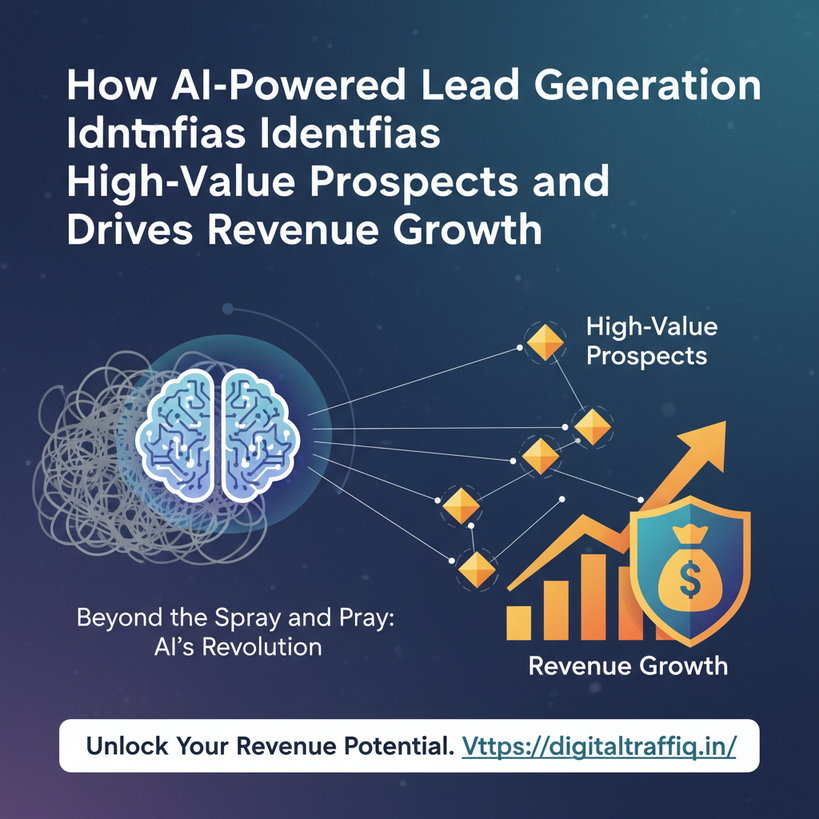
Beyond the Spray and Pray: How AI is Revolutionizing the Hunt for High-Value Prospects
Estimated reading time: 5 minutes
Key Takeaways
- AI moves lead generation from a wasteful “spray and pray” model to a precise, data-driven process focused on high-value prospects.
- Predictive lead scoring analyzes thousands of signals to assign a probability of conversion, allowing sales to prioritize confidently.
- Automated lead nurturing delivers hyper-personalized content and engagement based on micro-behaviors and predicted needs.
- The bottom-line impact includes increased sales efficiency, higher deal sizes, improved marketing ROI, and reduced customer acquisition cost.
- Successful implementation starts with a clean data foundation, a strategic pilot, and alignment between sales and marketing teams.
Table of Contents
For years, B2B sales and marketing teams have operated with a fundamental inefficiency: they spend immense resources generating leads, only for sales to sift through a mountain of contacts to find the few gems worth pursuing. This traditional ‘spray and pray’ approach is not just wasteful; it’s a direct drag on revenue growth and sales morale. At Digital Traffiq, we’ve seen a paradigm shift. The emergence of sophisticated AI lead generation is moving businesses from guesswork to precision, transforming how they identify, prioritize, and convert high-value prospects.
This isn’t about replacing human intuition but augmenting it with data-driven superpowers. AI-powered systems analyze vast, complex datasets—far beyond human capacity—to uncover patterns and signals that predict buying behavior. The result? Sales teams are no longer chasing every lead. They’re strategically engaging with sales qualified leads (SQLs) who are demonstrably ready to buy, directly fueling revenue growth. Let’s explore the mechanics of this transformation.
The Core Engine: Predictive Lead Scoring and AI Prospecting
At the heart of modern AI prospecting tools lies predictive lead scoring. Traditional lead scoring often relies on manual rules (e.g., +10 for downloading a whitepaper, +5 for visiting the pricing page). AI-driven scoring is dynamic and infinitely more nuanced.
How it works: The AI model is trained on your historical customer data. It analyzes the demographic, firmographic, and behavioral patterns of your past customers who became high-value clients versus those who didn’t. It then applies this learning in real-time to new prospects. The system evaluates thousands of signals—website engagement intensity, content consumption patterns, technographic data, intent data from third-party platforms, and even email response timing.
This predictive lead generation model doesn’t just assign a score; it provides a probability. It can tell you, “This prospect has an 87% likelihood of converting into an enterprise customer within this quarter, based on similar pathways we’ve seen.” This allows sales to prioritize their pipeline with confidence, focusing energy on opportunities with the highest propensity to close and the highest potential lifetime value.
From Identification to Nurturing: The Automated Journey
Identifying a high-value prospect is only half the battle. The other half is engaging them with the right message at the right time until they are sales-ready. This is where automated lead nurturing powered by AI excels.
- Hyper-Personalized Content Delivery: AI segments audiences not by broad categories, but by micro-behaviors and predicted needs. A prospect showing intent signals for “security features” will automatically receive case studies and content related to your platform’s security, while another interested in “integration capabilities” gets a different stream.
- Optimal Channel and Timing: AI determines whether a prospect is more responsive to email, LinkedIn messages, or retargeting ads. It also predicts the best time to send communications for maximum engagement, dramatically increasing open and response rates.
- Conversational AI & Chatbots: Advanced chatbots can qualify prospects 24/7, answer initial questions, and book meetings directly for your sales team, ensuring no high-intent signal goes unanswered, even after hours.
This automated, intelligent nurture path guides prospects smoothly through the funnel, handing off a fully informed, warm, and qualified lead to sales—a stark contrast to the cold, out-of-context calls of the past.
Driving Tangible Revenue Growth: The Bottom-Line Impact
The ultimate goal of any sales and marketing investment is revenue growth. AI-powered lead generation delivers this impact through several key mechanisms:
- Increased Sales Efficiency: By focusing only on high-value prospects, sales teams close more deals in less time. They spend 80% of their effort on the 20% of leads that matter, drastically improving win rates and shortening sales cycles.
- Higher Average Deal Size: AI models can be tuned to identify not just likely buyers, but likely high-value buyers. This means targeting prospects with larger budgets, greater need, or who fit your ideal customer profile (ICP) perfectly, leading to larger contracts.
- Improved Marketing ROI: Marketing can precisely measure which campaigns, channels, and content pieces are actually generating pipeline and revenue, not just leads. This allows for reallocation of budget to the highest-performing activities.
- Reduced Customer Acquisition Cost (CAC): Eliminating wasted effort on low-probability leads and improving conversion rates at every stage of the funnel directly lowers the cost to acquire a new customer.
In essence, AI transforms your lead generation from a cost center into a predictable, scalable revenue growth engine.
Implementing AI in Your B2B Lead Generation Strategy
Adopting AI doesn’t require replacing your entire tech stack overnight. A strategic approach is key:
- Data Foundation First: AI is only as good as the data it’s fed. Begin by auditing and consolidating your CRM, marketing automation, and website analytics data. Clean, unified data is the prerequisite.
- Start with a Pilot: Choose a specific segment, such as inbound leads from your website or a targeted account list, to pilot an AI lead scoring model. Measure the difference in conversion rates between AI-prioritized leads and those handled traditionally.
- Choose the Right AI Prospecting Tools: Look for platforms that integrate seamlessly with your existing CRM (like Salesforce or HubSpot) and offer transparent modeling. The tool should explain why a lead is scored highly.
- Align Sales & Marketing (SMarketing): This is critical. Both teams must agree on the definition of a “high-value prospect” and a “sales qualified lead.” AI provides the objective data to fuel this alignment, moving beyond gut feelings to shared metrics.
- Focus on Continuous Conversion Optimization: Use AI insights to constantly refine your messaging, landing pages, and offer strategy. If AI identifies that prospects from a specific industry engage most with ROI calculators, double down on creating that asset.
The Future is Predictive, Personalized, and Profitable
The era of generic email blasts and hoping for the best is over. B2B lead generation has evolved into a sophisticated discipline powered by artificial intelligence. By leveraging predictive lead generation and automated lead nurturing, forward-thinking companies are not just generating more leads; they are systematically identifying and capturing their most valuable future customers.
At Digital Traffiq, we specialize in building and implementing these intelligent revenue engines. Our expertise lies in connecting advanced AI capabilities with your unique business goals to create a predictable pipeline of sales qualified leads. The question is no longer whether AI will transform sales and marketing, but whether your business will be using it to outpace the competition.
Ready to move beyond guesswork and start targeting with precision? The tools are here, and the opportunity for accelerated, efficient revenue growth has never been greater.