
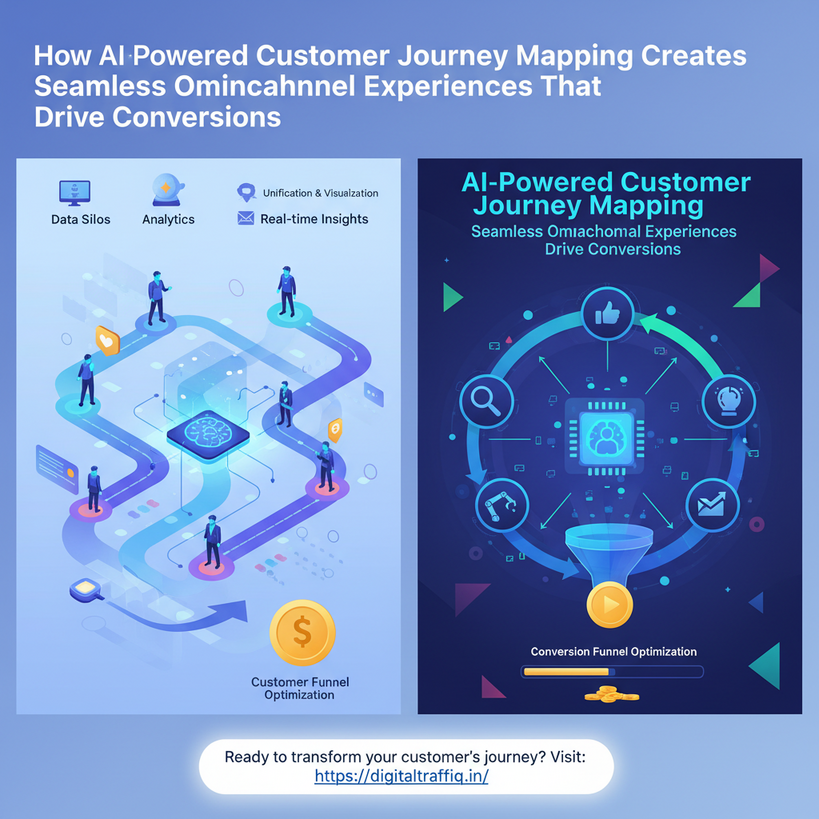
How AI-Powered Customer Journey Mapping Creates Seamless Omnichannel Experiences That Drive Conversions
Estimated reading time: 5-7 minutes
Key Takeaways:
- AI transforms static maps into dynamic, predictive models that unify data and anticipate customer needs in real-time.
- The core AI engine works through a cycle of unification, prediction, and prescriptive orchestration to automate personalized experiences.
- This approach directly boosts revenue by reducing friction, increasing engagement, and optimizing the entire conversion funnel.
- Implementation is a strategic, phased process, starting with a key journey segment before scaling.
- The result is a measurable transition from channel-focused marketing to proactive, journey-driven growth.
Table of Contents
In today’s fragmented digital landscape, customers glide effortlessly between your website, social media, email, physical stores, and mobile apps. They expect every interaction to be connected, contextual, and personalized. Yet, for most businesses, the reality is a patchwork of disconnected touchpoints, data silos, and missed opportunities. The bridge between this chaotic reality and the seamless experience customers demand is AI-powered customer journey mapping. This isn’t just about drawing a pretty flowchart; it’s about deploying intelligent systems to understand, predict, and orchestrate every step a customer takes, transforming sporadic interactions into a cohesive, conversion-driving narrative.
At Digital Traffiq, we specialize in turning complex customer data into a clear, actionable roadmap. By leveraging advanced AI customer journey mapping, we empower businesses to move beyond guesswork and build truly intelligent, omnichannel strategies that resonate and convert.
The Omnichannel Conundrum: More Channels, More Complexity
The promise of omnichannel marketing is a unified customer experience. The challenge is execution. Traditional journey mapping, often a static, manual exercise, cannot keep pace with the volume, velocity, and variety of modern customer data. It answers what happened in the past but struggles to predict what will happen next or prescribe what should happen in real-time.
This is where legacy systems break down:
- Data Silos: Marketing, sales, and service data live in separate platforms, preventing a unified customer view.
- Static Analysis: Manual maps are snapshots in time, unable to adapt to dynamic customer behavior.
- Reactive Engagement: Teams respond to events after they occur, missing crucial micro-moments of intent.
- Generic Personalization: Segments are too broad, leading to irrelevant messaging across channels.
AI customer journey analytics solves this by processing millions of data points in real-time, identifying patterns invisible to the human eye, and automating the optimization of every touchpoint.
The Engine of Intelligence: How AI Transforms Journey Mapping
AI-powered mapping is a living, breathing model of your customer’s experience. It works through a continuous cycle of data ingestion, analysis, prediction, and action.
1. Unification & Visualization: Creating the Single Source of Truth
The first step is breaking down data silos. AI algorithms ingest data from every source—CRM, web analytics, email platforms, POS systems, call logs, and social media—to stitch together a complete, individual-level unified customer view. This isn’t just a profile; it’s a dynamic timeline of every interaction across all omnichannel marketing touchpoints. Advanced visualization tools then render this complex data into intuitive, actionable journey maps that update in real-time, showing not just paths, but drop-off points, loops, and moments of friction.
2. Predictive Analytics & Micro-Segmentation: Knowing the Next Step
This is where AI shifts from descriptive to predictive. By analyzing historical and real-time data, machine learning models can:
- Predict Churn: Identify customers showing subtle signs of disengagement long before they leave.
- Forecast Intent: Predict the next best product, content piece, or offer a customer is likely to need.
- Define Micro-Segments: Move beyond basic demographics to create dynamic segments based on real-time behavior, sentiment, and journey stage. This enables true cross-channel personalization.
3. Prescriptive Orchestration & Automation: Delivering the Right Experience
Insights are worthless without action. Journey orchestration AI uses the predictive model to automate and personalize interactions in real-time. This is customer experience automation at scale.
- Dynamic Touchpoint Optimization: If a customer abandons a cart on mobile, the AI can trigger a personalized email with a reminder and serve a complementary product ad on their social feed an hour later.
- Adaptive Content Pathways: The website experience changes based on the customer’s known journey. A first-time visitor sees educational content, while a repeat visitor is guided directly to a demo request.
- Intelligent Routing: Customer service inquiries are automatically routed to the agent or chatbot best equipped to handle the specific issue based on the customer’s journey history.
The Conversion Payoff: Turning Insight into Revenue
Implementing an AI-driven approach to the customer journey directly impacts the bottom line by optimizing the entire conversion funnel.
- Reduced Friction: By identifying and automating fixes for journey drop-off points (e.g., a confusing form, lack of payment options), you smooth the path to purchase.
- Increased Engagement: Hyper-personalized, timely interactions across channels significantly boost engagement rates and brand affinity.
- Higher Customer Lifetime Value (CLV): Predictive nurturing keeps customers engaged post-purchase, driving repeat business and advocacy.
- Accurate Marketing Attribution: AI marketing attribution models move beyond last-click, showing the true value of every touchpoint in the journey, allowing for optimal budget allocation.
For example, an e-commerce client using our platform identified through AI touchpoint optimization that customers who viewed a specific product video on social media and then read a related blog post had a 70% higher conversion rate. The AI was then orchestrated to automatically serve that video-blog post sequence to similar high-intent visitors, lifting overall site-wide conversions by 18%.
Implementing AI Journey Mapping: A Strategic Approach with Digital Traffiq
Transitioning to an AI-powered journey strategy is a phased process:
- Audit & Foundation: We start by auditing your existing data infrastructure and touchpoints to identify gaps and opportunities for unification.
- Pilot & Map: We select a key customer segment or journey (e.g., “new customer onboarding”) to build and train the initial AI model, creating a living map.
- Predict & Analyze: We layer on predictive analytics to uncover hidden patterns, micro-segments, and conversion opportunities within that journey.
- Orchestrate & Automate: We implement automated, personalized triggers and actions across your marketing stack to optimize the journey in real-time.
- Scale & Optimize: We expand the model to encompass more journeys and channels, continuously learning and improving conversion funnel optimization.
The Future is a Connected Journey
The goal is no longer just to map the customer journey, but to manage it intelligently. AI-powered customer journey mapping is the central nervous system for modern customer-centric businesses. It transforms omnichannel from a buzzword into a measurable, automated, and highly profitable reality.
At Digital Traffiq, we build these intelligent systems. We provide the technology and strategic expertise to move from reactive, channel-focused marketing to proactive, journey-driven growth. By understanding the complete story of your customer—past, present, and predicted future—you can finally deliver the seamless, personalized experiences that not only satisfy but actively drive conversions.
Ready to transform your customer’s journey into your most powerful conversion engine? Let’s connect and map the path forward.