
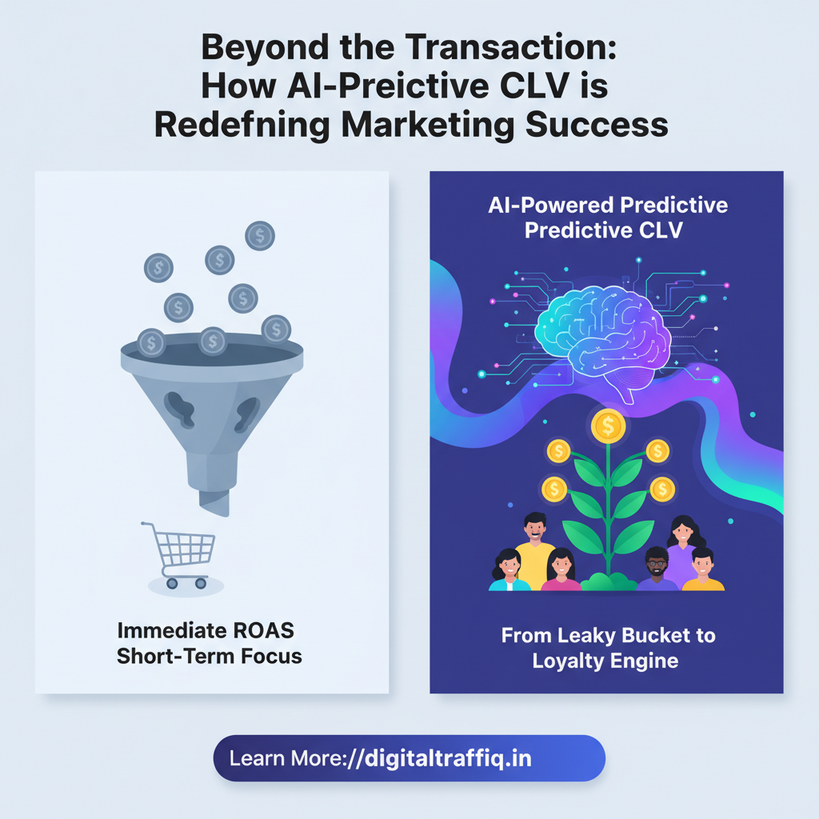
Beyond the Transaction: How AI-Predictive CLV is Redefining Marketing Success
Estimated reading time: 5 minutes
Key Takeaways
- AI-powered predictive CLV moves marketing focus from short-term ROAS to long-term customer value.
- It enables hyper-personalized strategies for acquisition, segmentation, and retention.
- Implementation requires data consolidation, model training, and a cultural shift towards value-centric KPIs.
- This approach transforms customers into appreciating assets, enabling accurate revenue forecasting and strategic resource allocation.
Table of Contents
For decades, marketing strategy has been anchored in a fundamental, yet flawed, metric: the immediate return on ad spend (ROAS). While crucial for short-term campaign health, this myopic focus on the next click or conversion has left a staggering amount of long-term revenue on the table. Businesses have poured resources into acquiring customers, only to watch them churn after a single purchase, turning the marketing funnel into a leaky bucket. The missing piece? A true, forward-looking understanding of a customer’s lifetime value (CLV).
Enter the era of AI-powered predictive customer lifetime value modeling. This isn’t just an incremental upgrade to your analytics dashboard; it’s a paradigm shift. By leveraging machine learning and vast datasets, businesses can now move from historical reporting to prescient forecasting. They can identify not just who bought, but who will buy again, how much they’ll spend, and what will keep them loyal. At Digital Traffiq, we see this as the cornerstone of modern, sustainable growth. This article will explore how predictive CLV modeling transforms every facet of marketing strategy, turning guesswork into precision and maximizing long-term revenue.
What is Predictive CLV Modeling, and Why Does AI Change Everything?
Traditional CLV calculations are often simple, backward-looking formulas based on average purchase value, frequency, and customer lifespan. They treat all customers from a segment as identical and fail to account for complex, individual behaviors. Predictive CLV modeling shatters these limitations.
AI and machine learning algorithms analyze hundreds of potential signals—from transaction history and website engagement to customer service interactions and even external market data. They detect non-linear patterns and subtle correlations impossible for humans to discern. The result is a dynamic, individual score assigned to each customer or prospect, predicting their future net value over a defined period.
The power of AI customer lifetime value prediction lies in its specificity and adaptability. It answers critical questions: Which new sign-up has the potential of a high-value VIP? Which seemingly loyal customer is at a high risk of churning in 90 days? This is the foundation of predictive customer analytics that drives action.
Transforming Marketing Strategy: From Spray-and-Pray to Surgical Precision
With a robust predictive CLV model in place, your marketing strategy evolves from broad segmentation to hyper-personalized, value-based action. Here’s how:
1. Revolutionizing Acquisition: Quality Over Quantity
Instead of optimizing for the cheapest cost-per-lead, you can optimize for the highest predicted lifetime value. AI-driven retention strategy starts at acquisition. By analyzing the attributes of your highest-CLV existing customers, AI can identify lookalike audiences in your prospecting pools with far greater accuracy. This allows you to allocate your acquisition budget toward audiences predisposed to long-term loyalty, fundamentally improving marketing ROI from the first touchpoint.
2. Dynamic, CLV-Based Customer Segmentation
Forget basic demographics. Predictive CLV enables dynamic segmentation based on future value and behavior risk. You can create cohorts such as “High CLV, At Risk of Churn” or “Low CLV, High Upsell Potential.” This allows for CLV-based marketing tactics that are precisely tailored. Your high-CLV segment might receive exclusive loyalty offers and premium support, while a segment with high upsell potential might receive targeted education on advanced product features.
3. Hyper-Personalized Retention & Loyalty Programs
Customer retention AI uses CLV predictions as its primary fuel. By knowing which customers are most valuable and which are slipping away, you can automate personalized intervention campaigns. A high-CLV customer showing reduced engagement might trigger a personalized win-back email from a dedicated account manager, while a lower-CLV customer might receive a different automated incentive. This ensures your retention resources are invested where they generate the highest return.
4. Strategic Resource Allocation & Revenue Forecasting
Predictive CLV transforms financial planning. With a clear view of future revenue streams from your existing customer base, you gain unparalleled accuracy in revenue forecasting AI. This allows for smarter, more confident budgeting across departments. You can justify investments in customer success, premium content, or community building by directly linking them to projected increases in aggregate CLV.
Implementing a Predictive CLV Framework: A Strategic Blueprint
Adopting this technology requires more than just a new software tool; it requires a strategic shift. Here is a foundational blueprint:
- Data Consolidation: Unify your data sources (CRM, email, web analytics, support tickets) into a single customer view. Data quality is paramount.
- Model Development & Training: This is where expertise like Digital Traffiq’s becomes critical. Selecting the right algorithms (e.g., regression models, survival analysis, gradient boosting) and training them on your historical data to predict future value.
- Integration & Activation: The model’s scores must be fed in real-time to your marketing automation, CRM, and ad platforms to trigger personalized workflows.
- Culture of Value-Centricity: Move organizational KPIs from short-term conversion metrics to CLV growth and customer health scores.
The Future is Predictive: Building Unbreakable Customer Equity
The companies that will thrive in the next decade are those that recognize customers as appreciating assets, not one-time transactions. AI-powered predictive CLV modeling is the most powerful tool yet for managing and growing this asset portfolio. It enables a proactive, strategic, and deeply personal approach to marketing that fosters genuine loyalty and maximizes the lifetime revenue of every customer relationship.
At Digital Traffiq, we specialize in helping businesses navigate this transformation—building, implementing, and activating sophisticated predictive CLV models that drive tangible growth. It’s time to stop looking only at the last click and start investing in the lifetime journey.
Ready to move beyond reactive marketing and build a strategy powered by future-value intelligence? The future of your revenue depends on it.