
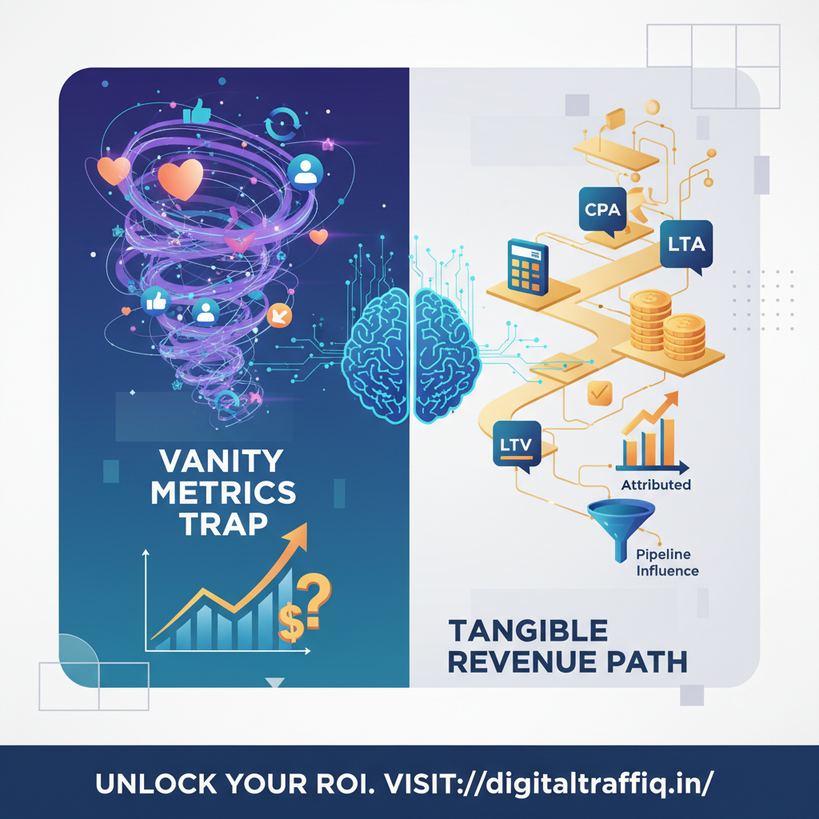
The Vanity Metric Trap: Why Your Social Media “Success” Might Be an Illusion
Estimated reading time: 6 minutes
Key Takeaways:
- Traditional metrics like likes and followers measure activity, not profitability, creating a dangerous illusion of success.
- True social media ROI is defined by revenue metrics like Cost-Per-Acquisition, Attributed Revenue, and Customer Lifetime Value.
- AI-powered attribution modeling is essential for tracing complex, multi-touch customer journeys back to revenue.
- Implementing an AI-driven framework involves data unification, model selection, and generating actionable insights.
- The shift to accountable measurement leads to justified spend, optimized budgets, and enhanced sales alignment.
Table of Contents
For years, marketing teams have celebrated spikes in likes, shares, and follower counts. Boardroom presentations are filled with impressive graphs showing viral reach and engagement rates. But a silent, pressing question often lingers in the background: Is any of this actually making us money? The harsh reality for many businesses is that their social media strategy, while generating buzz, operates in a revenue vacuum. You’re driving conversations, but can you trace a direct line from a Twitter thread to a closed deal? From an Instagram Story to a cart checkout? This disconnect between activity and outcome is the fundamental flaw of the vanity metric era.
Enter the new paradigm: AI-Powered Social Media ROI Tracking. This isn’t just another analytics dashboard. It’s a fundamental shift from measuring popularity to measuring profitability. At Digital Traffiq, we see this as the core challenge for modern businesses: moving beyond the fog of engagement data into the clear, accountable light of revenue attribution. This article will explore how artificial intelligence is dismantling the vanity metric trap and providing the missing link between your social efforts and your bottom line.
Beyond Impressions: Defining True Social Media ROI
First, let’s reframe the definition of success. Traditional social media metrics are activity-based. They tell you what you did. True ROI metrics are outcome-based. They tell you what you earned.
The Old Guard: Vanity Metrics
- Likes/Reactions: Measures sentiment, not intent.
- Follower Count: Measures audience size, not audience quality or readiness to buy.
- Impressions & Reach: Measures potential eyes, not actual impact or conversion.
- Shares/Retweets: Measures amplification, but not the value of the resulting actions.
The New Standard: Revenue Metrics
- Cost-Per-Acquisition (CPA) by Channel/Post: How much did it cost to get a customer via a specific LinkedIn campaign?
- Attributed Revenue: What dollar amount can be directly or indirectly tied to a social media interaction?
- Customer Lifetime Value (LTV) by Source: Do customers from Instagram spend more over time than those from Facebook?
- Pipeline Influence: How did a YouTube tutorial contribute to moving a lead through the sales funnel, even if it wasn’t the “last click”?
The bridge between these two worlds is attribution—and this is where human analysis fails and AI excels.
The AI Engine: How Machine Learning Uncovers the Revenue Pathway
Human marketers think in linear paths: Click Ad → Land on Page → Make Purchase. Modern customer journeys are nothing like this. They are complex, multi-touch, cross-device, and non-linear. A user might see a TikTok, Google your brand a week later, read a blog post shared on LinkedIn, then finally convert via a retargeting ad on Facebook. Which element gets the credit?
AI-powered attribution modeling solves this puzzle. Here’s how it transforms data into dollars:
1. Multi-Touch Attribution (MTA) Modeling
AI algorithms analyze thousands of customer journeys to statistically determine the contribution weight of each touchpoint. Instead of giving 100% credit to the last click, it can reveal that the initial brand-awareness tweet played a 30% role, the educational blog post shared on Facebook a 40% role, and the final retargeting ad a 30% role. This allows for budget allocation that truly reflects influence.
2. Predictive Revenue Forecasting
Beyond looking backward, AI can analyze ongoing campaign performance and engagement patterns to predict future revenue. It can forecast which types of content (e.g., demo videos vs. case studies) are likely to generate high-value leads, allowing teams to optimize in real-time.
3. Anomaly Detection & Optimization
AI doesn’t just report; it recommends. It can instantly detect when a surge in likes is NOT correlating to a surge in website traffic or lead form fills, flagging a potential misalignment. It can then suggest pivots—for example, shifting spend from a high-engagement, low-conversion platform to a more commercially viable one.
Implementing AI-Driven ROI Tracking: A Practical Framework
Transitioning to a revenue-centric social media measurement system requires a strategic approach. It’s not just about buying a tool; it’s about reshaping process and perspective.
Phase 1: Data Unification & Goal Alignment
The first step is breaking down data silos. Your AI model is only as good as the data it feeds on. Social platform APIs, your CRM (like Salesforce or HubSpot), your advertising platforms, and your website analytics must be integrated. The business goal must also shift from “increase engagement by 15%” to “generate $50,000 in influenced revenue from social channels in Q3.”
Phase 2: Model Selection & Training
Different models suit different businesses. A data-driven attribution model (often the most powerful) uses AI to assign credit dynamically. For companies with longer sales cycles, a time-decay model weighted toward touches closer to conversion might be an initial step. The key is to start and let the AI learn and refine over time.
Phase 3: Reporting & Actionable Insights
The output should not be a confusing data dump. Effective AI systems, like those we champion at Digital Traffiq, translate complex analysis into clear, actionable insights: “Your Instagram Carousel ads targeting feature-X are driving a 22% lower cost-per-lead than your Facebook video ads. Reallocating $5,000 of budget could yield an estimated 15 more sales-qualified leads this month.”
The Tangible Business Outcomes: What You Gain When You Measure Right
The shift to AI-powered ROI tracking delivers concrete competitive advantages:
- Justified Marketing Spend: Defend your budget with confidence by showing CFOs the direct revenue impact of social initiatives.
- Optimized Budget Allocation: Stop wasting money on channels and content types that only generate empty engagement. Pour resources into what actually drives sales.
- Improved Content Strategy: Create more of what works. If live Q&A sessions on LinkedIn consistently generate high-value leads, double down on them.
- Enhanced Sales & Marketing Alignment: Provide your sales team with rich lead-source data, showing them the social content that warmed up their prospects, leading to more effective sales conversations.
Conclusion: The Future of Social Media is Accountable
The age of guessing is over. The pressure for marketing to be a proven revenue center, not a cost center, has never been greater. AI-powered social media ROI tracking is the key to that accountability. It replaces vanity with value, and impressions with income.
This transformation is at the heart of what we do at Digital Traffiq. We believe that data should drive decisions, and that every marketing dollar should be held to a standard of tangible return.
By leveraging AI to connect social media activity directly to revenue, businesses can finally unlock the true, quantifiable power of their social presence—transforming from broadcasters to strategic revenue generators.
Ready to move your metrics from the realm of vanity to the ledger of value? The tools and technology exist today. The first step is deciding that measuring business impact is no longer optional—it’s the only metric that matters.