
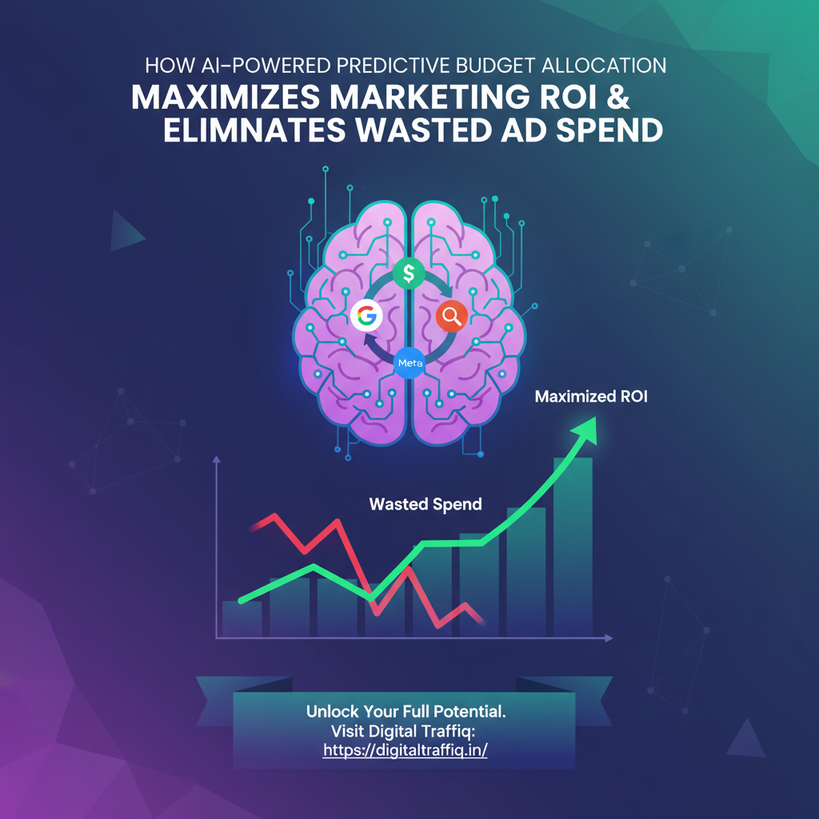
How AI-Powered Predictive Budget Allocation Maximizes Marketing ROI While Eliminating Wasted Ad Spend
Estimated reading time: 5 minutes
Key takeaways:
- Static marketing budgets lead to wasted spend and missed opportunities in a dynamic digital landscape.
- AI-powered predictive budget allocation uses machine learning to forecast ROI and reallocate funds in real-time to the highest-performing channels.
- The benefits include dramatically increased ROI, elimination of wasted ad spend, proactive opportunity capture, and scalable, data-driven decision-making.
- Successful implementation requires a solid data foundation, clear KPIs, and a strategic shift from human-led to AI-augmented budget management.
- This approach transforms the marketing budget from a static document into a dynamic, intelligent financial engine.
Table of Contents
- The High Cost of Static Budgets in a Dynamic World
- What is AI-Predictive Budget Allocation?
- The Tangible Benefits: From Efficiency to Exponential Growth
- Implementing Predictive Budget Allocation: A Strategic Approach
- The Digital Traffiq Advantage: Your Partner in Predictive Performance
- The Future of Marketing Finance is Predictive
For modern marketing leaders, the annual budget planning session is often a high-stakes exercise in educated guesswork. You analyze last year’s data, consider market trends, and allocate funds across channels, hoping your bets pay off. But in a digital landscape that changes by the minute, static budgets are a recipe for wasted spend and missed opportunities. At Digital Traffiq, we’ve seen a paradigm shift. The future isn’t about planning a budget; it’s about deploying a continuously learning, AI-powered financial engine that allocates every dollar in real-time for maximum return. This is the power of AI-powered predictive budget allocation.
The High Cost of Static Budgets in a Dynamic World
Traditional budget allocation operates on a “set-and-forget” principle. A campaign is funded, launched, and runs its course, with mid-flight adjustments being reactive, manual, and often too late. The flaws in this model are glaring:
- Lagging Indicators: You’re optimizing based on what already happened, not what will happen.
- Channel Silos: Budgets are often locked into channels (e.g., $X for Google Ads, $Y for Meta), preventing fluid movement to where performance is hottest.
- Human Bias & Fatigue: Decisions can be swayed by past preferences or sheer inability to process the volume of cross-channel data in real-time.
The result? Significant wasted ad spend languishing in underperforming campaigns while high-potential opportunities are starved of funds.
What is AI-Predictive Budget Allocation?
AI-powered predictive budget allocation moves marketing finance from a rear-view mirror exercise to a forward-looking navigation system. It uses machine learning algorithms to analyze vast, multidimensional datasets—including historical campaign performance, real-time engagement metrics, competitive activity, market conditions, and even external factors like weather or economic indicators.
The AI doesn’t just report; it predicts. It forecasts the potential ROI of every possible budget allocation scenario across your entire marketing mix. Then, it automatically—or with human oversight—shifts funds to the campaigns, channels, and audiences predicted to deliver the highest return at that exact moment. This is smart budget management at the speed of your market.
Core Mechanisms of an AI-Driven System
- Predictive ROI Modeling: The foundation. AI builds models that predict future customer lifetime value (LTV), conversion probability, and cost-per-acquisition (CPA) for different segments and touchpoints.
- Continuous Performance Forecasting: It simulates thousands of “what-if” scenarios to answer critical questions: “What if we shift 15% of our social budget to search during this product launch?” or “How will a change in competitor spend impact our display ad efficiency?”
- Automated Budget Reallocation: Based on these forecasts, the system can execute automated budget reallocation rules. For example, it can pause a underperforming ad set the moment its predicted CPA exceeds a target threshold and reallocate those funds to a high-converting search campaign.
- Unified Cross-Channel View: It breaks down silos, treating the entire marketing budget as a single, fluid pool of capital to be invested wherever the algorithmic analysis indicates the best return.
The Tangible Benefits: From Efficiency to Exponential Growth
Implementing a predictive approach to marketing budget automation delivers transformative outcomes that go far beyond simple cost-cutting.
1. Dramatically Increased Marketing ROI
This is the primary goal. By consistently funneling money into the highest-performing avenues, the overall efficiency of your spend skyrockets. Companies using AI-driven budget optimization routinely report ROI increases of 20-40% or more, as every dollar is working harder.
2. The Virtual Elimination of Wasted Ad Spend
Waste occurs in the gap between performance change and human reaction. AI closes this gap instantly. If a keyword’s cost spikes or a social audience fatigues, the AI reallocates funds immediately. This turns ad spend efficiency from an aspiration into a constant, automated reality.
3. Proactive Opportunity Capture
While humans are busy managing existing campaigns, AI is scouting for new wins. It can identify emerging high-intent search trends, undervalued audience segments, or time-of-day efficiencies and recommend or activate budget to capitalize on them before competitors do.
4. Scalable, Data-Driven Decision Making
It removes guesswork and emotion from budget meetings. Decisions are backed by predictive analytics and simulation data, fostering alignment between marketing, finance, and executive teams. This is AI-driven financial planning in its most practical form.
5. Enhanced Agility and Competitive Response
In a competitive bidding environment, speed is advantage. An AI system can react to a competitor’s promotional campaign in milliseconds, adjusting bids and budget allocations to defend market share or exploit a weakness.
Implementing Predictive Budget Allocation: A Strategic Approach
Transitioning to an AI-optimized budget model is a strategic journey, not just a software install.
- Data Foundation & Integration: Success hinges on data quality and connectivity. Your first step is to ensure clean, unified data flows from all marketing platforms (Google Ads, Meta, LinkedIn, CRM, etc.) into a central data warehouse or the AI platform itself.
- Define KPIs & Business Rules: What does “success” mean for the AI? Is it lowest CPA, highest ROAS, or maximum lead volume? You must establish clear key performance indicators and guardrails (e.g., “never allocate less than 10% to brand campaigns”).
- Start with Augmentation, Not Automation: Begin by using the AI’s predictive insights to inform human decisions. Run simulations and follow its recommendations. This builds trust and understanding before flipping the switch to full automated budget reallocation.
- Iterate and Refine: The AI’s models improve with more data and feedback. Regularly review its decisions and outcomes with your team, refining the rules and parameters to better align with business goals.
The Digital Traffiq Advantage: Your Partner in Predictive Performance
At Digital Traffiq, we don’t just provide tools; we provide a partnership in ROI optimization AI. Our expertise lies in integrating cutting-edge predictive AI with deep marketing channel knowledge. We help you build the data infrastructure, configure the intelligent models specific to your industry and goals, and manage the change within your team to ensure you realize the full value of predictive marketing spend optimization.
Our platform acts as your central marketing financial brain, continuously executing a strategy of cost-per-acquisition optimization across every touchpoint. We move you from a mindset of cost control to one of strategic investment.
The Future of Marketing Finance is Predictive
The question is no longer if AI will transform marketing budget allocation, but when. The brands that embrace predictive ROI modeling and smart budget management today are building a decisive competitive moat. They are replacing waste with precision, guesswork with foresight, and rigid plans with agile, responsive investment strategies.
Stop letting your marketing budget be a static document. Start treating it as your most dynamic and intelligent asset. By leveraging AI to predict, allocate, and optimize in real-time, you unlock unprecedented efficiency and growth, ensuring that every single marketing dollar is an investment toward a more profitable future.
Ready to eliminate wasted ad spend and maximize your marketing ROI? Explore how Digital Traffiq’s AI-powered predictive budget allocation can transform your marketing financial strategy. Contact us for a personalized consultation and see what our predictive models can forecast for your bottom line.