
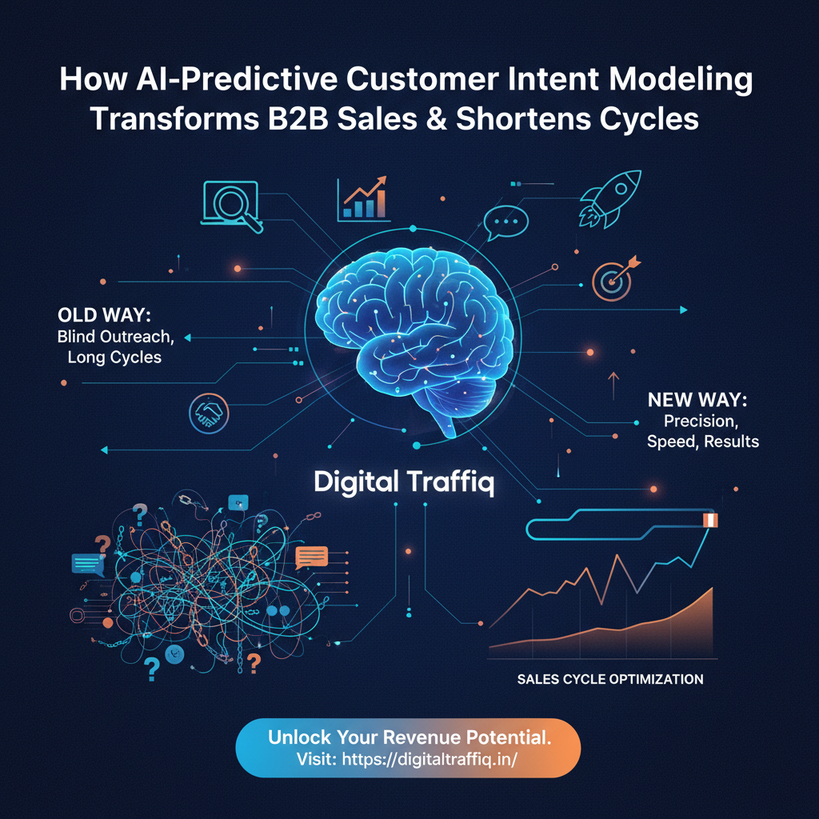
How AI-Powered Predictive Customer Intent Modeling Transforms B2B Sales Conversations and Shortens Sales Cycles
Estimated reading time: 5-7 minutes
Key Takeaways
- Predictive intent modeling uses AI to analyze digital behavior and forecast a company’s likelihood to buy, moving sales from intuition to data-driven precision.
- It directly addresses critical gaps in traditional sales: poor timing, irrelevant messaging, and lack of pre-call insight.
- Armed with intent data, sales conversations shift from generic pitches to personalized, consultative dialogues that establish immediate credibility.
- The technology accelerates sales cycles by enabling faster qualification, reducing buyer friction, and allowing for proactive competitive neutralization.
- Successful implementation requires integrating data sources, aligning sales and marketing teams, and training reps in insight-led selling.
Table of Contents
- What is Predictive Customer Intent Modeling?
- The Critical Gap in Traditional B2B Sales Approaches
- Transforming Sales Conversations with AI-Driven Insight
- The Direct Impact on Sales Cycle Optimization
- Implementing an Intent-Driven Outreach Strategy
- The Future is Predictive, Personalized, and Powered by AI
For decades, B2B sales has been a high-stakes game of intuition, relationship-building, and reactive hustle. Sales teams chase leads, hoping their timing is right, their pitch resonates, and that the prospect is genuinely “in-market.” This approach is not just inefficient; it’s exhausting and costly. Today, a seismic shift is underway. The advent of AI-powered predictive customer intent modeling is moving sales from an art of persuasion to a science of precision. This technology doesn’t just support sales teams—it fundamentally rewires the sales process, enabling hyper-personalized conversations and dramatically compressing sales cycles. At Digital Traffiq, we see this not as a future trend, but as the operational bedrock of modern, high-velocity B2B revenue engines.
What is Predictive Customer Intent Modeling?
At its core, predictive customer intent modeling is the application of artificial intelligence and machine learning to analyze vast datasets of digital behavior to forecast a company’s likelihood to buy. It moves beyond basic firmographics (company size, industry) or explicit actions (downloading a whitepaper). Instead, it synthesizes buyer intent signals—such as repeated website visits, content consumption patterns, keyword searches, technology stack changes, and engagement with competitor content—into a dynamic, predictive score.
Think of it as a high-resolution radar for your market. Instead of seeing blips (leads), you see detailed weather patterns (intent clusters). You know not just who is looking, but what they’re looking for, how urgently they need it, and what specific problems they are trying to solve. This transforms anonymous web traffic and stagnant CRM entries into a prioritized map of commercial opportunity.
The Critical Gap in Traditional B2B Sales Approaches
Traditional sales methodologies often create critical friction points:
- The Timing Problem: Outreach is either too early (when the prospect is just browsing) or too late (when they’ve already engaged with three competitors).
- The Relevance Problem: Generic, spray-and-pray messaging fails to connect because it doesn’t address the prospect’s specific, real-time stage in the buyer’s journey.
- The Insight Problem: Sales reps enter conversations blind, forced to spend the first half of the call diagnosing needs instead of providing valuable solutions.
This gap is where deals stall, cycles elongate, and resources are wasted. Predictive sales intelligence bridges this gap by providing actionable insight before the first conversation even begins.
Transforming Sales Conversations with AI-Driven Insight
The most profound impact of intent modeling is felt in the quality of sales conversations. Here’s how:
From Generic Pitch to Personalized Dialogue
Armed with intent data, a sales rep no longer opens with, “I’d like to tell you about our platform.” Instead, they can say, “I noticed your team has been researching solutions for [specific pain point] and has engaged with content on [specific topic]. Based on that, I thought our approach to solving [their inferred challenge] might be highly relevant to your current initiative.” This immediately establishes credibility, relevance, and respect for the buyer’s time—setting a collaborative tone from the first sentence.
Enabling Consultative Selling at Scale
AI sales enablement tools powered by intent data equip reps to act as consultants. The AI highlights not just that a prospect is active, but why. It can surface the specific challenges they’re likely facing based on the content they consume. This allows the rep to lead with insight, asking informed questions and framing their solution within the context of the buyer’s unique journey. This is the essence of conversation intelligence AI—augmenting human skill with machine-driven insight.
Prioritizing Effort with Predictive Lead Scoring
Not all intent is created equal. Predictive lead scoring uses modeling to assign a dynamic, algorithmic score to each account. This score constantly updates based on new signals. Sales teams can then prioritize their outreach with surgical precision, focusing energy on accounts that are not just a good fit, but are actively in-market and exhibiting high-intent behavior. This eliminates guesswork and maximizes the ROI of every sales hour.
The Direct Impact on Sales Cycle Optimization
Shortening the sales cycle is a direct mathematical driver of revenue growth. Predictive intent modeling attacks cycle length from multiple angles:
- Faster Qualification: Instant identification of in-market accounts means no more weeks spent nurturing cold leads. Sales Development Representatives (SDRs) can target accounts that are already warm, drastically reducing the time to a qualified sales conversation.
- Reduced Buyer Friction: When conversations are deeply relevant, buyers move faster. They don’t need to educate the seller on their basic problems, so discussions can quickly advance to solution design, validation, and consensus-building.
- Competitive Neutralization: By identifying prospects researching competitors, your team can engage proactively with tailored counter-messaging and differentiation, often intercepting the decision process before a competitor fully entrenches themselves.
- Improved Win Rates: Higher relevance leads to higher engagement. Higher engagement leads to better understanding. Better understanding leads to more compelling proposals. This virtuous cycle directly translates into more closed deals.
Implementing an Intent-Driven Outreach Strategy
Adopting this model requires more than just buying software; it requires a strategic shift:
- Integrate Data Sources: Effective modeling requires feeding the AI a rich diet of data—website analytics, CRM data, marketing engagement, and third-party B2B intent data.
- Align Sales & Marketing: Marketing uses intent data to create hyper-targeted content and campaigns. Sales uses it for personalized outreach. Both teams must operate from the same intent-driven playbook, a core service alignment we champion at Digital Traffiq.
- Train for Insight-Led Selling: Coaching reps to leverage intent insights conversationally is key. It’s about enhancing human intuition, not replacing it.
- Measure What Matters: Track new metrics like “Time-to-Intent,” “Intent-Driven Conversion Rate,” and the average cycle length for intent-prioritized deals versus traditional leads.
The Future is Predictive, Personalized, and Powered by AI
The era of generic, interruptive B2B sales is over. Buyers demand personalization, relevance, and insight.
AI-powered predictive customer intent modeling is the key to meeting that demand at scale. It empowers sales teams to be smarter, more efficient, and more effective, transforming random outreach into intent-driven outreach that feels like a welcome conversation.
At Digital Traffiq, we specialize in helping B2B organizations harness this transformative power. By integrating advanced intent modeling into your sales and marketing fabric, you stop chasing and start engaging. The result is not just shorter sales cycles, but stronger customer relationships, higher win rates, and a predictable, scalable revenue pipeline. The future of sales isn’t about talking more; it’s about understanding better and acting with precision. That future is here.