
From Data Deluge to Decisive Action: The C-Suite’s New AI Copilot
Estimated Reading Time: 5 minutes
Key Takeaways
- AI dashboards transform executives from reviewers of past performance to active pilots of future growth.
- Predictive metrics and automated reporting provide foresight, not just hindsight, enabling proactive strategy.
- A unified marketing ROI dashboard clarifies the impact of every dollar across complex customer journeys.
- Real-time intelligence compresses decision cycles from weeks to hours, fostering agility and alignment.
- Successful implementation starts with defining executive-level KPIs and fostering a data-led culture from the top down.
Table of Contents
- Beyond Spreadsheets: What Makes an AI Dashboard a C-Suite Essential?
- The Pillars of AI-Driven Executive Intelligence
- The Tangible Impact on C-Suite Decision Making
- Implementing AI Dashboards: A Strategic Blueprint for Leadership
- Conclusion: The Future of Leadership is Informed, Real-Time, and AI-Augmented
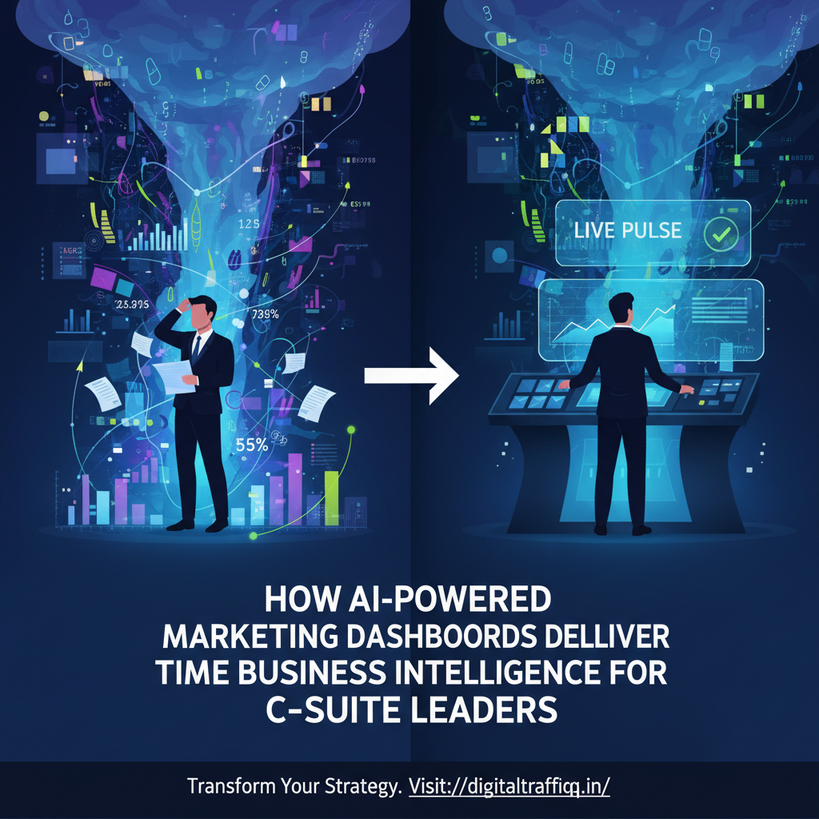
In the boardrooms of today’s most competitive companies, a quiet revolution is underway. The era of waiting for quarterly reports, sifting through static PDFs from disparate departments, and making high-stakes decisions based on hindsight is over. C-suite executives—CEOs, CMOs, CFOs—are now demanding a live pulse on their business. They need to see the direct impact of every marketing dollar, understand shifting customer sentiment in real-time, and forecast outcomes with confidence. This is no longer a luxury; it’s a survival imperative. Enter the AI-powered marketing performance dashboard: a transformative tool that consolidates, analyzes, and visualizes data to deliver real-time business intelligence directly into the hands of decision-makers.
For companies like Digital Traffiq, the mission is clear: to bridge the gap between vast marketing data streams and actionable executive insight. The modern AI marketing dashboard is the engine of this transformation, moving beyond simple data display to become an intelligent partner for strategic leadership.
Beyond Spreadsheets: What Makes an AI Dashboard a C-Suite Essential?
Traditional dashboards often act as fancy rear-view mirrors. They show you where you’ve been. An AI-driven dashboard, however, is like a GPS combined with a weather radar and a traffic predictor for your business journey. It tells you where you are, what’s ahead, and how to navigate the fastest route to your goals. For the C-suite, this shift is profound. It transforms their role from reviewers of historical performance to active pilots of future growth.
The core value lies in automated KPI reporting. Instead of your team spending days each month manually compiling reports from Google Analytics, CRM platforms, social media, and ad servers, an AI dashboard does this continuously. It ingests data from all connected sources, normalizes it, and presents a single source of truth. This eliminates the “version conflict” of reports and frees up strategic minds for analysis, not assembly.
The Pillars of AI-Driven Executive Intelligence
So, what specific capabilities elevate a dashboard to a C-suite marketing analytics powerhouse? Let’s break down the key features that deliver tangible strategic marketing intelligence.
1. Predictive Performance Metrics & Proactive Alerts
AI doesn’t just report on the past; it models the future. By analyzing trends, seasonality, and campaign correlations, advanced dashboards can project key metrics like pipeline revenue, customer acquisition cost (CAC), and lead volume weeks in advance. Imagine a system that alerts the CFO that CAC is trending 15% above target due to increased channel competition, or notifies the CMO that a content campaign is likely to over-perform, suggesting a budget re-allocation. This is predictive performance metrics in action—turning hindsight into foresight.
2. Unified Marketing ROI Dashboard
The perennial question, “What’s the ROI of our marketing?” is answered instantly. A true marketing ROI dashboard doesn’t just track spend. It attributes revenue across complex, multi-touch customer journeys. By using algorithmic attribution models, it shows how each channel—from an initial blog read to a final retargeting ad—contributed to a sale. This allows the C-suite to see not just overall marketing efficiency, but the precise ROI of each investment, enabling confident, data-backed budget decisions.
3. Real-Time Visualization of Strategic Initiatives
Performance visualization AI translates complex data sets into intuitive, at-a-glance visuals. A CEO can log in and see a live “health score” for the business, driven by marketing, sales, and customer success metrics. Drill-down capabilities allow them to explore from a high-level goal (e.g., “Increase Market Share in EMEA”) down to the daily performance of specific ad sets or content pieces. This narrative-driven visualization supports faster comprehension and more informed strategic discussions.
The Tangible Impact on C-Suite Decision Making
Adopting this technology is not about having prettier charts; it’s about fundamentally improving the quality, speed, and impact of executive decisions.
- Speed: Decision cycles compress from weeks to hours. When market conditions shift, leadership can see the effect immediately and convene to adjust strategy, not wait for the monthly report to confirm a problem that’s already a month old.
- Alignment: A single, trusted dashboard creates alignment across the executive team. When the CMO, CFO, and CEO are all looking at the same real-time data, discussions move from debating the numbers to deciding on actions. It fosters a data-driven culture from the top down.
- Risk Mitigation: Predictive insights allow for proactive risk management. Seeing a forecasted dip in lead quality allows for preemptive campaign adjustments. Identifying an underperforming market early can prevent significant budget waste.
- Strategic Agility: With a clear, real-time view of what’s working, resources can be pivoted with precision. This agility is a massive competitive advantage, allowing companies to double down on winning strategies and exit failing ones faster than their competitors.
Implementing AI Dashboards: A Strategic Blueprint for Leadership
For C-suite leaders ready to harness this power, the journey begins with clarity.
- Define Executive-Level KPIs: Start by identifying the 5-10 metrics that truly matter at the strategic level. These are rarely “clicks” or “likes.” Think: Marketing-Sourced Pipeline, Customer Lifetime Value (LTV) by Acquisition Channel, Brand Sentiment Index, or Competitive Share of Voice. The dashboard must be built around these north-star metrics.
- Demand Integration, Not Isolation: Ensure the chosen solution can integrate seamlessly with your entire martech stack—CRM, marketing automation, ad platforms, web analytics. The power is in the synthesis of data.
- Prioritize Actionable Intelligence Over Raw Data: Work with your provider (like Digital Traffiq) to configure alerts, forecasts, and insights that trigger specific actions. The goal is for the dashboard to answer “So what?” and “What should we do?”
- Foster a Data-Led Culture: Lead by example. Use the dashboard in leadership meetings. Base questions and decisions on its insights. This institutionalizes its value and drives adoption throughout the organization.
Conclusion: The Future of Leadership is Informed, Real-Time, and AI-Augmented
The complexity and velocity of modern business have rendered old reporting methods obsolete. The C-suite can no longer afford to operate on lagging indicators. AI-driven business insights delivered through intelligent performance dashboards represent the new standard for executive decision support.
This technology transforms the marketing function from a cost center into a transparent, accountable, and predictable growth engine. It empowers leaders to move from reactive management to proactive leadership, steering their companies with confidence based on a live, intelligent feed of their business reality.
At Digital Traffiq, we believe that the right intelligence at the right time is the ultimate competitive edge. By leveraging AI to cut through the noise and deliver crystal-clear, real-time business intelligence, we empower C-suite leaders to make the decisions that shape their company’s future—not just report on its past.
The question for today’s executive is no longer whether they need this level of insight, but how quickly they can implement it. The dashboard of the future is here, and it’s speaking the language of leadership.