
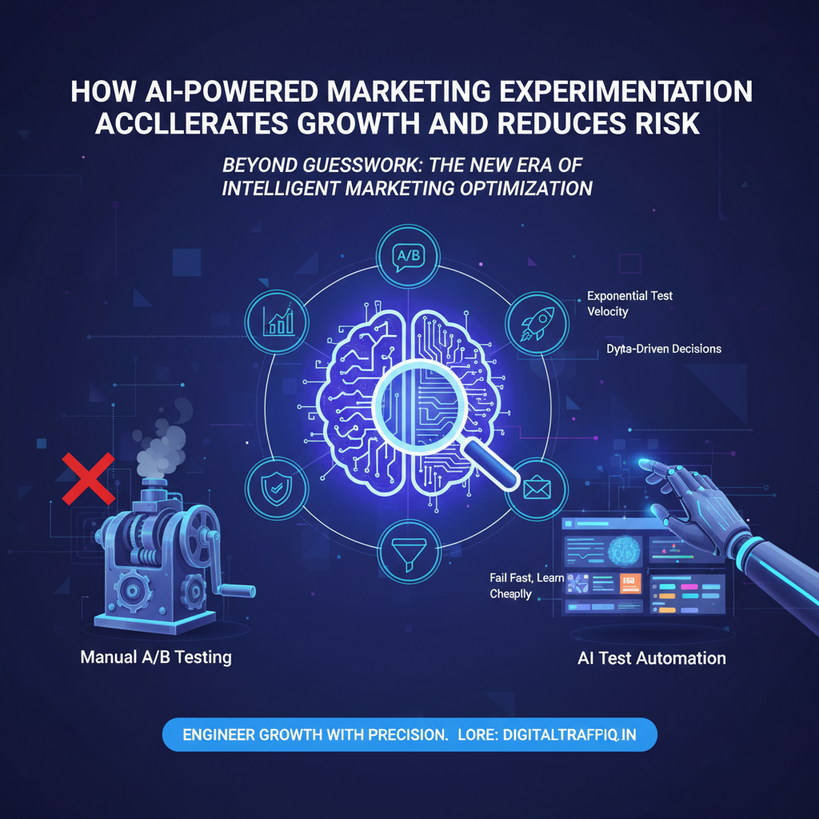
Beyond Guesswork: The New Era of Intelligent Marketing Experimentation
Estimated reading time: 6 minutes
Key Takeaways:
- AI-powered experimentation moves marketing from slow, manual A/B testing to continuous, intelligent optimization at scale.
- It solves critical bottlenecks like resource intensity, slow insights, and the inability to personalize effectively.
- The benefits are twofold: accelerating growth through exponential test velocity and reducing risk with data-driven decisions.
- Implementation requires a strategic roadmap, starting with data centralization and focusing on high-impact areas.
- The future belongs to autonomous marketing engines that learn and improve from every user interaction.
Table of Contents
For years, marketing optimization has been a game of educated guesses, manual effort, and painful bottlenecks. Teams would brainstorm hypotheses, painstakingly set up a handful of A/B tests, wait weeks for statistical significance, and often end up with inconclusive results or marginal gains. The process was slow, risky, and impossible to scale across dozens of campaigns, channels, and audience segments. This traditional approach leaves massive growth potential untapped and exposes businesses to the risk of costly, misguided decisions.
Enter the paradigm shift: AI-powered marketing experimentation. This isn’t just about automating a button click; it’s about fundamentally transforming how we discover growth opportunities. At Digital Traffiq, we see this as the core of modern, data-driven marketing. By leveraging artificial intelligence to run, manage, and interpret thousands of simultaneous experiments, businesses can move from a culture of sporadic testing to one of continuous, intelligent optimization. This article explores how this technological leap accelerates growth while systematically de-risking your marketing investments.
The Scaling Problem: Why Manual A/B Testing Hits a Wall
Traditional A/B testing frameworks crumble under the weight of modern marketing’s complexity. Consider the variables: email subject lines, hero images, CTA button colors, page layouts, ad copy, landing page forms, pricing table structures, and personalization logic. The possible combinations are virtually infinite. A human-led process can only test a minuscule fraction of this universe.
The bottlenecks are clear:
- Resource Intensity: Each test requires design, development, and analytics bandwidth.
- Time to Insight: Waiting for 95% confidence on a single test can stall campaigns.
- Analysis Paralysis: Interpreting results and deciding “what’s next” is slow and subjective.
- Inability to Personalize: A winner for one segment may be a loser for another, but testing for all segments is impractical manually.
This is where AI test automation becomes a force multiplier. It removes these bottlenecks, allowing teams to shift from being executors of tests to strategists of experimentation programs.
How AI-Driven Hypothesis Testing and Experimentation Works
An intelligent testing platform doesn’t just execute your ideas; it generates its own. The process moves through a sophisticated cycle:
- Hypothesis Generation: AI analyzes historical performance data, user behavior flows, and engagement patterns to surface high-potential areas for testing. It can ask, “What if we changed the value proposition for users who abandoned at the pricing page?”
- Test Design & Launch: The system can automatically create nuanced multivariate tests, combining multiple element variations (e.g., headline + image + CTA) simultaneously to find the optimal overall combination, not just isolated winners.
- Real-Time Optimization: Using adaptive algorithms (like multi-armed bandit models), AI can dynamically allocate more traffic to winning variations in real-time, maximizing conversion gains while the test is still running, rather than waiting for a final result.
- Intelligent Analysis & Learning: Beyond declaring a “winner,” AI uncovers the “why.” It identifies which user segments (by device, source, behavior) responded to which variation, building a rich, segment-specific playbook. Each experiment’s outcome feeds the AI’s knowledge, making future hypothesis generation even sharper.
This creates a self-improving system where marketing optimization at scale becomes a continuous reality, not a periodic project.
The Tangible Benefits: Accelerating Growth and Mitigating Risk
The shift to AI-powered experimentation delivers value across two critical axes: growth acceleration and risk reduction.
Accelerating Growth:
- Exponential Test Velocity: Run hundreds or thousands of experiments concurrently across your digital footprint, uncovering growth levers at a pace impossible for human teams.
- Compound Learning: Every experiment informs the next. You build a proprietary, AI-curated knowledge base of what drives conversions for your unique audience, creating a formidable competitive moat.
- Hyper-Personalization: Automatically serve different winning variations to different audience segments without manual segment-by-segment testing, maximizing relevance and conversion rates for all.
Reducing Risk:
- Data-Driven Decisions, Not Hunches: Eliminate the risk of rolling out major changes based on opinion or HiPPO (Highest Paid Person’s Opinion). Every change is validated by robust, AI-analyzed experimental data.
- Fail Fast, Learn Cheaply: AI can identify failing test variations early and reallocate resources, minimizing the opportunity cost of poor-performing campaigns.
- Predictive Insights: Advanced models can predict the potential impact of a test before full deployment, allowing teams to prioritize the highest-value experiments.
- Systematic, Not Sporadic: A continuous testing culture reduces the risk of stagnation. You’re always iterating and improving, keeping you ahead of market shifts and competitor moves.
Implementing an AI-First Experimentation Strategy: A Practical Roadmap
Transitioning to an AI-driven experimentation model requires strategic planning. Here’s a roadmap we advocate at Digital Traffiq:
- Audit & Centralize: Consolidate your data sources (web analytics, CRM, email platforms). AI requires clean, accessible data to formulate intelligent hypotheses.
- Start with High-Impact Areas: Begin your growth experimentation journey on key conversion points like primary landing pages, checkout flows, or lead capture forms, where improvements have direct revenue impact.
- Define Goals & Metrics: Be crystal clear on what “success” means (e.g., conversion rate, average order value, lead quality). Your AI needs clear objectives to optimize towards.
- Choose the Right Platform: Select an intelligent testing platform that goes beyond simple A/B testing to offer multivariate capabilities, adaptive algorithms, and deep integration with your martech stack.
- Cultivate a Culture of Experimentation: Empower your team to propose hypotheses and trust the data. Move from “I think” to “The data shows.”
The Future is Autonomous Optimization
The evolution from manual A/B testing to AI-powered experimentation marks a move from reactive optimization to proactive, predictive growth engineering. The goal is not just to test faster but to build a marketing engine that learns and improves autonomously.
At Digital Traffiq, we believe that the competitive edge in the next decade of digital marketing will belong to those who master data-driven marketing experiments at scale. It’s about building a system where every pixel, word, and user journey can be intelligently optimized, not by gut feeling, but by a relentless, AI-powered pursuit of what works best.
By embracing AI-driven hypothesis testing and automated experimentation, you stop betting on campaigns and start engineering growth with precision. You reduce the risk of large-scale failures and unlock compound growth through countless small, data-validated wins. The question is no longer whether you should test, but how many experiments your AI can run for you today.