
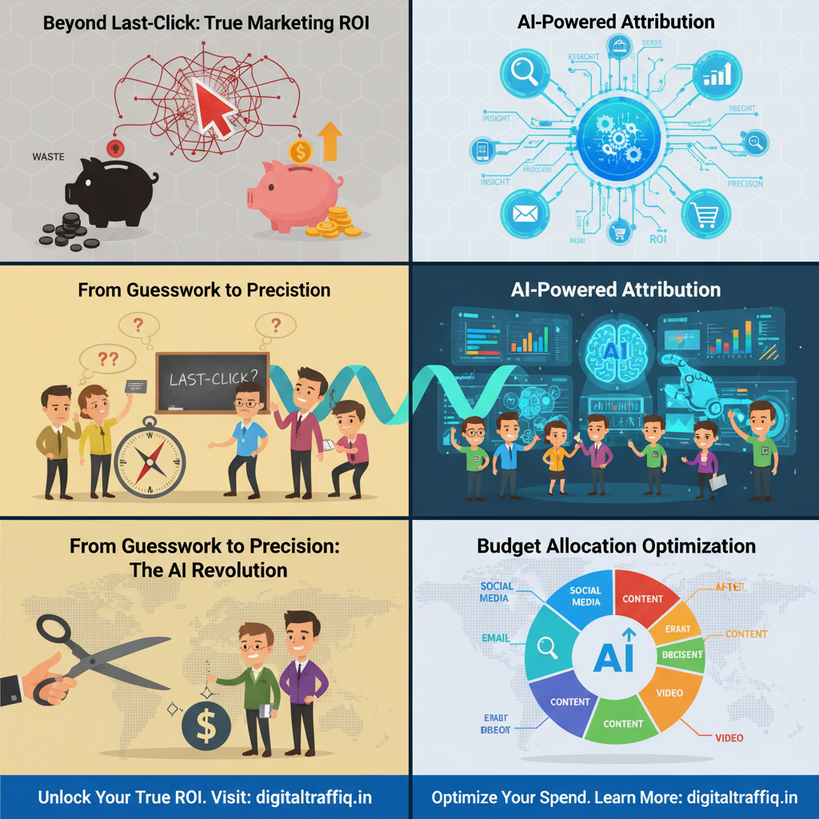
From Guesswork to Precision: The AI Revolution in Marketing Attribution
Estimated reading time: 5 minutes
Key Takeaways
- AI-powered attribution models move beyond flawed last-click methods to reveal the true influence of every marketing touchpoint.
- These models use machine learning to analyze entire customer journeys, enabling data-backed budget reallocation and uncovering hidden channel value.
- Implementation leads to tangible outcomes: optimized marketing spend efficiency, accurate ROI measurement, and smarter tactical execution.
- Successful adoption requires data unification, careful model selection, and integrating insights into daily operations.
- The shift to AI-driven attribution transforms marketing into a precisely measured profit driver and a key competitive advantage.
Table of Contents
- The Critical Flaws of Traditional Attribution Methods
- How AI-Powered Attribution Models Work: A Data-Driven Deep Dive
- Key Capabilities of Advanced AI Attribution
- The Tangible Business Impact: Revealing True ROI and Optimizing Budget
- Implementing AI Attribution: A Practical Guide with Digital Traffiq
- Overcoming Common Challenges
- The Future of Marketing Accountability is Here
For decades, marketing teams have operated with a fundamental blind spot: which touchpoints truly drive conversions and revenue? Traditional models, like last-click attribution, gave disproportionate credit to the final interaction, painting a dangerously incomplete picture. This led to misallocated budgets, undervalued channels, and strategic decisions based on flawed data. At Digital Traffiq, we’ve seen this challenge stifle growth for even the most sophisticated brands. Today, a new era of clarity is dawning, powered by artificial intelligence. AI-powered marketing attribution models are transforming how businesses understand their customer journey, measure true ROI, and allocate every dollar for maximum impact.
The Critical Flaws of Traditional Attribution Methods
Before we explore the AI-driven solution, it’s essential to understand why the old ways are breaking. First-touch and last-click attribution are simplistic by design. They ignore the complex, non-linear reality of the modern buyer’s journey, which often involves numerous interactions across search, social, email, content, and more. Linear or time-decay models offer a slight improvement but still rely on arbitrary rules set by humans, not data-driven insights.
The result? Upper-funnel channels like brand awareness campaigns or informative blog content get zero credit for nurturing a lead that eventually converts via a branded search. Conversely, a bottom-funnel retargeting ad might receive all the credit, leading to over-investment in a channel that only works because of prior investments elsewhere. This isn’t just an analytical error; it’s a direct threat to marketing spend efficiency and sustainable growth.
How AI-Powered Attribution Models Work: A Data-Driven Deep Dive
AI-driven attribution cuts through the noise by analyzing the entire conversion path analysis at an individual level. Instead of applying a one-size-fits-all rule, machine learning algorithms process vast datasets—including touchpoint sequences, time between interactions, channel type, creative elements, and external factors—to statistically determine the actual influence of each marketing interaction.
Think of it as a forensic analyst for your marketing data. The AI examines millions of customer journeys, identifying patterns and correlations that are invisible to the human eye. It answers the pivotal question: “What was the incremental contribution of this specific ad, email, or keyword to the probability of conversion?” This approach, often rooted in marketing mix modeling (MMM) principles but applied at a granular, user-level, is what we call multi-touch attribution at its most advanced.
Key Capabilities of Advanced AI Attribution
- Algorithmic Weight Assignment: AI dynamically assigns fractional credit to each touchpoint based on its proven influence, moving beyond fixed rules.
- Cross-Device and Cross-Channel Tracking: It connects user interactions from mobile to desktop, from social media to your website, creating a unified view.
- Offline Conversion Integration: Sophisticated models can even factor in offline data, like in-store purchases or call center conversions, for a true omnichannel picture.
- Continuous Learning: The model constantly refines its understanding as new data flows in, ensuring insights remain accurate as market conditions and consumer behavior change.
The Tangible Business Impact: Revealing True ROI and Optimizing Budget
The transition to an AI-powered model isn’t just an IT upgrade; it’s a strategic revolution with direct bottom-line benefits. The core output is a clear, accurate, and actionable view of ROI measurement for every campaign, channel, and even creative asset.
1. Data-Backed Budget Reallocation
This is where theory meets practice. With an AI attribution model, you can move budget from over-credited, low-incremental channels to under-valued, high-impact ones. For example, you might discover that your high-cost branded search campaigns are primarily capturing demand you already created through organic social and video content. By reallocating spend to those top-of-funnel activities, you can grow the total pipeline more efficiently. This is the essence of budget allocation optimization.
2. Uncovering Hidden Channel Performance
Comprehensive channel performance analytics become possible. A channel previously deemed “low-converting” might be revealed as an essential catalyst in the majority of sales. This insight allows you to defend and strategically invest in these critical nurturing channels, rather than cutting them based on last-click data.
3. Smarter Bidding and Tactical Execution
Granular attribution data feeds directly into platform bidding strategies. You can optimize Google Ads or Meta bids based on a keyword’s or ad’s true role in the full journey, not just its last-click performance. This increases efficiency and lowers customer acquisition costs.
Implementing AI Attribution: A Practical Guide with Digital Traffiq
Adopting an AI-powered attribution solution requires careful planning. At Digital Traffiq, we guide our clients through a structured process to ensure success.
- Data Unification: The first step is aggregating clean, consistent data from all marketing platforms, your CRM, and website analytics. Data quality is non-negotiable.
- Model Selection & Training: We help select the right algorithmic model for your business size, sales cycle, and data maturity. The AI model is then trained on your historical data.
- Insight Generation & Visualization: The raw output is transformed into intuitive dashboards that show cross-channel attribution weights, true ROI by segment, and actionable optimization opportunities.
- Integration & Activation: The final and most critical step is integrating these insights into daily operations—reshaping budget meetings, campaign planning, and performance reviews around the new truth.
Overcoming Common Challenges
Transitioning can bring challenges: data privacy compliance (like GDPR/CCPA), internal resistance to changing “how we’ve always done it,” and the technical complexity of integration. A partner like Digital Traffiq provides the expertise to navigate these hurdles, ensuring a smooth transition that focuses on change management and proving quick, tangible wins to secure organizational buy-in.
The Future of Marketing Accountability is Here
The question is no longer whether you need advanced attribution, but how quickly you can implement it. In a landscape of tightening budgets and intense competition, marketing spend efficiency is the ultimate competitive advantage. AI-powered marketing attribution provides the map to that efficiency, turning marketing from a cost center into a precisely measured profit driver.
By embracing AI-driven attribution, you stop guessing and start knowing. You can confidently defend your budget, double down on what truly works, and eliminate wasteful spending. The result is not just improved ROI measurement, but a more agile, intelligent, and effective marketing organization poised for scalable growth.
At Digital Traffiq, we specialize in implementing these sophisticated models for our clients, transforming their data into their most valuable strategic asset. Ready to move beyond last-click and see your true marketing ROI? The path to precision starts with a single, data-driven decision.