
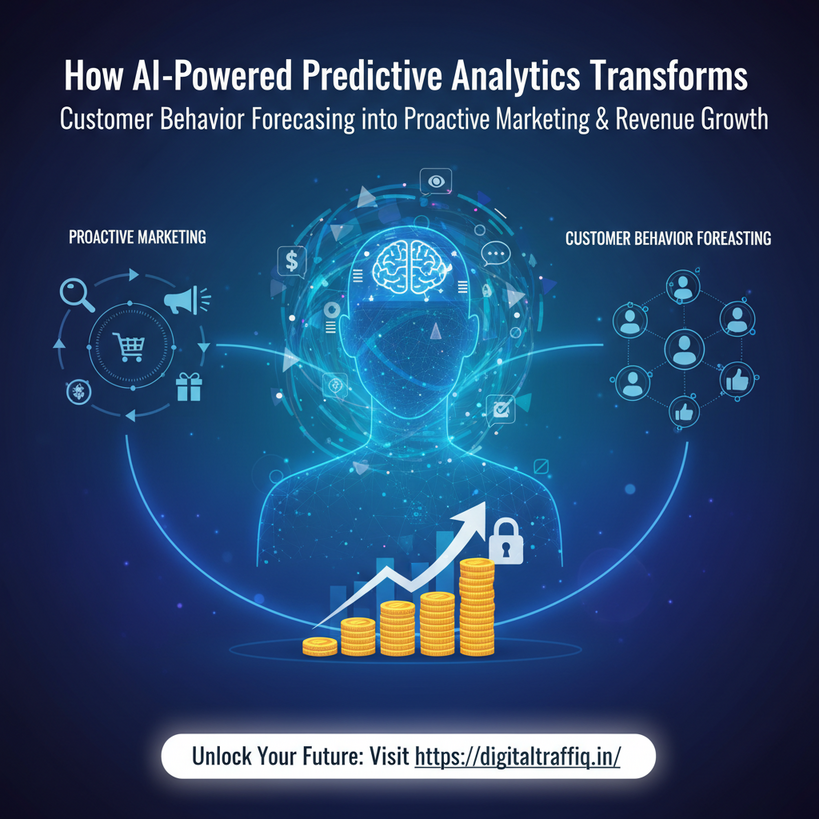
From Reactive to Proactive: How AI-Powered Predictive Analytics is Redefining Marketing Strategy
Estimated reading time: 5 minutes
Key Takeaways:
- AI predictive analytics shifts marketing from analyzing past behavior to forecasting future customer actions.
- Activating insights through proactive campaigns enables hyper-personalized engagement, churn prevention, and optimized resource allocation.
- Successful implementation requires a solid data foundation, strategic prioritization, and cross-functional team alignment.
- This technology transforms marketing into a predictable, scalable growth driver and a key competitive advantage.
Table of Contents
- Decoding Intent: The Science Behind AI Predictive Customer Behavior
- From Prediction to Profit: Activating Proactive Marketing Campaigns
- The Digital Traffiq Advantage: Integrating Predictive Intelligence into Your Growth Engine
- Building a Future-Ready, Proactive Marketing Organization
- Conclusion: The Predictive Imperative for Sustainable Growth
In today’s hyper-competitive digital landscape, reacting to customer behavior is no longer a viable strategy—it’s a recipe for stagnation. The most successful businesses are those that anticipate. They don’t just analyze what happened yesterday; they predict what will happen tomorrow, next week, and next quarter. This shift from hindsight to foresight is powered by one transformative technology: AI-powered predictive analytics for customer behavior forecasting. For forward-thinking companies like Digital Traffiq, this isn’t just a tool; it’s the core engine for driving proactive marketing and unlocking unprecedented, sustainable revenue growth.
Gone are the days of broad demographic targeting and hoping for the best. Modern consumers leave a complex, rich trail of digital signals—browsing patterns, engagement history, purchase cycles, and social interactions. AI-driven demand forecasting systems ingest this vast dataset, identifying subtle patterns and correlations invisible to the human eye. They move beyond simple segmentation to model individual customer propensity, predicting future actions with remarkable accuracy. This is the foundation of truly proactive marketing AI.
Decoding Intent: The Science Behind AI Predictive Customer Behavior
At its heart, AI predictive customer behavior modeling is about understanding intent before it translates into action. Traditional analytics tell you a customer abandoned a cart. Predictive analytics tell you which customers are most likely to abandon their cart in the next 48 hours, and why. This is achieved through sophisticated machine learning algorithms, including:
- Regression Models: Forecasting continuous outcomes, like customer lifetime value (CLV) or expected spend.
- Classification Models: Predicting discrete outcomes, such as churn risk (high/medium/low) or likelihood to purchase a specific product category.
- Time Series Analysis: Understanding seasonal trends, purchase cycles, and engagement rhythms for precise revenue growth prediction.
- Clustering Algorithms: Performing advanced behavioral trend analysis to uncover new, high-potential customer segments based on predicted future behavior, not just past actions.
By synthesizing these approaches, businesses gain a dynamic, evolving map of their customer base. This isn’t a static report; it’s a living system that continuously learns and refines its predictions, turning raw data into actionable AI customer insights.
From Prediction to Profit: Activating Proactive Marketing Campaigns
Insight without action is merely trivia. The true power of prediction lies in its activation through predictive marketing campaigns. This is where strategic execution separates leaders from followers. Let’s explore practical applications:
1. Hyper-Personalized Engagement at Scale: Imagine knowing a segment of users is predicted to be interested in a new product launch in two weeks. A proactive campaign can nurture them with tailored content, early-access offers, and targeted ads, warming them up precisely as their intent peaks. This moves marketing from a broadcast to a personalized conversation.
2. Dynamic Churn Prevention: Instead of reacting to cancellation requests, AI customer insights flag at-risk customers based on declining engagement, support ticket sentiment, or usage patterns. Marketing and customer success teams can then intervene with personalized retention offers, check-in calls, or helpful resources, potentially saving a significant portion of predicted churn.
3. Optimized Inventory and Resource Allocation: For product-based businesses, AI-driven demand forecasting predicts regional demand spikes, preventing stockouts or overstock. For service-based firms like agencies or SaaS companies, it can forecast support ticket volume or feature adoption, allowing for optimal staff scheduling and resource planning.
4. Smarter Budget Allocation and Media Buying: Predictive models can forecast the ROI of different marketing channels for specific customer segments. This enables marketers to shift budgets in real-time towards the highest-performing pathways, maximizing every dollar spent and directly fueling revenue growth prediction models.
The Digital Traffiq Advantage: Integrating Predictive Intelligence into Your Growth Engine
Implementing a robust predictive analytics framework requires more than just buying software. It demands strategic integration, clean data governance, and a shift in organizational mindset. This is where expertise matters. At Digital Traffiq, we specialize in building these self-reinforcing growth loops for our clients.
Our approach begins with a deep audit of your existing data ecosystem. We then architect a tailored predictive modeling strategy focused on your most critical business outcomes—whether that’s reducing customer acquisition cost (CAC), increasing average order value (AOV), or improving retention. We build the pipelines that automate data flow from source to model to activation point, enabling revenue forecasting automation that provides a clear, data-backed vision of future performance.
The result? Marketing transitions from a cost center to a predictable, scalable growth driver. Leaders gain confidence in their forecasts, and teams are empowered to act on intelligence, not instinct.
Building a Future-Ready, Proactive Marketing Organization
Adopting AI-powered predictive analytics is a journey. The first step is often the hardest: moving from a culture of “reporting on the past” to “acting on the future.” Success hinges on three pillars:
- Data Foundation: Consolidating siloed data (CRM, web analytics, email, support) into a unified customer view.
- Strategic Prioritization: Starting with a high-impact, well-defined use case (e.g., predicting top-of-funnel lead quality) to demonstrate quick value and build internal buy-in.
- Cross-Functional Alignment: Ensuring marketing, sales, product, and customer success teams are aligned on the insights and processes. A prediction of high purchase intent is useless if the sales team doesn’t receive the alert.
As these pillars solidify, businesses experience a fundamental transformation. They stop chasing trends and start setting them. They allocate resources with precision, create unmatched customer experiences through anticipation, and build a formidable competitive moat based on intellectual agility.
Conclusion: The Predictive Imperative for Sustainable Growth
The question for modern businesses is no longer if they should adopt predictive analytics, but how quickly they can mature their capabilities. In an economy where customer attention is the ultimate currency, customer intent prediction is the most valuable asset a company can possess.
AI-powered predictive analytics represents the culmination of data-driven marketing. It’s the key to unlocking proactive strategies that drive efficient growth, deepen customer relationships, and create a resilient, forward-looking business. It transforms marketing from an art into a scalable science of growth.
At Digital Traffiq, we are passionate about guiding businesses through this transformation. We don’t just provide tools; we build your internal capability to forecast, anticipate, and act—turning predictive insight into your most powerful driver of revenue growth and market leadership. The future belongs to the proactive. Is your organization ready to meet it?