
The AI Revolution in Financial Marketing: Beyond Automation to Intelligent Growth
Estimated reading time: 5 minutes
Key Takeaways
- AI transforms compliance from a bottleneck into a seamless, automated layer, reducing risk and accelerating campaign launches.
- Hyper-personalization at scale is now possible, allowing financial firms to move beyond generic messaging to anticipate individual client needs.
- AI-driven client onboarding and intelligent lead generation create efficient, frictionless growth by targeting high-intent prospects.
- Successful implementation requires a strategic focus on data integrity, clear objectives, and choosing the right AI marketing partners built for finance.
- The future leader will use AI as the central system for marketing, achieving both stringent compliance and dynamic growth simultaneously.
Table of Contents
- The Compliance Conundrum: From Burden to Competitive Advantage
- Hyper-Personalization at Scale: The End of One-Size-Fits-All Banking
- Streamlining the First Impression: AI-Driven Client Onboarding
- Intelligent Acquisition: Finding Quality Leads in a Noisy Market
- Implementing AI-Powered Marketing: A Strategic Blueprint
- The Future is Intelligent and Integrated
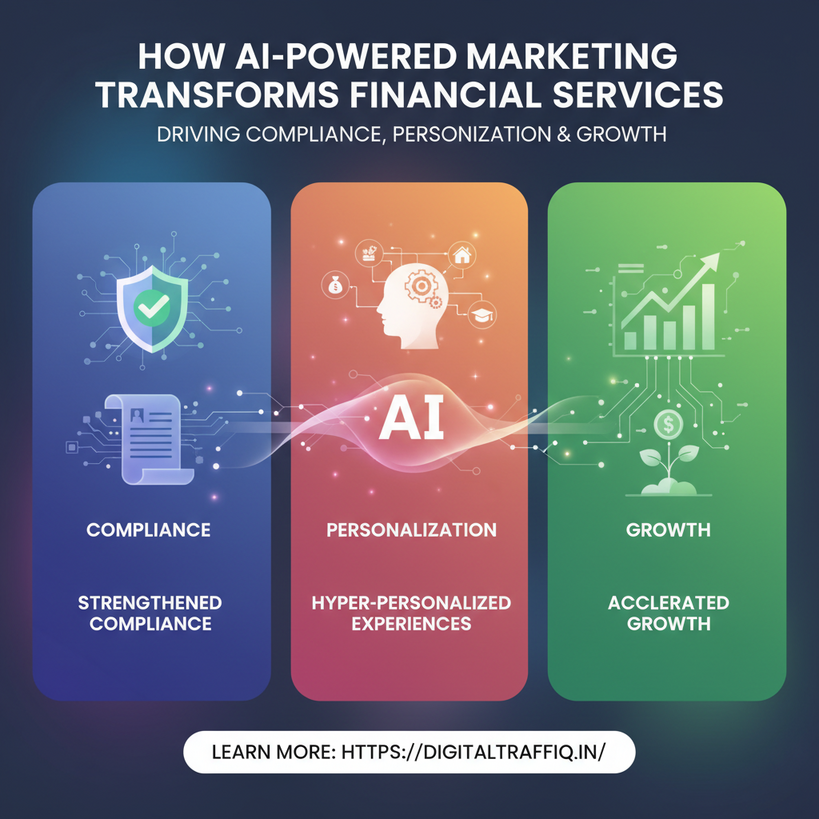
For decades, marketing in the financial services and FinTech sectors was a delicate balancing act. On one side, the relentless drive for client acquisition and growth. On the other, the immovable object of stringent regulatory compliance, data privacy laws, and the inherent need for trust. Traditional methods often forced a choice: be highly compliant but impersonal, or strive for personalization and risk regulatory missteps. This dichotomy is now dissolving, thanks to the strategic application of Artificial Intelligence. AI-powered marketing is not just another tool; it’s a paradigm shift, enabling firms to simultaneously strengthen compliance, deliver hyper-personalized experiences, and drive efficient client acquisition. For forward-thinking companies like Digital Traffiq, this represents the core of modern financial growth strategy.
The Compliance Conundrum: From Burden to Competitive Advantage
Financial marketing operates under a microscope. Every communication, advertisement, and client interaction must adhere to a complex web of regulations like FINRA, SEC guidelines, GDPR, and CCPA. Manual review processes are slow, expensive, and prone to human error. This is where regulatory marketing AI shines. Advanced AI systems can be trained on an organization’s specific compliance rules and broader regulatory frameworks.
Imagine an AI that pre-scans every marketing email, social media post, and blog content draft in real-time. It flags potential issues—unsubstantiated performance claims, missing risk disclosures, or non-compliant terminology—before anything goes live. This is financial services compliance automation in action. It transforms compliance from a reactive, bottleneck function into a seamless, integrated layer of the marketing workflow. The result? Faster time-to-market for campaigns, significantly reduced legal risk, and empowered marketing teams who can innovate with confidence, knowing a digital guardian is ensuring every output is audit-ready.
Hyper-Personalization at Scale: The End of One-Size-Fits-All Banking
Today’s clients expect experiences as tailored as their Netflix recommendations. Generic mass marketing is not just ineffective; it can damage brand perception in a relationship-driven industry. AI unlocks true personalized banking marketing by analyzing vast, permissioned datasets—transaction histories, life events inferred from behavior, channel preferences, and engagement patterns.
For wealth management, this means wealth management personalization that goes beyond addressing a client by name. An AI engine can identify when a client’s cash reserves exceed a certain threshold and trigger a personalized guide on short-term investment vehicles. It can sense a life event (like frequent searches for college funding) and deliver timely, relevant content on education savings plans. This depth of personalization fosters deeper loyalty and transforms the banking customer experience from transactional to advisory. AI doesn’t just segment audiences; it understands individuals, predicting needs and serving relevant solutions at the perfect moment in their financial journey.
Streamlining the First Impression: AI-Driven Client Onboarding
The onboarding process is a critical juncture where many potential clients are lost due to friction, complexity, or sheer boredom. AI-driven client onboarding reimagines this process. Chatbots and virtual assistants can guide users through form completion, document submission, and identity verification 24/7, answering questions in real-time.
More importantly, AI can use the data gathered during onboarding to immediately personalize the next steps. If a new client indicates an interest in sustainable investing during sign-up, their first welcome email and dashboard can already feature relevant ESG fund information and educational content. This creates a powerful “wow” effect, demonstrating attentiveness and sophistication from minute one, dramatically increasing activation and retention rates.
Intelligent Acquisition: Finding Quality Leads in a Noisy Market
Automated financial lead generation powered by AI moves far beyond simple contact scraping. AI models can analyze online behavior, content engagement, and firmographic data to build ideal customer profiles (ICPs) and then scour the digital landscape to find lookalike audiences with a high propensity to convert.
For AI for investment marketing, this means identifying professionals in specific industries with liquidity events on the horizon or tracking interest in alternative asset classes within niche online communities. The AI can then orchestrate multi-touch nurture campaigns tailored to these micro-segments, delivering whitepapers on tax-efficient investing to one group and webinars on venture capital opportunities to another. This ensures marketing spend is concentrated on high-intent, high-quality prospects, maximizing ROI and driving efficient FinTech customer acquisition.
Implementing AI-Powered Marketing: A Strategic Blueprint
Adopting this technology requires a thoughtful approach:
- Start with Data Integrity: AI is only as good as the data it consumes. Ensure clean, integrated, and compliant data flows from your CRM, website analytics, and marketing platforms.
- Define Clear Objectives: Are you prioritizing compliance efficiency, personalization lift, or lead quality? Start with a focused pilot project.
- Choose the Right Partners: Look for solutions, like those championed by Digital Traffiq, that are built with the financial sector’s regulatory reality in mind, not generic marketing tools retrofitted for finance.
- Foster Human-AI Collaboration: The goal is to augment your team’s creativity and strategic insight, not replace it. Marketers set the strategy; AI executes and optimizes at scale.
- Commit to Continuous Learning: Regularly review AI recommendations and outcomes. Refine models and rules to ensure they align with evolving business goals and regulatory changes.
The Future is Intelligent and Integrated
The convergence of AI and financial marketing is no longer a futuristic concept—it’s a present-day imperative. The firms that will lead in the coming decade are those that leverage AI not as a siloed tool, but as the central nervous system of their marketing and client engagement engine. They will achieve what was once considered impossible: marketing that is simultaneously more compliant, more personal, and more effective at driving growth.
By embracing AI FinTech marketing strategies, financial services and FinTech companies can build deeper trust through flawless compliance, create unmatched loyalty through anticipatory personalization, and achieve sustainable growth through intelligent acquisition. The era of choosing between safety and growth is over. The era of intelligent, AI-powered marketing that delivers both has begun.