
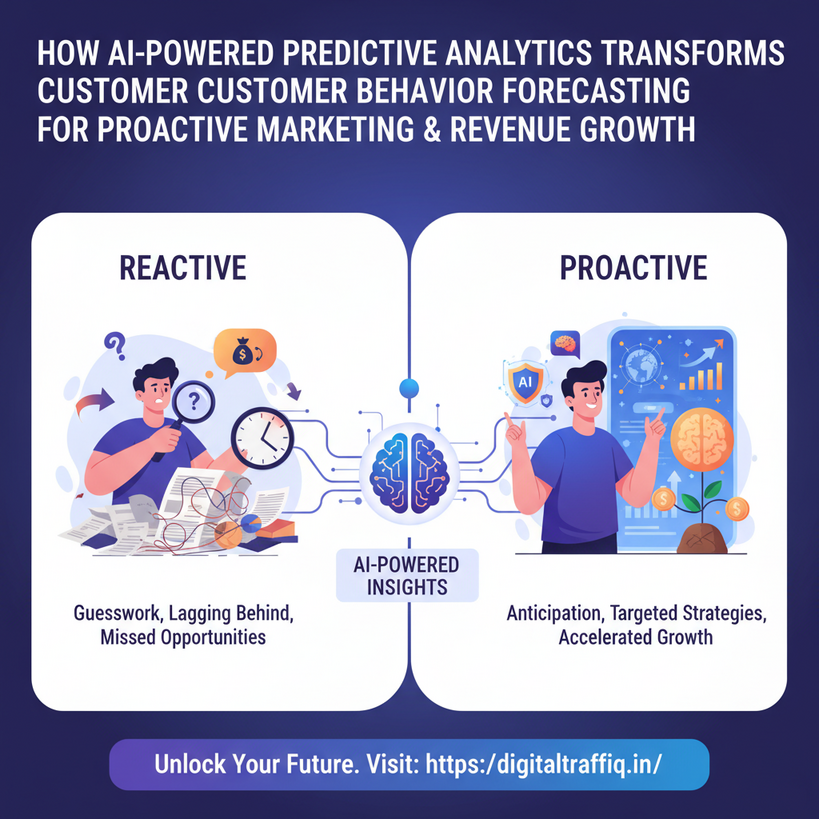
From Reactive to Proactive: How AI-Powered Predictive Analytics is Redefining Marketing Success
Estimated reading time: 6 minutes
Key Takeaways
- AI-powered predictive analytics shifts marketing from reacting to past behavior to forecasting future customer actions with high accuracy.
- Key applications include propensity modeling, churn prediction, and next-best-action recommendations, directly driving revenue growth.
- Successful implementation requires a solid data foundation, clear business objectives, and a closed-loop system for continuous AI learning.
- The tangible ROI spans increased marketing efficiency, accelerated revenue, enhanced customer experience, and stronger competitive advantage.
- The future of marketing is proactive, moving business strategy from guesswork to a discipline of calculated probability.
Table of Contents
- Understanding the Core: What is AI-Powered Predictive Analytics for Customer Behavior?
- The Strategic Shift: From Proactive Marketing to Revenue Growth Prediction
- Implementing AI Forecasting: A Framework for Success
- The Tangible Impact: Connecting Behavioral Trend Analysis to the Bottom Line
- The Future is Predictive: Your Next Step
In today’s hyper-competitive digital landscape, reacting to customer behavior is no longer enough. The brands that thrive are those that anticipate it. This shift from reactive to proactive marketing is powered by one transformative technology: Artificial Intelligence (AI) and its application in predictive analytics. For forward-thinking companies like Digital Traffiq, harnessing AI for customer behavior forecasting isn’t just a technological upgrade—it’s a fundamental strategic imperative that drives measurable revenue growth and creates unassailable competitive advantage.
Gone are the days of relying solely on historical data and intuition. AI-powered predictive analytics synthesizes vast, complex datasets—from browsing patterns and purchase history to social signals and real-time interactions—to forecast future customer actions with remarkable accuracy. This isn’t about crystal balls; it’s about mathematical probability, machine learning models, and deep behavioral science converging to illuminate the path ahead. Let’s explore how this technology is revolutionizing marketing from a cost center to a powerful growth engine.
Understanding the Core: What is AI-Powered Predictive Analytics for Customer Behavior?
At its heart, AI-powered predictive analytics uses machine learning algorithms to analyze current and historical data to identify patterns and predict future outcomes. In the context of customer behavior, this means moving beyond knowing what a customer did to understanding why they did it and, most importantly, what they will do next.
Key models include:
- Propensity Modeling: Predicting the likelihood of a specific action, such as making a purchase, churning, or upgrading a service.
- Customer Lifetime Value (CLV) Forecasting: Projecting the total revenue a business can expect from a single customer account.
- Next-Best-Action (NBA) Prediction: Determining the most effective message, offer, or channel for an individual at a precise moment in their journey.
- Demand Forecasting: Anticipating market demand for products or services at a granular level, optimizing inventory and marketing spend.
For businesses, this transforms vague notions of “customer intent” into quantifiable, actionable scores. It’s the difference between guessing and knowing.
The Strategic Shift: From Proactive Marketing to Revenue Growth Prediction
The true power of behavioral forecasting lies in its application. Proactive marketing, fueled by AI insights, allows businesses to intervene strategically in the customer journey.
1. Hyper-Personalized Campaigns That Convert
Generic email blasts are dead. Predictive marketing campaigns dynamically segment audiences not just by demographics, but by predicted behavior. AI can identify which customers are in a “buying window” for a specific product category. Marketing automation platforms can then trigger personalized content, offers, and retargeting ads precisely when the customer is most receptive, dramatically increasing conversion rates and ROI.
2. Dramatically Reducing Customer Churn
Revenue growth isn’t just about new acquisitions; it’s about retention. Predictive analytics can flag customers with a high churn risk score based on subtle behavioral shifts—decreased engagement, support ticket sentiment, or usage pattern changes. Proactive retention teams can then engage these at-risk customers with win-back offers, dedicated support, or personalized check-ins before they decide to leave, protecting recurring revenue streams.
3. Optimizing Pricing and Product Development
AI-driven demand forecasting provides a clear view of what customers will want, and what they’ll be willing to pay for it. This informs dynamic pricing strategies, inventory management, and even R&D roadmaps. By aligning product development with predicted behavioral trends, companies can reduce launch risk and ensure market fit from day one.
4. Supercharging Sales Efficiency
Sales teams equipped with customer intent prediction tools can prioritize leads that are “sales-ready.” AI scores leads based on their digital body language and engagement signals, allowing sales to focus efforts on prospects with the highest probability to close, shortening sales cycles and improving win rates.
Implementing AI Forecasting: A Framework for Success
Adopting AI-powered predictive analytics requires more than just buying software. It demands a strategic framework.
- Data Foundation: The accuracy of predictions is directly tied to the quality and breadth of data. Companies must integrate data from CRM, web analytics, marketing automation, support systems, and transactional databases into a unified customer view.
- Defining Clear Objectives: Start with a specific business goal: “Reduce churn by 15%” or “Increase cross-sell revenue by 20%.” This focuses the predictive model on a measurable outcome.
- Choosing the Right Models & Partners: Not all AI is created equal. Working with specialists like Digital Traffiq ensures you deploy models specifically tuned for marketing and sales outcomes, avoiding the pitfalls of generic, off-the-shelf solutions.
- Creating a Closed-Loop System: Predictions must fuel actions, and the results of those actions must feed back into the AI model to continuously learn and improve. This creates a virtuous cycle of increasing accuracy and effectiveness.
The Tangible Impact: Connecting Behavioral Trend Analysis to the Bottom Line
The return on investment (ROI) from AI customer insights is profound and multi-faceted:
- Increased Marketing ROI: By targeting the right person with the right message at the right time, marketing spend becomes exponentially more efficient.
- Accelerated Revenue Growth: Revenue forecasting automation provides more accurate pipelines, while proactive strategies unlock new revenue from existing customers through timely upsells and reduced churn.
- Enhanced Customer Experience: Proactive, personalized interactions make customers feel understood, fostering loyalty and increasing lifetime value.
- Competitive Insulation: Companies that can anticipate market shifts and customer needs can innovate faster and respond to competitors’ moves before they gain traction.
The Future is Predictive: Your Next Step
The era of reactive marketing is over. The future belongs to organizations that leverage AI-powered predictive analytics to navigate uncertainty with confidence. This technology moves business strategy from a game of chance to a discipline of calculated probability.
At Digital Traffiq, we specialize in transforming complex data into clear, actionable forecasts that drive proactive marketing and tangible revenue growth. Our expertise lies in building custom predictive models that integrate seamlessly into your marketing and sales workflows, turning insight into outcome.
Don’t just track your customers’ past—start building their future, and yours. The key to next quarter’s growth isn’t in your rearview mirror; it’s in the predictive insights waiting to be unlocked in your data today.