
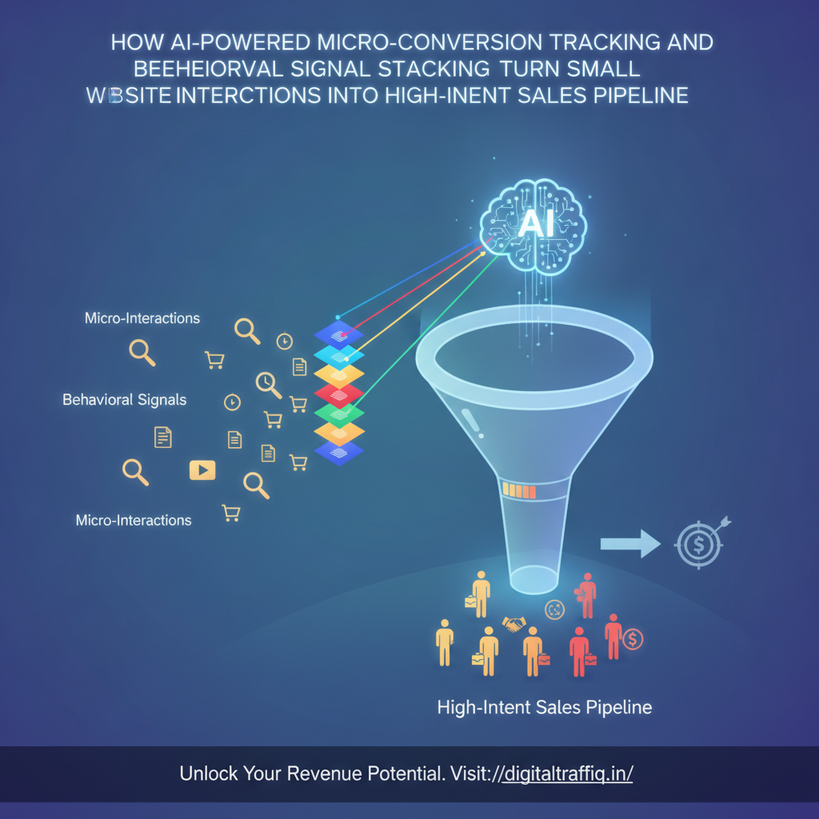
How AI-Powered Micro-Conversion Tracking and Behavioral Signal Stacking Turn Small Website Interactions into High-Intent Sales Pipeline
Estimated Reading Time: 8 minutes
Key Takeaways
- Micro-conversions are the small interactions—scrolls, hovers, return visits—that signal true buyer intent long before a form fill.
- Behavioral signal stacking AI aggregates multiple micro-signals into a single predictive intent score, giving sales teams a real-time prioritization engine.
- AI-powered intent signal detection continuously learns from data, improving lead scoring accuracy and shortening sales cycles.
- Behavioral segmentation AI enables personalization at scale, fast-tracking high-intent prospects while nurturing medium-intent ones.
- Conversion path analytics AI reveals which micro-moment sequences drive revenue, allowing marketers to optimize deliberately.
Table of Contents
- The Limitations of Traditional Conversion Tracking
- What Are Micro-Conversions and Why Do They Matter?
- Behavioral Signal Stacking: The Secret Sauce
- How AI-Powered Intent Signal Detection Works
- Data Collection and Integration
- Signal Processing and Scoring
- Real-Time Automation
- The Role of Conversion Path Analytics AI
- Behavioral Segmentation AI: Personalization at Scale
- AI-Driven Pipeline Acceleration
- Real-World Applications
- Conclusion
In today’s digital landscape, the buyer’s journey is rarely a straight line. It’s a series of small, often overlooked interactions—a scroll, a hover, a return visit—that collectively signal a prospect’s true intent. Traditional conversion tracking focuses on the finish line: form fills, demo requests, and purchases. But what about the hundreds of micro-moments that lead up to those actions? This is where AI micro-conversion tracking and behavioral signal stacking AI are revolutionizing how businesses identify and nurture high-intent leads.
At Digital Traffiq, we specialize in harnessing these subtle signals to build a robust, high-intent sales pipeline. By leveraging micro-conversion analytics and AI-powered intent signal detection, we help companies transform anonymous website visitors into sales-ready prospects. In this article, we’ll explore how this technology works and why it’s essential for modern marketing and sales teams.
The Limitations of Traditional Conversion Tracking
For years, marketers have relied on macro-conversions—newsletter sign-ups, contact form submissions, and purchases—to gauge campaign success. While these are important, they represent only a fraction of the buyer’s journey. Most visitors leave without converting, and their valuable behavioral data is lost. This creates a blind spot: you miss the opportunity to engage prospects who are interested but not yet ready to commit.
Moreover, traditional tracking often fails to capture the nuances of website behavior tracking AI can reveal. It doesn’t account for the sequence of pages viewed, time spent on specific sections, or the frequency of visits. Without this context, lead scoring becomes a guessing game, and sales teams waste time on low-intent leads while high-intent prospects slip through the cracks.
What Are Micro-Conversions and Why Do They Matter?
Micro-conversions are small, incremental actions that indicate engagement and interest. Examples include:
- Scrolling to the bottom of a blog post
- Clicking on a product detail page
- Watching a video for more than 30 seconds
- Downloading a gated asset (e.g., whitepaper, case study)
- Adding an item to cart without purchasing
- Returning to the site multiple times within a short window
Individually, these actions may seem insignificant. But when aggregated and analyzed over time, they form a powerful pattern that reveals a prospect’s level of interest. Micro-conversion analytics uses AI to track and quantify these micro-moments, providing a granular view of the buyer’s journey.
Behavioral Signal Stacking: The Secret Sauce
Behavioral signal stacking AI takes micro-conversion tracking to the next level. Instead of viewing each action in isolation, AI algorithms stack multiple signals—such as page views, time on site, content downloads, and referral sources—to create a comprehensive behavioral profile. This stacking process enables predictive buyer intent scoring, where the system assigns a score to each visitor based on the likelihood they are ready to engage with sales.
For example, a visitor who reads three blog posts, watches a product demo, and returns to the pricing page twice within a week is exhibiting high-intent behavior. AI-powered signal stacking detects this pattern and flags the prospect as sales-ready. Conversely, a visitor who bounces after 10 seconds is scored low. This real-time scoring allows sales teams to prioritize outreach effectively.
How AI-Powered Intent Signal Detection Works
At the core of this technology is AI-powered intent signal detection. Machine learning models are trained to recognize patterns in website behavior that correlate with purchase intent. These models continuously learn from data, improving their accuracy over time. Key components include:
1. Data Collection and Integration
AI systems collect data from various sources—website analytics, CRM, email marketing, and ad platforms—and integrate it into a unified customer profile. This holistic view is essential for accurate intent detection.
2. Signal Processing and Scoring
Advanced algorithms process the data to identify meaningful signals. AI lead scoring micro-signals such as repeat visits, content engagement depth, and referral source quality are weighted and combined to produce a real-time intent score.
3. Real-Time Automation
Real-time intent scoring automation triggers actions based on the score. For instance, a high-intent prospect might receive a personalized email or a retargeting ad, while a low-intent prospect enters a nurturing sequence. This automation ensures timely follow-up and maximizes conversion opportunities.
The Role of Conversion Path Analytics AI
Conversion path analytics AI maps the journey a visitor takes from first touch to conversion. By analyzing the sequence of micro-conversions, AI identifies which paths are most effective at driving sales. This insight allows marketers to optimize their website and campaigns for the behaviors that matter most.
For example, if data shows that visitors who watch a specific video are 3x more likely to convert, you can prioritize that video in your content strategy. Similarly, if a particular page sequence leads to high-intent scores, you can create similar pathways for other visitors.
Behavioral Segmentation AI: Personalization at Scale
Behavioral segmentation AI groups visitors based on their micro-conversions and intent scores. This segmentation enables personalized marketing at scale. Instead of treating all visitors the same, you can tailor messaging, offers, and content to specific segments. High-intent segments can be fast-tracked to sales, while medium-intent segments receive educational content to nurture them further.
AI-Driven Pipeline Acceleration
By identifying high-intent lead detection AI early, sales teams can focus their efforts on prospects most likely to convert. This AI-driven pipeline acceleration shortens sales cycles and increases win rates. Moreover, the continuous learning of AI models ensures that your pipeline gets smarter over time, adapting to changing buyer behaviors.
Real-World Applications
Consider an e-commerce company that sells high-ticket items. Traditional tracking might show a 2% conversion rate. But with AI micro-conversion tracking, the company discovers that visitors who compare three specific products and read customer reviews are 10x more likely to purchase. Armed with this insight, they can trigger a chat invitation or offer a discount to these high-intent visitors, boosting conversions.
Or think of a B2B software firm. By tracking micro-conversions like whitepaper downloads and webinar attendance, AI identifies a segment of leads who are actively researching solutions. The sales team can then prioritize these leads, resulting in a 30% increase in qualified meetings.
Conclusion
The future of lead generation lies in the ability to decode small interactions and turn them into actionable intelligence. AI micro-conversion tracking and behavioral signal stacking are not just buzzwords—they are essential tools for any business looking to build a high-intent sales pipeline. At Digital Traffiq, we are at the forefront of this technology, helping our clients leverage AI marketing signal intelligence to gain a competitive edge.
If you’re ready to stop guessing and start capitalizing on every micro-moment, contact Digital Traffiq today. Let us help you transform your website interactions into a predictable revenue engine.