
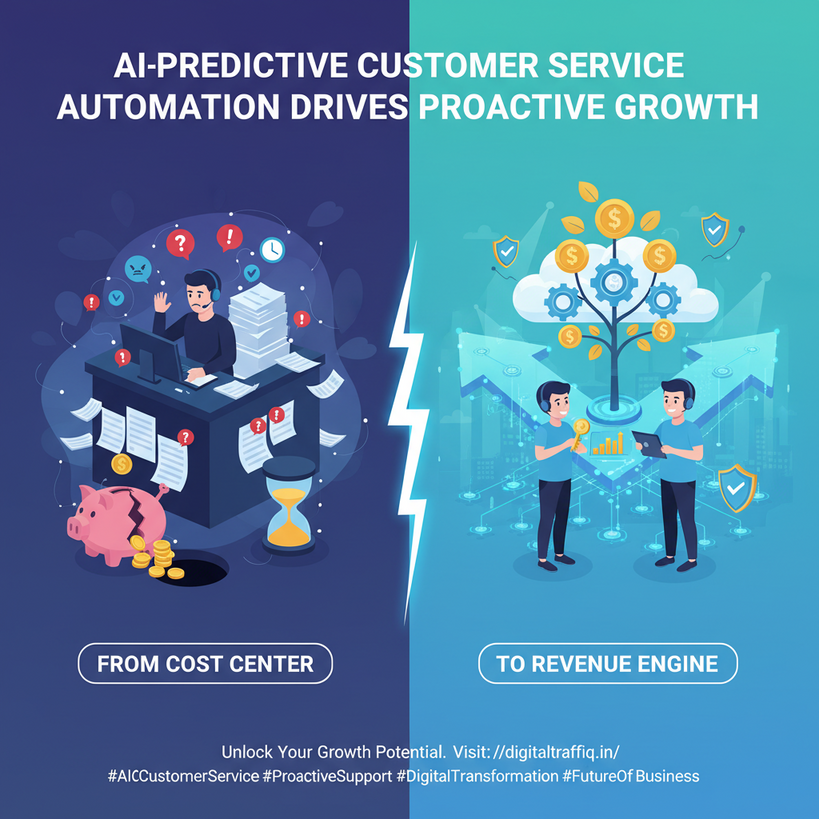
The End of Reactive Support: Why AI-Powered Proactivity is the New Competitive Frontier
Estimated reading time: 6 minutes
Key Takeaways
- Shift from Cost Center to Revenue Channel: Modern customer service, powered by AI, can be transformed from a reactive expense into a proactive, profit-generating engine.
- Predictive Issue Resolution is Key: AI can analyze customer behavior to identify and resolve problems before the customer even notices, preventing frustration and tickets.
- Guide Customers to Value: Proactive support uses contextual data to offer timely, helpful guidance on upgrades or features, driving adoption and revenue.
- Monetize the Experience: Proactive strategies directly impact revenue through churn reduction, accelerated upselling, and the creation of brand advocates.
- Implementation is Phased: Success requires data unification, starting with high-impact scenarios, choosing the right AI platform, and measuring business-outcome metrics.
Table of Contents
For decades, customer service has been viewed through a singular, costly lens: a necessary expense. A reactive department that fields complaints, solves problems after they occur, and measures success by how quickly it can close tickets. But what if this entire paradigm is not just outdated, but actively holding your business back? At Digital Traffiq, we see a different reality. We see customer service not as a cost center, but as the most potent, underutilized revenue channel in your organization. The key to unlocking this potential lies in shifting from a reactive stance to a predictive, proactive model powered by Artificial Intelligence.
The Broken Reactive Model
The traditional support model is fundamentally broken. It operates on a break-fix cycle, waiting for the customer to experience friction—a dropped call, a bug, a billing confusion—before springing into action. This approach, while sometimes efficient at resolving individual issues, is a net negative for the business. It leads to customer frustration, brand erosion, and churn. More critically, it misses countless opportunities to deepen relationships, drive adoption, and uncover new revenue streams at the very moment a customer is most engaged.
AI-powered predictive customer service automation shatters this old model. By leveraging machine learning, natural language processing, and vast datasets of customer behavior and interaction history, businesses can now anticipate needs, resolve issues before they become problems, and guide customers toward greater success and spending. This isn’t just about faster chatbots; it’s about building an intelligent, autonomous system that transforms every support touchpoint into a strategic, value-creating interaction.
Beyond the Ticket Queue: The Core Pillars of Predictive, Proactive Support
Transforming support into a revenue-generating support function requires a foundational shift. It’s built on three interconnected pillars that move you from hindsight to foresight.
1. Predictive Issue Resolution: Stopping Problems Before They Start
Imagine a system that analyzes a user’s interaction patterns with your software. It notices they’ve repeatedly clicked on a specific feature but abandoned the process halfway through three times in a week. Instead of waiting for a frustrated support ticket titled “Feature X not working,” an intelligent support automation system triggers a proactive intervention. This could be an in-app message with a tailored tutorial video, an automated email offering a live walkthrough, or even a direct alert to a customer success manager.
This is predictive issue resolution in action. By analyzing behavioral data, purchase history, support ticket trends, and even sentiment in communications, AI models can identify patterns that precede common problems—from technical glitches to confusion about pricing tiers. The system then automates a personalized resolution path, dramatically reducing ticket volume while simultaneously improving the customer’s experience and perception of your brand’s competence.
2. Contextual, Automated Guidance Toward Value
Proactive support isn’t just about preventing bad experiences; it’s about architecting great ones that drive business outcomes. AI-powered customer success tools can identify when a customer is primed for an upgrade or an add-on service. For instance, if a user is consistently hitting their storage limit or utilizing a basic feature at an enterprise scale, the system can automatically deliver contextual guidance.
This could be a notification that says, “We see you’re getting great value from Feature Y. Our Pro plan unlocks advanced analytics for this tool, which could help you achieve [specific outcome]. Would you like to see a quick demo?” This moves the interaction from a generic sales pitch to a timely, value-based recommendation embedded within the support framework. It feels like helpful guidance, not sales pressure, because it is rooted in real usage data and a genuine desire for the customer to succeed.
3. Monetizing the Customer Experience Through Intelligence
This leads to the ultimate goal: customer experience monetization. When support becomes proactive and intelligent, every interaction becomes an opportunity to reinforce value, reduce churn, and increase lifetime value (LTV). The revenue impact is multi-faceted:
- Churn Reduction: By predicting and addressing dissatisfaction before a customer decides to leave, you protect your recurring revenue base. This is direct revenue preservation.
- Upsell/Cross-sell Acceleration: By identifying expansion opportunities in real-time and facilitating them through automated, context-rich workflows, you shorten sales cycles and increase average revenue per user (ARPU).
- Brand Advocacy Creation: A customer who is consistently delighted by unexpectedly smooth and helpful service becomes a promoter. This drives referral revenue and lowers customer acquisition costs (CAC).
The support team, armed with AI support analytics, transitions from firefighters to strategic growth advisors. They have a dashboard showing them not just ticket backlog, but predictive churn risk scores, expansion opportunity alerts, and customer health trends.
Implementing Your Proactive Revenue Channel: A Strategic Blueprint
Building this future-state support engine doesn’t happen overnight, but a phased, strategic approach makes it achievable.
- Data Unification & Analysis: The fuel for AI is data. The first step is to break down silos between your CRM, support ticketing system, product analytics, and billing platform. Create a unified customer profile. Analyze historical data to identify the most common precursors to tickets, churn, and upgrades.
- Start with High-Impact, Predictable Scenarios: Don’t boil the ocean. Identify 2-3 frequent, high-friction issues that are highly predictable (e.g., “onboarding stall after day 3,” “confusion before monthly billing,” “feature usage drop-off”). Build your initial proactive support automation rules and campaigns around these.
- Choose and Integrate the Right AI Platform: This is where a partner like Digital Traffiq provides immense value. You need a platform that can ingest your data, run predictive models, and execute automated workflows across email, in-app messaging, and even direct human handoffs. Look for solutions focused on automated support monetization and outcomes, not just ticket deflection.
- Measure the Right Metrics: Abandon traditional metrics like “first response time” as your north star. Shift to business-outcome metrics:
- Predictive Ticket Volume Avoidance
- Customer Health Score Trends
- Impact on Net Revenue Retention (NRR)
- Upsell/Cross-sell Attribution to Support Interactions
- Iterate and Expand: Use the insights from your initial campaigns to refine your models and expand your proactive net to more customer journey stages and more complex use cases.
The Future is Proactive: Your Support Team as Growth Architects
The transformation to preemptive customer service is no longer a futuristic concept; it’s a present-day imperative for businesses that want to compete on experience and efficiency. The technology is here, and the ROI is clear: reduced operational costs, protected revenue, and new revenue creation—all stemming from the same department once seen only as an expense.
At Digital Traffiq, we specialize in helping tech-driven and service-based businesses architect this very future. We build and implement the intelligent systems that turn customer interactions into predictable growth. We move you from waiting for the phone to ring to strategically guiding each customer toward their—and your—greatest possible success.
The question is no longer if you should adopt AI-powered predictive customer service, but how quickly you can start the journey. The gap between the reactive and the proactive is where your next major competitive advantage—and revenue stream—is waiting to be captured.