
“`html
Beyond the Blast: Why AI-Powered Personalization is Your Ultimate Growth Lever
Estimated reading time: 6 minutes
Key Takeaways
- AI personalization dramatically increases conversion rates without increasing ad spend
- 80% of consumers are more likely to purchase from brands offering personalized experiences
- Personalized calls-to-action convert 202% better than default versions
- AI enables micro-segmentation beyond basic demographics for hyper-targeted marketing
- Implementation drives higher conversion rates, increased AOV, and improved customer lifetime value
Table of Contents
- What is AI Personalization in Modern Marketing?
- The Direct Link Between Personalization and Conversion Rate Optimization
- Key Strategies for Implementing AI-Driven Personalization
- Measuring Success: The Tangible ROI of AI Personalization
- Getting Started with Your AI-Personalization Strategy
- Conclusion: Stop Spending More, Start Converting Smarter
You’ve optimized your campaigns, A/B tested your ad copy, and refined your target demographics. Yet, your conversion rates have plateaued, and the thought of increasing your ad budget to force growth is a painful one. You’re not alone. In today’s saturated digital landscape, the traditional ‘spray and pray’ approach is not just inefficient; it’s a fast track to burning through your marketing budget with diminishing returns.
The solution isn’t shouting louder; it’s speaking more personally. This is where AI-powered personalization transforms from a buzzword into your most powerful competitive advantage. It’s the strategic lever that allows you to dramatically increase conversion rates without increasing your ad spend. By delivering the right message to the right person at the right time, you move beyond generic marketing and into the realm of one-to-one customer experiences that drive action.
What is AI Personalization in Modern Marketing?
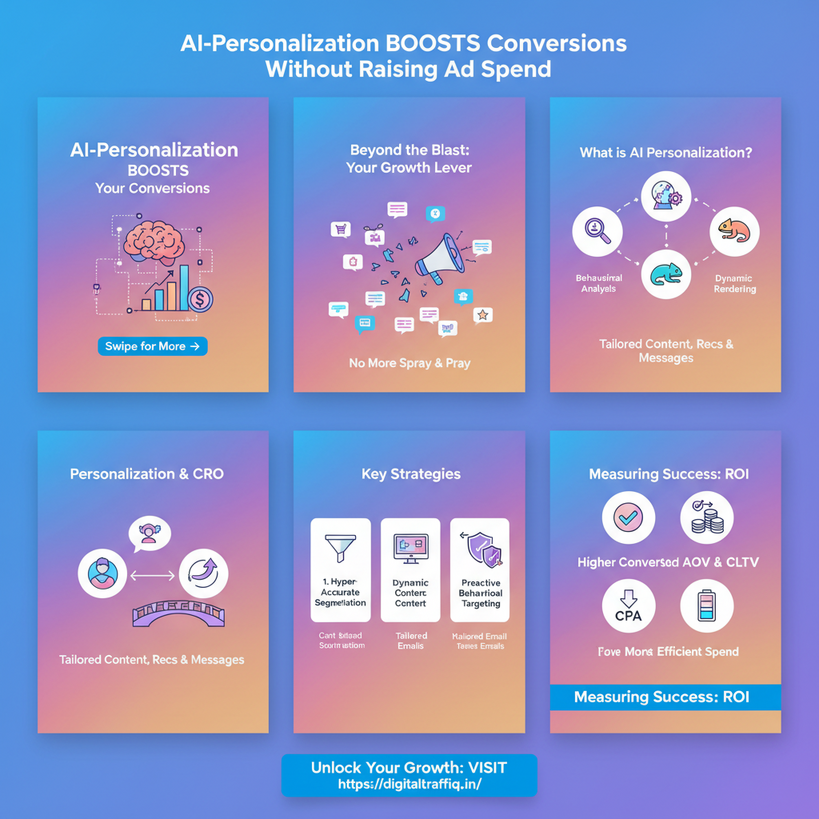
At its core, AI-powered personalization is the use of machine learning algorithms and real-time data analysis to deliver uniquely tailored content, product recommendations, and marketing messages to individual users. It goes far beyond simply inserting a first name into an email.
True AI personalization involves:
- Behavioral Analysis: Tracking user interactions like pages visited, time on site, items clicked, and past purchases.
- Predictive Modeling: Anticipating a user’s future needs and interests based on their behavior and similar user profiles.
- Dynamic Content Rendering: Automatically altering website copy, banners, offers, and product displays for each visitor.
This isn’t a distant future concept; it’s the driving force behind the success of platforms like Netflix and Amazon. The good news is that these capabilities are now accessible to businesses of all sizes through advanced marketing platforms.
The Direct Link Between Personalization and Conversion Rate Optimization
Why does personalization work so effectively? The answer lies in fundamental human psychology and the principles of conversion rate optimization (CRO). When a potential customer feels understood, their resistance lowers, and their engagement skyrockets.
Consider these statistics:
- 80% of consumers are more likely to make a purchase from a brand that provides personalized experiences. (Epsilon)
- Personalized calls-to-action convert 202% better than default versions. (HubSpot)
AI supercharges this process. Instead of manual customer segmentation based on broad demographics (e.g., “women aged 25-40”), AI enables micro-segmentation. It can identify nuanced audiences like “users who abandoned a cart after viewing high-end product reviews” or “visitors who read three blog posts about a specific service.” This level of granularity is the bedrock of high-converting personalized marketing campaigns.
Key Strategies for Implementing AI-Driven Personalization
So, how do you put this into practice without a team of data scientists? Here are the core strategies that deliver the highest ROI optimization.
1. Hyper-Accurate AI Customer Segmentation
Move beyond basic demographics. Use AI to analyze user data and create dynamic segments in real-time. These can include:
- Engagement Level: First-time visitors vs. returning loyalists.
- Purchase Intent: Users showing high-intent signals like repeated visits to a pricing page.
- Content Affinity: Grouping users based on the type of content they consume most.
By understanding these micro-segments, you can tailor your entire marketing funnel to address their specific needs and pain points.
2. Dynamic Content Personalization Across Channels
This is where the magic happens. Dynamic content personalization means your website and ads are no longer static. They become fluid experiences that adapt. Examples include:
- Website Personalization: Showing returning visitors a homepage banner featuring products they previously viewed or complementary items.
- Personalized Email Sequences: Triggering an email with a specific guide or case study based on a download or page view.
- Retargeting Ads with a Twist: Instead of just showing the product a user looked at, show them that product alongside items frequently bought together by similar customers.
3. Proactive Behavioral Targeting and Predictive Offers
AI can identify patterns that are invisible to the human eye. Through behavioral targeting, you can intervene at critical moments to guide a user toward conversion.
For instance, if AI detects a user is about to abandon their cart (based on mouse movement and time on page), it can instantly trigger a pop-up with a limited-time free shipping offer. This proactive approach, driven by predictive analytics, rescues sales that would otherwise be lost.
Measuring Success: The Tangible ROI of AI Personalization
The ultimate goal is ROI optimization. When implemented correctly, AI personalization impacts every key metric in your marketing dashboard:
- Higher Conversion Rates: More relevant experiences lead directly to more purchases, sign-ups, and leads.
- Increased Average Order Value (AOV): Effective cross-selling and up-selling through personalized recommendations.
- Improved Customer Lifetime Value (CLV): Personalized experiences foster loyalty, turning one-time buyers into brand advocates.
- Lower Cost Per Acquisition (CPA): By converting more of your existing traffic, you reduce your reliance on expensive new customer acquisition campaigns.
This last point is critical. By focusing on converting more of the traffic you already have, you achieve growth without demanding a larger ad budget. You are simply making your current spend infinitely more efficient.
Getting Started with Your AI-Personalization Strategy
Transitioning to an AI-driven customer experience may seem daunting, but it’s a journey of incremental steps. Start by auditing your current data collection. Then, identify one high-impact area to personalize, such as your email welcome series or your homepage for logged-in users.
The key is to begin. The data you collect from these initial efforts will fuel more sophisticated personalization down the line, creating a powerful, self-improving cycle of engagement and conversion.
Conclusion: Stop Spending More, Start Converting Smarter
In the race for customer attention, the most efficient path to growth isn’t a bigger megaphone. It’s a more attentive ear. AI-powered personalization is the tool that allows you to listen at scale and respond with relevance. It represents the pinnacle of modern conversion rate optimization—a way to respect your audience’s individuality while dramatically improving your bottom line.
By harnessing the power of AI to deliver truly personalized journeys, you can break through the plateau, unlock new levels of efficiency, and drive higher conversion rates without ever asking for a larger ad budget. The future of marketing is not broad; it’s deeply, intelligently personal.
“`