
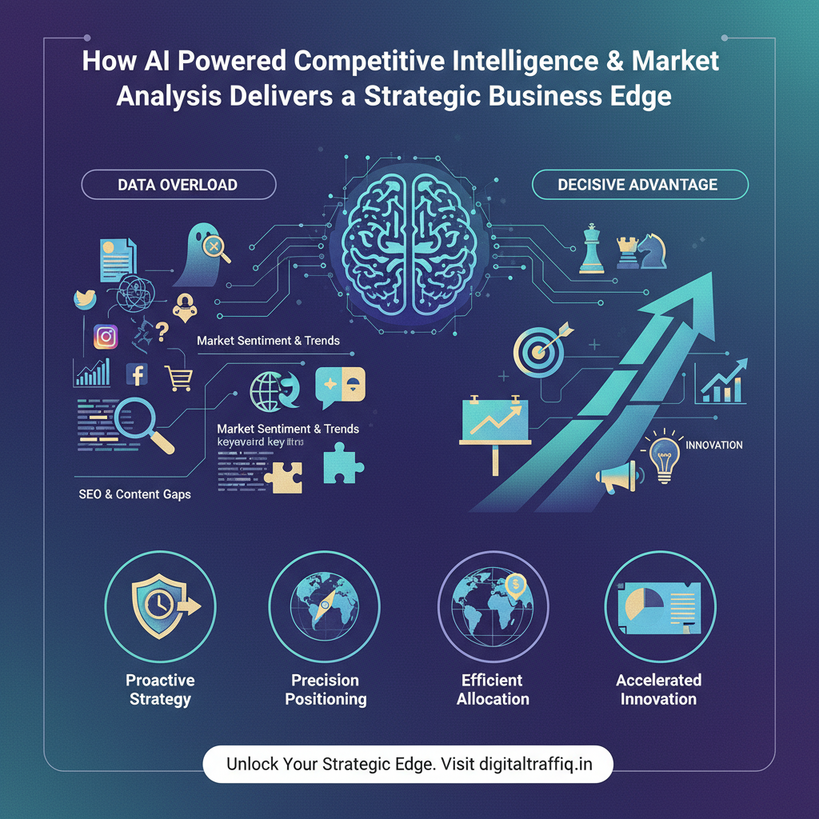
From Data Overload to Decisive Advantage: The AI Revolution in Competitive Intelligence
Estimated reading time: 5-7 minutes
Key Takeaways:
- AI-powered competitive intelligence automates the collection and analysis of vast market data, moving beyond basic monitoring to predictive insights.
- It enables proactive strategy, precise market positioning, efficient resource allocation, and accelerated innovation.
- A robust system integrates NLP, machine learning, data aggregation, and automated reporting.
- Successful implementation follows a phased roadmap: define objectives, identify data sources, select tools, establish workflows, and continuously refine.
- The future lies in predictive analytics, transforming intelligence into strategic foresight for a sustainable competitive edge.
Table of Contents
- What is AI-Powered Competitive Intelligence? Beyond Basic Monitoring
- The Tangible Benefits: Turning Insights into Actionable Outcomes
- Key Components of a Robust AI Competitive Intelligence System
- Implementing AI-Driven Competitive Intelligence: A Practical Roadmap
- The Future is Predictive: From Intelligence to Foresight
- Conclusion: The Strategic Edge is No Longer Optional
In today’s hyper-competitive digital landscape, simply knowing your competitors exist is no longer enough. The real challenge lies in understanding their every move, anticipating market shifts before they happen, and uncovering hidden opportunities that others miss. Traditional market research methods—manual data scraping, periodic reports, and gut-feel analysis—are too slow, too expensive, and too fragmented to keep pace. This is where a paradigm shift is occurring. AI-powered competitive intelligence is transforming raw data into a crystal-clear strategic roadmap, giving forward-thinking businesses an unprecedented edge. At Digital Traffiq, we see this not as a mere tool, but as the new foundational layer for AI-driven strategy and sustainable growth.
What is AI-Powered Competitive Intelligence? Beyond Basic Monitoring
At its core, AI competitive intelligence is the application of artificial intelligence and machine learning to automate the collection, analysis, and interpretation of vast amounts of data about your market, competitors, and customers. It moves far beyond setting up Google Alerts for a competitor’s name. Imagine a system that continuously tracks:
- Competitor Digital Footprints: Real-time changes to pricing, product features, promotional campaigns, and content strategies.
- Market Sentiment & Trends: Analyzing social media, review sites, and news to gauge brand perception and emerging consumer needs.
- SEO & Content Gaps: Identifying keywords your competitors rank for but you don’t, and uncovering topics they’ve missed entirely.
- Advertising Strategies: Deciphering the targeting, messaging, and spend behind competitors’ paid search and social ads.
This system doesn’t just collect data; it connects the dots. Through business intelligence automation, it identifies patterns, predicts likely competitor moves, and surfaces actionable insights, transforming information overload into a coherent strategic narrative.
The Tangible Benefits: Turning Insights into Actionable Outcomes
Adopting an AI market research approach delivers concrete advantages that directly impact your bottom line and strategic positioning.
1. Proactive, Not Reactive, Strategy
Instead of reacting to a competitor’s surprise product launch, AI tools can detect early signals—like patent filings, talent acquisitions in specific domains, or shifts in R&D spending—allowing you to prepare or counter effectively. This shifts your posture from defensive to opportunistic.
2. Precision in Market Positioning
Market positioning AI helps you understand the precise niches your competitors own and, more importantly, the whitespace they ignore. You can identify underserved customer segments, unmet needs, and messaging angles that resonate uniquely, allowing you to carve out a distinct and defensible market position.
3. Hyper-Efficient Resource Allocation
Why spend six figures on a marketing campaign in a channel where your main competitor dominates? Competitor tracking AI reveals where your rivals are winning and where they are vulnerable. You can reallocate budget to high-opportunity, lower-competition areas, ensuring maximum ROI for every dollar spent.
4. Accelerated Innovation and Opportunity Identification
By analyzing customer complaints about competitor products or gaps in their service offerings, AI uncovers direct opportunities for innovation. This strategic marketing insight fuels product development and service enhancements that are directly aligned with market demand.
Key Components of a Robust AI Competitive Intelligence System
Not all competitive analysis tools are created equal. A sophisticated platform, like the solutions Digital Traffiq leverages, integrates several key components:
- Natural Language Processing (NLP): To understand the context, sentiment, and themes within unstructured data from news articles, social posts, and forum discussions.
- Machine Learning Models: To predict trends, classify data automatically, and improve accuracy over time by learning what insights are most valuable to your business.
- Data Aggregation & Fusion: Pulling together data from dozens of disparate sources (web, social, review sites, financial databases) into a single, unified dashboard.
- Automated Reporting & Alerting: Delivering tailored insights directly to decision-makers via digestible reports or real-time alerts on critical developments.
Implementing AI-Driven Competitive Intelligence: A Practical Roadmap
Getting started doesn’t require a complete overhaul of your business processes. A phased approach ensures alignment and measurable value.
- Define Strategic Objectives: Start by asking, “What do we need to know to win?” Is it about pricing, feature development, content strategy, or geographic expansion? Your goals dictate what the AI should monitor.
- Identify Critical Data Sources: Work with experts to map the digital and market landscapes relevant to your industry. This includes key competitor websites, industry forums, specific social channels, and relevant news outlets.
- Select & Configure the Right Tools: Choose a platform that balances power with usability. It should be configurable to your specific KPIs and integrate with your existing business intelligence systems.
- Establish an Insights-to-Action Workflow: The greatest insight is useless if it doesn’t reach the right person. Create a process where marketing, sales, product, and executive teams receive and can act on the intelligence provided.
- Continuously Refine and Iterate: AI-driven strategy is a cycle, not a one-time project. Regularly review the insights generated, refine your tracking parameters, and measure the business impact of decisions made from the intelligence.
The Future is Predictive: From Intelligence to Foresight
The next evolution of AI competitive intelligence is predictive analytics. We’re moving from describing what happened to forecasting what *will* happen. Advanced systems will model potential competitor responses to your strategic moves, simulate market reactions to pricing changes, and identify future market disruptions with increasing accuracy. This transforms competitive intelligence from a tactical support function into the central nervous system of corporate strategy.
Conclusion: The Strategic Edge is No Longer Optional
In an era defined by data, the competitive advantage AI provides is the difference between leading the market and struggling to keep up. AI-powered competitive intelligence and market analysis democratize strategic insight, making what was once the domain of large corporations with massive research budgets accessible to agile businesses of all sizes.
At Digital Traffiq, we specialize in implementing these advanced competitive analysis tools and frameworks. Our mission is to empower businesses with the clarity and confidence that comes from truly understanding their battlefield. By automating the grind of data collection and analysis, we free you to focus on what humans do best: making strategic decisions, fostering innovation, and building deeper customer relationships.
The question is no longer if you should adopt AI for market intelligence, but how quickly you can implement it to secure your own unassailable strategic edge. The market waits for no one.