
The Future of Growth is Automated: How AI is Revolutionizing Customer Acquisition
Estimated reading time: 5 minutes
Key Takeaways
- AI-powered automation transforms chaotic marketing into a predictable, data-driven growth engine, moving beyond simple task automation into intelligent decision-making.
- It creates unfair advantages at every funnel stage: from intelligent prospecting and personalized nurturing at scale to precision sales enablement.
- The tangible ROI includes reduced Customer Acquisition Cost (CAC), increased conversion rates, improved sales productivity, and enhanced customer lifetime value.
- Successful implementation requires a strategic blueprint: a solid data foundation, starting with a pilot, choosing the right platform, maintaining the human touch, and continuous optimization.
- The future belongs to businesses that build a self-optimizing marketing funnel automation system, shifting marketing from a cost center to a core revenue driver.
Table of Contents
In today’s hyper-competitive digital landscape, the traditional marketing playbook is no longer enough. Manual prospecting, generic email blasts, and guesswork-based targeting are being rapidly eclipsed by a new paradigm: intelligent, automated, and hyper-efficient customer acquisition. For forward-thinking businesses, the question is no longer if they should adopt automation, but how to leverage it to build a predictable, scalable, and highly profitable growth engine. This is where AI-powered customer acquisition automation emerges as the definitive game-changer, transforming chaotic marketing efforts into a streamlined, data-driven process that consistently maximizes return on investment (ROI).
At its core, AI-powered customer acquisition automation is the strategic application of artificial intelligence and machine learning to automate and optimize every stage of the marketing and sales funnel—from initial awareness to final conversion and beyond. It moves beyond simple task automation (like scheduling social posts) into the realm of intelligent decision-making. The system learns, adapts, and executes in real-time, ensuring that your marketing resources are always focused on the highest-potential opportunities. For companies like Digital Traffiq, this represents the culmination of modern marketing technology, where data isn’t just collected—it’s actively orchestrated to drive growth.
Deconstructing the Funnel: Where AI Automation Creates Unfair Advantages
To understand the transformative power of this technology, let’s walk through a modern marketing funnel and see how AI-driven automation optimizes each critical phase.
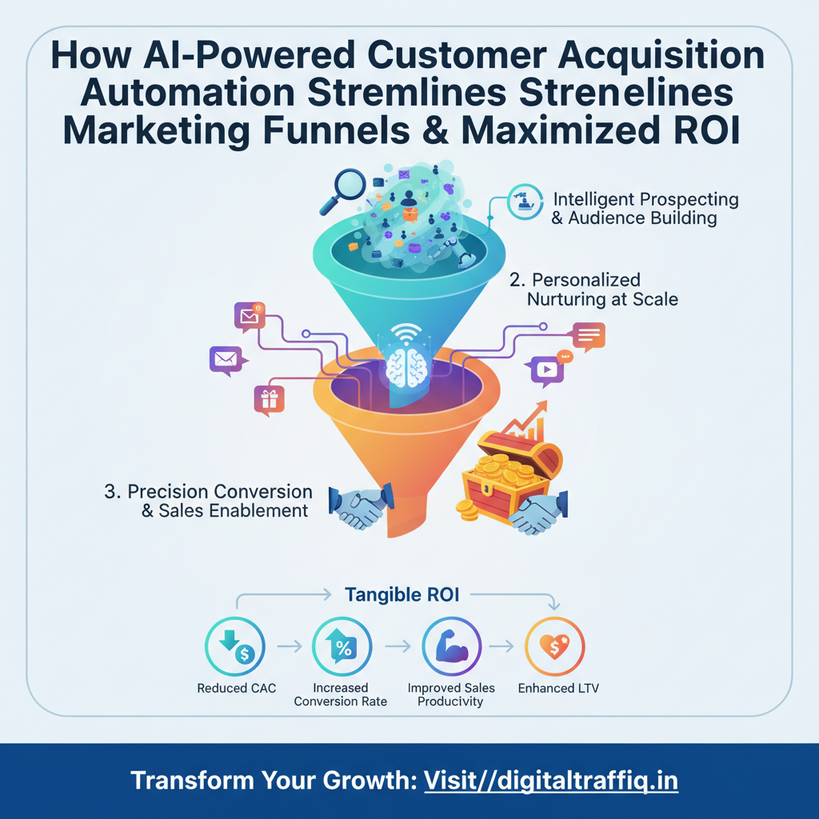
1. Top of Funnel: Intelligent Prospecting & Audience Building
Gone are the days of buying broad, unqualified email lists. AI-driven prospecting uses predictive analytics and intent data to identify your ideal customer profile (ICP) across the web. It can analyze firmographic, technographic, and behavioral signals to build a dynamic list of prospects who are not just a demographic match, but are showing active signs of need. This is automated lead capture at its most sophisticated—continuously scanning for and engaging potential customers based on their digital footprint, ensuring your outreach starts with a contextually relevant and timely foundation.
2. Middle of Funnel: Personalized Nurturing at Scale
This is where traditional automation often fails, relying on rigid, linear email sequences. AI transforms nurturing into a responsive, multi-channel conversation. By analyzing engagement data (email opens, link clicks, content consumption, website behavior), the AI determines individual interest levels and pain points. It then automatically adjusts the messaging, channel (email, social, retargeting ads), and content offered to each prospect. This automated conversion optimization ensures no lead falls through the cracks due to generic messaging, dramatically increasing the velocity at which prospects move toward a decision.
3. Bottom of Funnel: Precision Conversion & Sales Enablement
When a lead is sales-ready, AI doesn’t just send a notification—it empowers your team with intelligence. It can predict the likelihood of conversion, suggest the optimal offer or pricing tier, and even provide sales reps with talking points derived from the prospect’s interaction history. This closes the loop on customer acquisition automation, ensuring that sales efforts are highly informed and effective, reducing friction and shortening sales cycles.
The Tangible ROI: From Cost Center to Profit Driver
The ultimate measure of any marketing investment is its return. AI-powered automation directly impacts ROI across several key metrics:
- Reduced Customer Acquisition Cost (CAC): By automating repetitive tasks (research, initial outreach, follow-ups) and drastically improving targeting accuracy, you spend less to acquire each customer.
- Increased Lead-to-Customer Conversion Rate: Hyper-personalized nurturing converts more of your existing leads, making your entire funnel more efficient.
- Improved Sales Team Productivity: By handing off lead qualification and initial nurturing to AI, your sales team can focus exclusively on closing deals, not finding them.
- Enhanced Lifetime Value (LTV): AI can identify cross-sell and upsell opportunities post-purchase, increasing the value of each acquired customer.
This holistic improvement—lowering input costs while increasing output value—is what creates the step-change in marketing automation ROI. It shifts marketing from a discretionary expense to a core, measurable revenue driver.
Implementing AI Automation: A Strategic Blueprint
Adopting AI for customer acquisition is a strategic initiative, not just a software purchase. Success requires a clear blueprint:
- Data Foundation: AI is only as good as the data it feeds on. Ensure your CRM, website analytics, and marketing platforms are integrated and clean. Define your key success metrics upfront.
- Start with a Pilot: Don’t attempt to automate the entire funnel overnight. Identify one high-friction area—such as lead qualification or email nurture streams—and implement AI to optimize that specific stage.
- Choose the Right Platform: Look for solutions that offer true machine learning adaptability, seamless integration with your existing tech stack (your “marketing brain”), and transparent reporting. The platform should be a partner in optimization.
- Maintain the Human Touch: The goal is AI-powered sales funnel efficiency, not robotic impersonality. Use AI to handle scale and data, freeing your team to inject creativity, build relationships, and handle complex negotiations.
- Continuously Optimize: AI systems learn over time. Regularly review performance analytics, refine your ideal customer parameters, and adjust campaign goals to ensure continuous improvement.
Conclusion: Building Your Autonomous Growth Engine
The era of manual, intuition-based marketing is over. The businesses that will thrive are those that harness the power of AI to create a self-optimizing marketing funnel automation system. This technology represents more than just efficiency gains; it’s a fundamental shift towards predictable, scalable, and highly efficient growth.
At Digital Traffiq, we specialize in designing and implementing these intelligent growth systems. We understand that true AI marketing funnel optimization is about aligning technology with strategy, ensuring every automated action is a step towards a tangible business result. By leveraging AI to handle the complex, data-heavy work of customer acquisition, you free your team to focus on what humans do best: strategy, creativity, and building genuine customer relationships.
Ready to transform your customer acquisition from a cost center into your most reliable profit engine? The future of marketing is automated, intelligent, and waiting for you to seize it.