
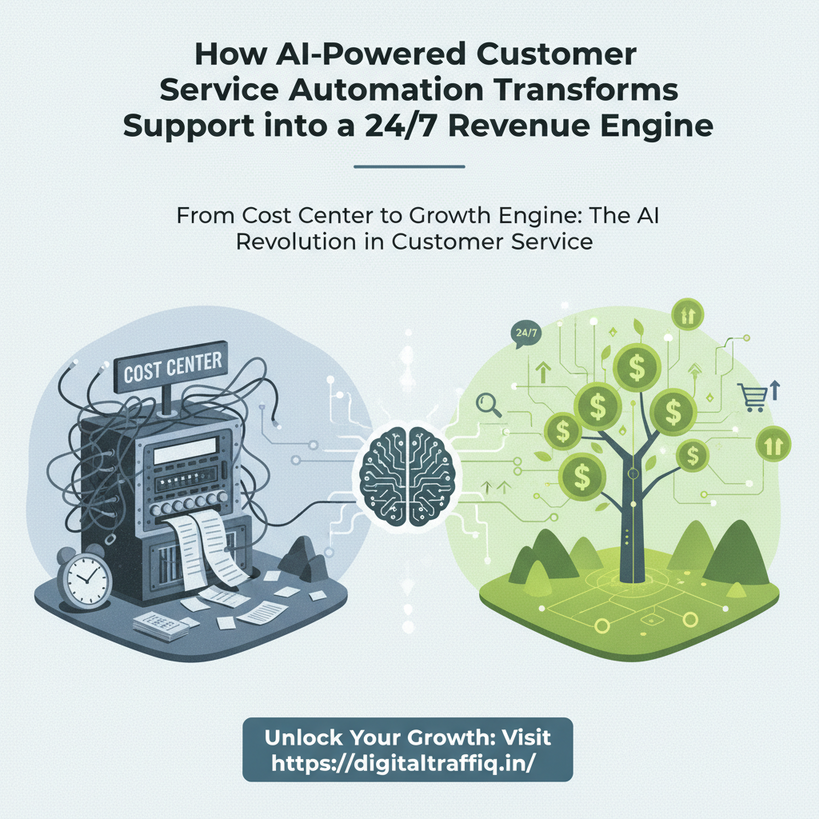
From Cost Center to Growth Engine: The AI Revolution in Customer Service
Estimated reading time: 6 minutes
Key Takeaways:
- AI transforms customer service from a reactive cost center into a proactive, 24/7 revenue-generating channel.
- Core technologies include intelligent chatbots, predictive analytics, omnichannel automation, and advanced self-service.
- Measurable benefits include significant cost reduction, faster resolution times, increased customer lifetime value (LTV), and new upsell opportunities.
- Successful implementation requires a strategic, phased approach, starting with an audit of current processes.
- The future of support is proactive, personalized, and profitable, driven by continuous AI optimization.
Table of Contents
For decades, customer support has been viewed as a necessary cost of doing business—a reactive department focused on putting out fires. But what if your support team could operate 24/7, predict issues before they happen, and consistently upsell or cross-sell during interactions? This isn’t a futuristic fantasy; it’s the tangible reality delivered by AI-powered customer service automation. At Digital Traffiq, we specialize in transforming traditional support frameworks into intelligent, always-on revenue channels. This shift represents a fundamental reimagining of customer service’s role, moving it from the back office to the front lines of growth and customer lifetime value.
The Limitations of Traditional Support Models
Legacy support models are plagued by inherent inefficiencies. They are constrained by human bandwidth, leading to long wait times outside business hours. They rely on agents manually triaging tickets, a process prone to human error and prioritization delays. Crucially, they operate in a silo, disconnected from sales, marketing, and product teams. This reactive stance means opportunities are consistently missed: the chance to resolve an issue before a customer complains, the moment to recommend a relevant product during a support chat, or the ability to gather predictive insights from support data. This operational model keeps support as a pure cost center, measured primarily by metrics like cost per ticket and average handle time.
Core Pillars of AI-Powered Customer Service Automation
Transforming support requires an integrated approach powered by artificial intelligence. Here are the key components that make this transformation possible.
1. Intelligent, Conversational AI Chatbots
Modern AI chatbots for service are a far cry from the frustrating, rule-based bots of the past. Powered by Natural Language Processing (NLP) and Large Language Models (LLMs), they understand context, intent, and customer sentiment. They can handle a vast majority of routine inquiries—password resets, order status checks, FAQ navigation—instantly and accurately, 24/7. This automated ticket resolution for Tier-1 issues frees human agents to focus on complex, high-value interactions that require empathy and deep problem-solving. The chatbot becomes the first line of defense and the first point of sale, seamlessly integrated with knowledge bases and CRM systems.
2. Predictive Support Analytics
This is where support transitions from reactive to proactive. Predictive support analytics use machine learning to analyze historical ticket data, user behavior, product usage patterns, and even external factors. The system can identify customers who are likely to encounter a specific issue, predict churn risk based on support interaction sentiment, or flag a potential upsell opportunity based on a user’s feature adoption. Imagine reaching out to a customer with a solution to a problem they haven’t even experienced yet. This level of proactive care dramatically boosts customer satisfaction automation and loyalty.
3. Seamless Omnichannel Automation
Customers reach out via email, live chat, social media, SMS, and phone. An AI-powered helpdesk unifies these channels into a single dashboard. AI can route inquiries to the best-suited agent or automation flow based on content, sentiment, and customer value. It maintains conversation context across channels, so a customer moving from chat to email doesn’t have to repeat themselves. This creates a cohesive, frictionless experience that customers now expect.
4. Advanced Self-Service Portals
Empowered customers prefer to help themselves. AI supercharges self-service by dynamically personalizing knowledge base articles, video tutorials, and community forums. An intelligent search function within the help center uses semantic understanding to deliver the most relevant article, even if the customer’s query doesn’t contain the exact keywords. This self-service AI reduces ticket volume while improving customer empowerment.
Quantifying the Transformation: Metrics That Matter
The impact of AI automation is measurable across both efficiency and revenue metrics.
Operational Efficiency & Cost Reduction
- Dramatic Support Cost Reduction: Automating 40-70% of routine queries directly slashes operational costs. This isn’t about replacing agents, but about enabling them to handle more complex cases, improving job satisfaction and reducing burnout.
- Faster Resolution Times: AI provides agents with instant, context-aware knowledge suggestions and automated workflows, slashing average handle time (AHT).
- 24/7 Coverage Without the Overhead: Offer round-the-clock support without managing graveyard shifts, expanding your market reach globally.
Revenue Generation & Growth
- Upsell/Cross-sell Integration: During a support interaction about a specific feature, an AI can intelligently suggest a relevant upgrade or complementary product. Because the suggestion is contextually relevant and solves a stated need, conversion rates are significantly higher than outbound cold sales.
- Reduced Churn & Increased Lifetime Value (LTV): Proactive, predictive support and faster resolutions directly increase customer retention. A retained customer has a higher LTV and is more likely to become a brand advocate.
- Qualified Lead Generation: Support interactions reveal unmet needs and product gaps. AI can analyze these conversations to surface high-intent leads for the sales team and provide product teams with actionable feedback.
Implementing Your AI-Powered Support Transformation with Digital Traffiq
Transitioning to an automated, revenue-focused support model requires a strategic partner. At Digital Traffiq, our process is built on understanding your unique customer journey and business objectives.
- Audit & Opportunity Mapping: We analyze your current support ticket data to identify the highest-volume, most repetitive inquiries ripe for automation and pinpoint moments in the support journey where revenue opportunities are being missed.
- Phased Integration Strategy: We recommend a phased rollout—starting with an intelligent chatbot and automated ticket triage, then layering in predictive analytics and proactive engagement tools. This minimizes disruption and allows for continuous optimization.
- Technology Agnostic Guidance: We help you select and integrate the best-fit AI customer service automation platforms that align with your existing tech stack (CRM, e-commerce platform, etc.).
- Ongoing Optimization & Training: AI models improve with data. We provide ongoing management to train the AI on your specific domain language, analyze performance metrics, and refine conversation flows to maximize both resolution rates and revenue impact.
The Future of Support is Proactive, Personalized, and Profitable
The era of viewing customer service as a passive cost center is over.
With AI-powered customer service automation, every interaction becomes an opportunity—to delight, to retain, and to grow. It enables a 24/7 support AI operation that not only defends your brand reputation but actively contributes to the bottom line through automated ticket resolution, predictive care, and intelligent revenue recommendations.
At Digital Traffiq, we are committed to helping forward-thinking businesses make this critical pivot. By transforming your support function into an intelligent, always-on revenue-generating channel, you unlock unprecedented efficiency, deepen customer relationships, and create a sustainable competitive advantage. The question is no longer if you should automate, but how quickly you can start capturing the immense value waiting within your customer support interactions.
Ready to transform your support team from a cost center into a growth engine? Contact Digital Traffiq today for a personalized consultation on implementing AI-powered customer service automation.