
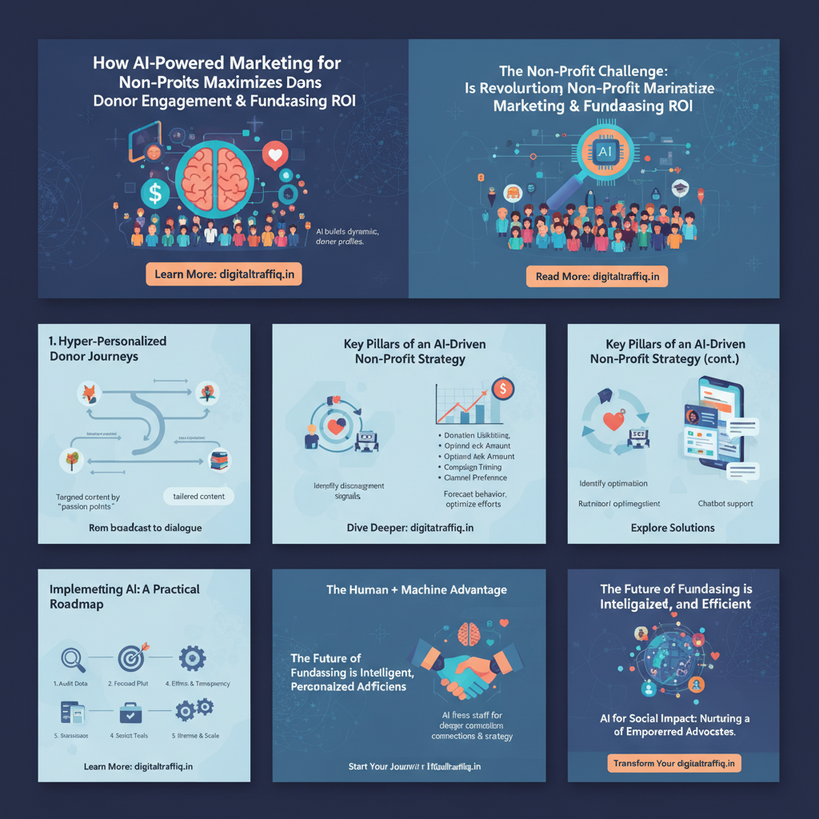
Beyond the Bake Sale: How AI is Revolutionizing Non-Profit Marketing and Fundraising
Estimated reading time: 5 minutes
Key Takeaways:
- AI enables hyper-personalization at scale, moving beyond generic campaigns to build individual donor relationships.
- Predictive analytics optimize fundraising ROI by forecasting donor behavior, ideal ask amounts, and best engagement timing.
- Intelligent automation focuses on donor retention and reactivation, identifying disengagement signals before a donor lapses.
- Implementing AI is a strategic evolution, starting with a data audit and a focused pilot project.
- The goal is a Human + Machine advantage, freeing staff from administrative tasks to focus on high-touch relationships and mission work.
Table of Contents
- The Non-Profit Challenge: Personalization at Scale
- Key Pillars of an AI-Driven Non-Profit Strategy
- Implementing AI for Social Impact: A Practical Roadmap
- The Human + Machine Advantage
For decades, non-profit organizations have operated with a fundamental tension: the urgent need to maximize their impact against the constant pressure to minimize overhead. Marketing and fundraising efforts, while essential, often consume precious resources—time, staff energy, and limited budgets. The result? Generalized campaigns, missed opportunities for personal connection, and donor fatigue. But a seismic shift is underway. Artificial Intelligence (AI) is no longer a futuristic concept reserved for tech giants; it’s a powerful, accessible tool that is fundamentally reshaping how non-profits connect, engage, and secure sustainable funding. At Digital Traffiq, we see AI not as a replacement for human compassion, but as a force multiplier for it, enabling organizations to work smarter, deepen relationships, and achieve unprecedented fundraising ROI.
The Non-Profit Challenge: Personalization at Scale
Every donor has a unique story—a personal reason for giving. Yet, traditional digital strategies often treat them as a monolithic group. Mass emails, broad social media blasts, and one-size-fits-all donation pages fail to resonate on an individual level. This lack of personalization leads to stagnant engagement rates and high donor churn. The core challenge is one of scale: how can a small team possibly understand and cater to the nuanced preferences of thousands of supporters?
This is where AI-powered marketing becomes a game-changer. By leveraging machine learning algorithms, non-profits can now analyze vast datasets—past donation history, event attendance, email opens, website behavior, and social interactions—to build dynamic, individual donor profiles. This moves the model from broadcast communication to a personalized dialogue.
Key Pillars of an AI-Driven Non-Profit Strategy
1. Hyper-Personalized Donor Journeys
Imagine a system that automatically segments donors not just by donation amount, but by their passion points. An AI can identify that “Donor A” always engages with content about educational programs, while “Donor B” is triggered by environmental advocacy. Donor journey automation then takes over, delivering tailored content, storytelling, and appeals that speak directly to each individual’s interests. A welcome series for a new donor who came via a wildlife petition will look entirely different from one for a gala attendee. This relevance dramatically increases open rates, click-throughs, and, ultimately, conversion.
2. Predictive Analytics for Fundraising ROI Optimization
Gone are the days of guessing which campaign will perform best. Automated fundraising analytics powered by AI can predict donor behavior with remarkable accuracy. Algorithms can analyze historical data to forecast:
- Donation Likelihood: Which supporters are most likely to give in the next quarter?
- Optimal Ask Amount: What is the perfect, personalized donation suggestion for each individual to maximize gift size without causing attrition?
- Campaign Timing: When is the best time to reach out to specific segments?
- Channel Preference: Does this donor respond better to email, social media, or direct mail?
This shifts fundraising from reactive to proactive, allowing teams to focus their efforts on the highest-potential opportunities and directly optimize fundraising ROI.
3. Intelligent Donor Retention and Reactivation
Acquiring a new donor is significantly more expensive than retaining an existing one. Donor retention AI identifies signals of disengagement before a donor lapses. A drop in email opens, a missed annual gift date, or decreased website visits can trigger automated, personalized re-engagement workflows. These might include a “We miss you” update with a compelling impact story related to their past giving, or a simple check-in survey. For lapsed donors, AI can help identify which reactivation message and offer have the highest probability of success, breathing new life into dormant relationships.
4. Dynamic, AI-Powered Donation Campaigns
AI-powered donation campaigns are adaptive in real-time. AI can optimize donation page elements (like imagery, headline, and button text) for different audience segments through A/B testing at an incredible speed. Furthermore, chatbots on donation pages can answer questions in real-time, reducing friction and abandonment. For peer-to-peer fundraising, AI can suggest potential fundraisers from your donor database who have high social influence and passion, and then provide them with personalized toolkits to maximize their success.
Implementing AI for Social Impact: A Practical Roadmap
Transitioning to an AI-enhanced non-profit digital strategy doesn’t require a complete overnight overhaul. It’s a strategic evolution:
- Audit & Unify Your Data: The foundation of any AI initiative is clean, integrated data. Consolidate your CRM, email platform, website analytics, and social data.
- Start with a Focused Pilot: Choose one high-impact area, such as personalizing your email welcome series or predicting mid-level donor upgrades. Measure results rigorously.
- Select the Right Tools: Many marketing automation platforms (like HubSpot, Salesforce Marketing Cloud) now have built-in AI capabilities tailored for non-profits. The key is choosing a platform that aligns with your tech stack and capacity.
- Focus on Ethics and Transparency: Be transparent with your donors about how you use data to improve their experience. Use AI to empower human connection, not replace it. Ensure all practices align with your mission and values.
- Iterate and Scale: Use insights from your pilot to refine your approach and gradually expand AI integration across other donor touchpoints.
The Human + Machine Advantage
The ultimate goal of AI for social impact is not to create a cold, automated fundraising machine. It’s the opposite. By automating administrative tasks, data analysis, and personalized communication triggers, AI frees up your most valuable asset—your people. Staff and volunteers can spend less time on spreadsheets and segmentation, and more time building genuine, high-touch relationships with major donors, crafting powerful narratives, and focusing on strategic mission work.
At Digital Traffiq, we believe technology should serve humanity’s greatest goals. For non-profits, AI-powered marketing represents a historic opportunity to deepen donor understanding, amplify compassionate storytelling, and build a more resilient, responsive, and effective funding model. It’s about moving from hoping for support to strategically nurturing a community of empowered advocates, one personalized interaction at a time.
The future of fundraising is intelligent, personalized, and efficient. By embracing AI as a core component of your non-profit digital strategy, you’re not just adopting new software—you’re investing in a capacity to understand and serve your donors better, ensuring your vital work has the sustainable resources it needs to change the world.