
From Reactive to Proactive: How AI-Powered Predictive Analytics is Reshaping Marketing Strategy
Estimated reading time: 5 minutes
Key Takeaways
- AI-powered predictive analytics transforms marketing from analyzing the past to forecasting future customer actions with high certainty.
- It enables a strategic shift from generic campaigns to continuous, proactive engagement based on individual customer intent.
- The technology drives measurable revenue growth by optimizing acquisition, boosting conversion, and improving retention across the customer lifecycle.
- Successful implementation requires a solid data foundation, clear business objectives, and a cycle of continuous model learning and optimization.
- Businesses that adopt proactive marketing AI gain a significant competitive advantage by anticipating market shifts and customer needs.
Table of Contents
- Understanding the Core: What is AI-Powered Predictive Behavior Forecasting?
- The Strategic Shift: From Campaigns to Continuous, Proactive Engagement
- The Tangible Business Impact: Driving Measurable Revenue Growth
- Implementing Predictive Analytics: A Practical Roadmap with Digital Traffiq
- The Future is Proactive: Embracing the Predictive Advantage
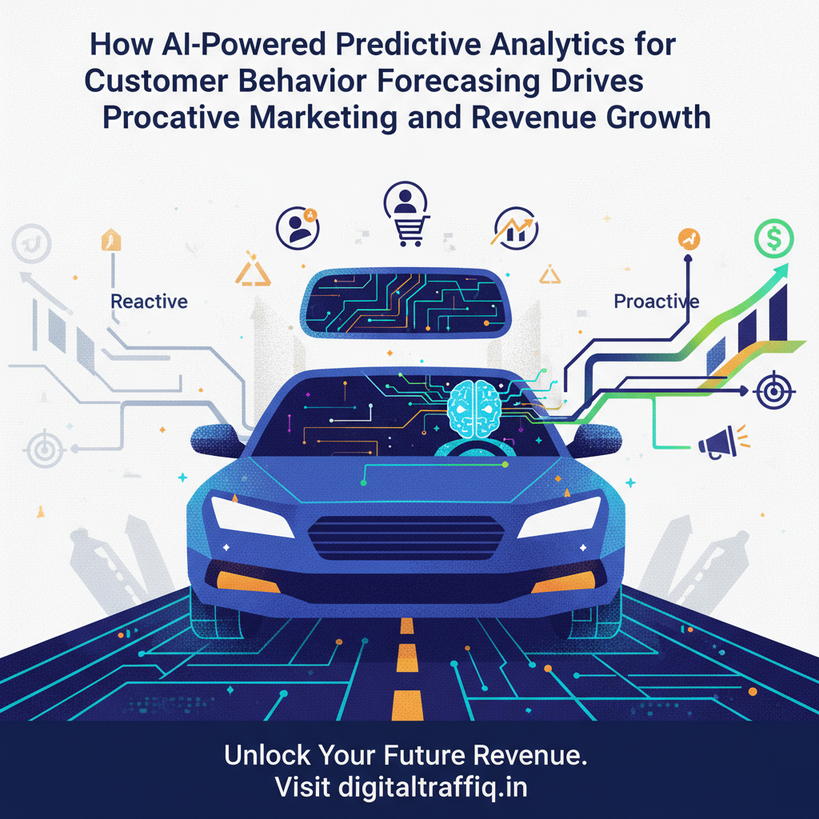
For decades, marketing has operated on a fundamental flaw: it’s been largely reactive. Businesses analyze past sales, survey customers about past experiences, and craft campaigns based on historical trends. While valuable, this approach is like driving a car by only looking in the rearview mirror. You know where you’ve been, but you’re ill-prepared for the road ahead. Today, a paradigm shift is underway, powered by artificial intelligence. At Digital Traffiq, we specialize in harnessing AI-powered predictive analytics for customer behavior forecasting, transforming marketing from a reactive discipline into a proactive, revenue-driving engine. This isn’t about guessing what customers might do; it’s about knowing with a high degree of certainty what they will do next.
Understanding the Core: What is AI-Powered Predictive Behavior Forecasting?
At its essence, AI predictive customer behavior modeling uses machine learning algorithms to analyze vast, complex datasets. These datasets go beyond simple purchase history. They encompass website interactions, social media engagement, email open rates, customer service inquiries, and even external market signals. The AI identifies subtle, non-linear patterns and correlations that are invisible to human analysts. It then builds models that can forecast future actions—such as the likelihood of a purchase, the risk of churn, or the potential lifetime value of a prospect. This moves you from behavioral trend analysis to precise customer intent prediction.
For instance, instead of just knowing that 20% of users who viewed a product page last quarter made a purchase, predictive AI can identify that a specific user, based on their unique digital footprint, has an 87% probability of buying within the next 72 hours. This granularity is the key to proactive marketing AI.
The Strategic Shift: From Campaigns to Continuous, Proactive Engagement
Implementing predictive analytics necessitates a shift in marketing philosophy. The traditional campaign calendar—Q1 email blast, Q2 social push—becomes augmented by a dynamic, always-on layer of personalized engagement.
1. Hyper-Personalized Customer Journeys
With AI customer insights, you can move beyond segment-based personalization (e.g., “women aged 25-34”) to individual intent-based personalization. The system can trigger a specific onboarding sequence for a user predicted to have high long-term value, or serve a targeted retention offer to a customer whose behavior signals imminent churn. Each touchpoint becomes a response to a predicted future state, not a past action.
2. Optimizing Marketing Spend with Precision
Revenue growth prediction models directly inform budget allocation. By forecasting demand for specific products or services in different regions or demographics (AI-driven demand forecasting), you can allocate ad spend precisely where it will generate the highest return. This eliminates wasteful spending on low-propensity audiences and doubles down on high-value opportunities before your competitors even recognize them.
3. Building Predictive Marketing Campaigns
These are not campaigns in the traditional sense. A predictive marketing campaign is a pre-programmed set of actions triggered by a predictive score. For example: “When a user’s ‘purchase intent score’ for Product X exceeds 80%, automatically add them to a LinkedIn retargeting audience, send a personalized email with a case study, and notify the sales team.” This automation, or revenue forecasting automation, ensures no high-potential lead falls through the cracks.
The Tangible Business Impact: Driving Measurable Revenue Growth
The ultimate goal of any marketing technology is to contribute to the bottom line. Predictive behavior analytics delivers this impact across the customer lifecycle:
- Acquisition: Identify and target lookalike audiences who mirror your most profitable existing customers, lowering customer acquisition cost (CAC) and improving lead quality.
- Conversion: Deploy dynamic website content and offers based on real-time intent prediction, significantly boosting conversion rates at key funnel stages.
- Retention & Expansion: Predict churn before it happens and intervene with win-back offers or proactive support. Identify customers ready for an upsell or cross-sell based on their usage patterns and predicted needs.
This holistic approach doesn’t just increase sales; it builds a more resilient, predictable revenue stream. Finance teams gain greater visibility into future cash flow, and the entire organization can align around data-driven forecasts.
Implementing Predictive Analytics: A Practical Roadmap with Digital Traffiq
The journey to proactive marketing requires more than just buying software. It requires strategy, clean data, and expertise. Here’s how we approach it at Digital Traffiq:
- Data Foundation Audit: We start by assessing the quality and connectivity of your first-party data. Predictive models are only as good as the data fed into them.
- Objective Alignment: We work with your team to define the key business outcomes—whether it’s reducing churn by 15%, increasing average order value, or improving lead-to-customer conversion.
- Model Development & Integration: Our experts build and train custom AI models tailored to your industry and specific goals. We then integrate these insights seamlessly into your existing marketing stack (CRM, email platforms, ad networks).
- Activation & Optimization: We help you design and automate the proactive engagement workflows—the predictive marketing campaigns—that turn insights into action. This is where forecasting meets execution.
- Continuous Learning: Predictive models are not set-and-forget. We establish a cycle of continuous monitoring and refinement, ensuring the algorithms adapt to changing market conditions and consumer behavior.
The Future is Proactive: Embracing the Predictive Advantage
The competitive landscape is clear: businesses that continue to market reactively will be consistently outmaneuvered by those that anticipate. AI-powered predictive analytics for customer behavior forecasting is the cornerstone of modern, growth-oriented marketing. It transforms intuition into intelligence and guesswork into strategy.
At Digital Traffiq, our mission is to empower businesses with this precise, actionable foresight. We move beyond generic analytics to deliver a system that tells you not just what happened, but what will happen next and, most importantly, what to do about it. By leveraging AI-driven demand forecasting and customer intent prediction, we enable truly proactive marketing AI strategies that lock in sustainable revenue growth prediction and create a formidable competitive moat.
The question is no longer if you should adopt predictive analytics, but how quickly you can implement it to stop looking backward and start shaping your future revenue. The tools and expertise exist. The time to act is now.