
Beyond Reaction: Building a Proactive, AI-Fortified Business
Estimated reading time: 7 minutes
Key Takeaways
- Shift from reactive to predictive and prescriptive analytics to build true operational resilience.
- AI-driven predictive maintenance radically reduces downtime and slashes maintenance costs by forecasting failures before they happen.
- An AI-optimized supply chain uses hyper-accurate demand forecasting and risk prediction to become both lean and shock-resistant.
- The greatest strategic advantage comes from integrating predictive maintenance with supply chain intelligence, creating a closed-loop system.
- Implementing AI is a practical journey: start with a strong data foundation, run a targeted pilot, then scale and integrate.
Table of Contents
- The High Cost of the “Wait-and-See” Approach: Why Reactive Models Fail
- AI-Powered Predictive Maintenance: From Downtime to Prime Time
- AI-Driven Supply Chain Optimization: Creating an Adaptive, Self-Healing Network
- The Digital Traffiq Advantage: Integrating Intelligence for Holistic Resilience
- Conclusion: Resilience as Your New Competitive Edge
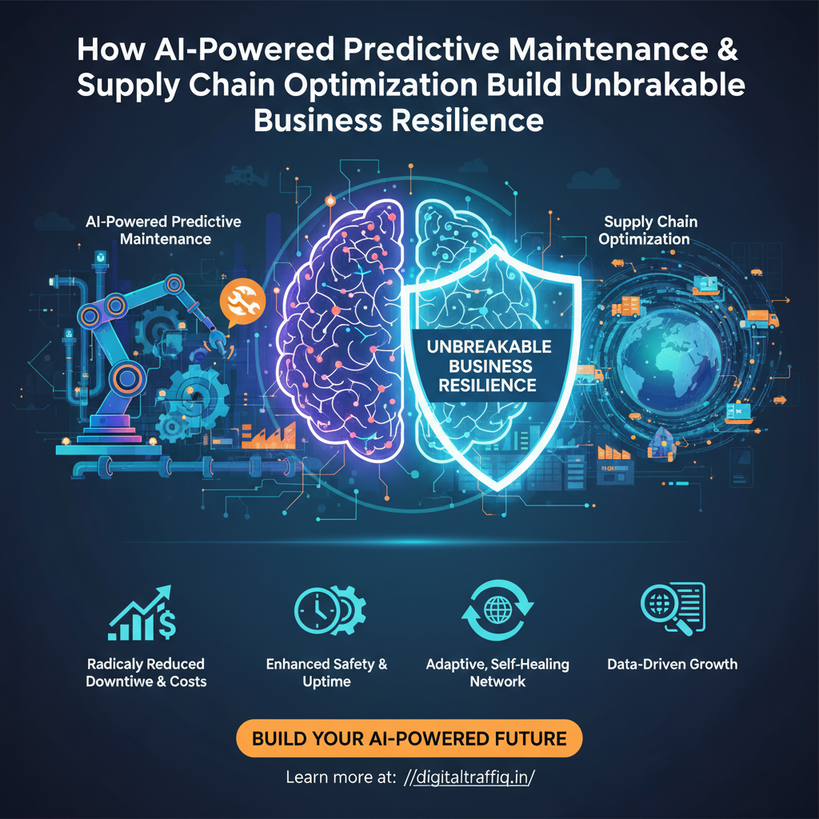
In today’s volatile economic landscape, resilience is no longer a luxury—it’s the cornerstone of survival and growth. For operations, logistics, and manufacturing leaders, the old paradigms of reactive maintenance and rigid supply chains are crumbling under the pressure of global disruptions, rising costs, and escalating customer expectations. The question is no longer if a disruption will occur, but when and how quickly your business can adapt. This is where the powerful synergy of Artificial Intelligence (AI) steps in, not as a futuristic concept, but as a practical, deployable strategy for building an unbreakable operational backbone. At Digital Traffiq, we see AI-driven predictive maintenance and supply chain optimization as the twin engines of modern business resilience, directly fueling unprecedented cost efficiency and competitive advantage.
The High Cost of the “Wait-and-See” Approach: Why Reactive Models Fail
Traditional operational models are fundamentally flawed by their reliance on hindsight. Scheduled maintenance, while better than pure run-to-failure, is inherently inefficient—often performing unnecessary work or missing early failure signs. Similarly, supply chains managed on historical averages and manual forecasts are perpetually playing catch-up, leading to either costly overstock or revenue-killing stockouts. The financial toll is staggering: unplanned downtime can cost industries billions annually, while supply chain inefficiencies erode margins through expedited shipping, waste, and lost sales. This reactive cycle drains resources and leaves businesses dangerously vulnerable to shocks. The shift required is from descriptive analytics (what happened) to predictive and prescriptive analytics (what will happen and what should we do about it).
AI-Powered Predictive Maintenance: From Downtime to Prime Time
Predictive maintenance (PdM) powered by AI represents a quantum leap from traditional methods. It moves beyond simple sensor alerts to a holistic understanding of asset health.
How It Works: The Intelligence Behind the Prediction
AI-driven predictive maintenance systems ingest vast, real-time data streams from IoT sensors, equipment logs, and environmental conditions. Machine Learning (ML) algorithms, particularly those designed for anomaly detection and time-series forecasting, analyze this data to identify subtle patterns and deviations that precede a failure. These models learn the unique “fingerprint” of normal operation for each asset and can flag anomalies weeks or even months before a breakdown occurs. This isn’t just about preventing failure; it’s about optimizing performance and extending asset lifecycles.
Tangible Business Benefits
- Radically Reduced Downtime: Transform unplanned, catastrophic stoppages into planned, minimal-impact interventions. Maintenance is scheduled at the optimal point—just before failure—maximizing uptime.
- Slashed Maintenance Costs: Eliminate unnecessary routine maintenance and prevent costly secondary damage from catastrophic failures. Resources (parts and labor) are deployed only when and where needed.
- Enhanced Safety & Compliance: Proactively address potential safety hazards and ensure equipment operates within regulatory parameters, protecting both personnel and brand reputation.
- Data-Driven Capital Planning: Move from gut-feel to data-informed decisions on asset repair, replacement, and investment, improving CAPEX efficiency.
AI-Driven Supply Chain Optimization: Creating an Adaptive, Self-Healing Network
While predictive maintenance fortifies your physical assets, AI-driven supply chain optimization fortifies your flow of materials and information. It creates a living, breathing supply chain that can anticipate and adapt.
The Pillars of an Intelligent Supply Chain
1. Demand Forecasting with Unprecedented Accuracy: AI goes beyond simple trend analysis. It incorporates hundreds of external variables—weather patterns, social sentiment, economic indicators, competitor activity—to generate hyper-accurate demand forecasts. This is the cornerstone of smart inventory management, enabling businesses to achieve the holy grail: high service levels with lower overall inventory.
2. Predictive Logistics and Risk Management: AI models can predict port delays, transit disruptions, and supplier risks by analyzing global news, traffic data, and geopolitical events. This allows for dynamic rerouting, alternative sourcing, and proactive customer communication, turning potential crises into managed events.
3. Autonomous Optimization: From dynamic warehouse slotting to real-time carrier selection and pricing, AI systems can make and execute micro-decisions continuously, optimizing for cost, speed, and carbon footprint simultaneously.
The Resilience and Efficiency Dividend
The outcome is a supply chain that is both lean and resilient. You reduce carrying costs, minimize waste from obsolescence, and cut expedited freight spend. More importantly, you build a network that can absorb shocks, maintain continuity, and fulfill customer promises even in turbulent times. This is the essence of a true business resilience strategy—one that is proactive, embedded, and intelligent.
The Digital Traffiq Advantage: Integrating Intelligence for Holistic Resilience
At Digital Traffiq, we understand that predictive maintenance and supply chain optimization are not isolated solutions. Their greatest power is unleashed when they are integrated, creating a closed-loop system of intelligence. Imagine a predictive maintenance alert on a critical packaging machine that automatically triggers an adjustment in production scheduling and a recalculation of finished goods inventory forecasts. The supply chain system, aware of the impending maintenance window, can proactively adjust shipment schedules and raw material orders, ensuring no customer order is impacted.
Our approach is to architect these AI-driven systems with a clear focus on business outcomes: cost efficiency automation and unshakeable operational resilience. We help you move from fragmented data and reactive processes to a unified, intelligent operational command center.
Building Your AI-Powered Future: A Practical Roadmap
- Assessment & Data Foundation: We start by evaluating your highest-value assets and most critical supply chain nodes, assessing data availability and quality. A strong data pipeline is the essential first step.
- Targeted Pilot Deployment: We recommend a focused pilot on a single production line or a specific product category’s supply chain. This proves value, builds internal confidence, and refines the model.
- Scale & Integrate: Successfully piloted solutions are scaled across the organization, with a deliberate strategy to integrate insights between maintenance and supply chain platforms.
- Continuous Evolution: AI models are not set-and-forget. We ensure they continuously learn and adapt to new data, maintaining their accuracy and relevance over time.
Conclusion: Resilience as Your New Competitive Edge
The convergence of AI-powered predictive maintenance and supply chain optimization marks the end of the era of operational guesswork. It ushers in a new age of precision, predictability, and profound resilience. This is not merely about technology adoption; it’s about fundamentally rewiring your business for agility and strength. The benefits—dramatic cost reduction, guaranteed uptime, customer trust, and the ability to navigate any disruption—translate directly to a stronger bottom line and a formidable market position.
In a world of constant change, the most resilient business wins. Let’s discuss how to transform your operations from a cost center into a strategic, AI-powered engine for growth and stability. The future belongs to those who predict, prepare, and prosper.