
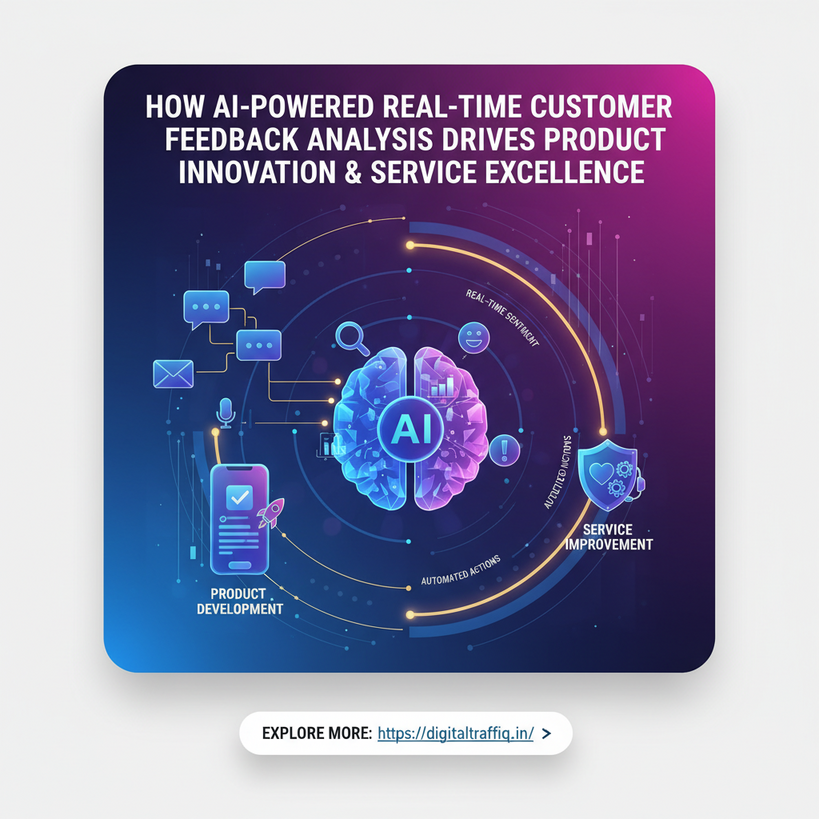
How AI-Powered Real-Time Customer Feedback Analysis Transforms Product Development and Service Improvement
Estimated reading time: 6 minutes
Key Takeaways:
- AI shatters the traditional feedback bottleneck by analyzing vast, unstructured data in real-time, moving from historical reports to instant insight.
- Product development shifts from guesswork to being evidence-based, using AI to prioritize features, uncover unspoken needs, and validate launches.
- Service improvement is automated, enabling instant feedback loops, empowered frontline teams, and proactive CX strategy.
- Implementation is a strategic partnership, requiring integration and process change to turn feedback into a continuous innovation engine.
- The future is a virtuous cycle where real-time understanding of customers fuels predictive innovation and superior experiences.
Table of Contents
- The Traditional Feedback Bottleneck: Why Old Methods Fall Short
- Enter the AI-Powered Feedback Engine: From Data to Instant Insight
- Transforming Product Development with Predictive Customer Insights
- Revolutionizing Service Improvement through Automation
- Implementing an AI Feedback Strategy: A Partnership with Digital Traffiq
- The Future Is a Continuous Conversation
For decades, businesses have collected customer feedback through surveys, support tickets, and reviews, only to face a common bottleneck: the sheer volume and velocity of data made it impossible to analyze comprehensively and act upon swiftly. The insights were often historical, fragmented, and reactive. Today, that paradigm has been shattered. At Digital Traffiq, we are at the forefront of a revolution where AI-powered real-time customer feedback analysis is no longer a luxury but a critical engine for continuous innovation and competitive advantage. This technology is fundamentally transforming how companies develop products and refine services, moving from a guesswork-driven model to a precise, evidence-based, and customer-centric approach.
The Traditional Feedback Bottleneck: Why Old Methods Fall Short
Before diving into the AI-driven solution, it’s crucial to understand the limitations of legacy systems. Traditional feedback analysis is typically manual, slow, and subjective. Product teams might sift through NPS scores quarterly, while customer service managers compile monthly reports from ticket themes. This process is plagued by delays, sampling bias (only the loudest voices are heard), and a lack of contextual understanding. By the time an insight is identified and prioritized, the market may have shifted, or the customer’s frustration may have already led to churn. This reactive loop creates a significant gap between customer expectations and a company’s ability to meet them.
Enter the AI-Powered Feedback Engine: From Data to Instant Insight
AI customer feedback analysis represents a quantum leap. It involves using machine learning (ML) and natural language processing (NLP) to automatically ingest, interpret, and categorize unstructured feedback data from dozens of sources simultaneously—social media, live chat transcripts, email, app store reviews, survey verbatims, and support calls (via transcription).
The core of this transformation lies in real-time sentiment analysis. Unlike simple keyword tracking, modern AI models understand nuance, sarcasm, intent, and emotion. They can discern if a customer saying “slick” about a feature is positive or sarcastically negative based on context. This happens not in weeks, but in milliseconds, providing a live pulse on customer perception.
Key Capabilities of an AI Feedback System:
- Automated Triage & Categorization: Instantly tags feedback into relevant themes (e.g., “UI/Usability,” “Billing Issue,” “Feature Request for Reporting”).
- Sentiment Tracking Over Time: Charts emotional trajectories around product launches or policy changes.
- Intent Detection: Identifies whether a comment is a complaint, suggestion, question, or praise.
- Urgency Scoring: Flags high-severity issues automatically based on language and sentiment intensity.
Transforming Product Development with Predictive Customer Insights
For product managers and developers, this shift is profound. AI-driven product innovation moves from being roadmap-centric to feedback-informed.
1. Prioritizing the Right Features
Instead of relying on internal hunches or the highest-paying client’s request, product teams can use data from AI-powered feedback loops. The AI can quantify the volume and sentiment behind specific feature requests across the entire user base. It can reveal that while 10 enterprise clients are asking for an advanced API, 2,000 small business users are struggling with a basic onboarding step. This democratizes the roadmap, ensuring resources are allocated to changes that impact the broadest customer satisfaction.
2. Uncovering Unspoken Needs
Often, customers can’t articulate what they need. AI customer feedback analysis excels at identifying latent needs. By analyzing patterns in complaints or wishes, the AI can surface underlying problems. For example, repeated comments about “workflow feels slow” might not point to a need for a faster server, but rather a UI redesign that reduces clicks. These predictive customer insights allow teams to solve root causes, not just symptoms.
3. Validating Ideas and Launches in Real-Time
When a new feature is launched, AI tools monitor feedback channels in real time. Is sentiment positive? Are users confused? Are they using the language the product team expected? This immediate feedback allows for rapid iteration—hotfixes, tutorial pop-ups, or UI tweaks—within days or even hours, dramatically increasing the success rate of new releases.
Revolutionizing Service Improvement through Automation
On the service and customer experience (CX) side, the impact is equally transformative. Service improvement automation turns feedback into action without manual intervention.
1. Closing the Loop Automatically
Imagine a system where a negative product review triggers an immediate, personalized workflow. The AI-powered feedback analysis detects a high-urgency complaint about a shipping error. It can automatically alert the logistics team, create a support ticket, and even trigger a template for a customer service agent to reach out with an apology and a solution. This is feedback loop automation in action, demonstrating responsiveness that builds immense loyalty.
2. Empowering Frontline Teams
Customer service agents receive real-time sentiment analysis during live chats or calls, alerting them to a customer’s growing frustration so they can escalate or adjust their approach. Post-interaction, automated feedback processing analyzes the conversation to provide agents with personalized coaching points, turning every service moment into a learning opportunity.
3. Strategic Customer Experience Optimization
Beyond individual tickets, leadership gains a holistic, real-time view of the customer experience optimization landscape. Dashboards show live sentiment maps, trending issues, and correlation analysis (e.g., does a dip in app store sentiment correlate with our latest update?). This enables proactive service strategy—pre-emptively addressing issues before they become widespread and strategically investing in service areas that drive the most retention.
Implementing an AI Feedback Strategy: A Partnership with Digital Traffiq
Adopting this technology is more than just buying software; it’s a strategic shift. It requires integrating data sources, training models on your specific industry lexicon, and building internal processes to act on the insights. This is where Digital Traffiq’s expertise becomes invaluable.
We partner with companies to build and manage their AI-powered real-time customer feedback analysis ecosystems. Our approach ensures the technology is aligned with your specific business goals, whether that’s reducing churn, accelerating product-market fit, or dominating service excellence in your niche.
The Future Is a Continuous Conversation
The ultimate goal is to create a seamless, continuous conversation with your market. AI-powered feedback loops create a virtuous cycle: better products and services lead to more positive feedback, which fuels further refinement and innovation. Companies that master this cycle will not only respond to their customers but will anticipate their needs, building products and experiences that feel intuitively right.
In an era where customer expectations are higher than ever, speed and precision are non-negotiable. Leveraging AI for real-time sentiment analysis and predictive insights is the key to moving from passively listening to your customers to actively understanding and growing with them. It transforms feedback from a rear-view mirror into a GPS for your company’s future.
Ready to transform your customer feedback into your greatest innovation engine? Explore how Digital Traffiq can architect your AI-driven feedback strategy.