
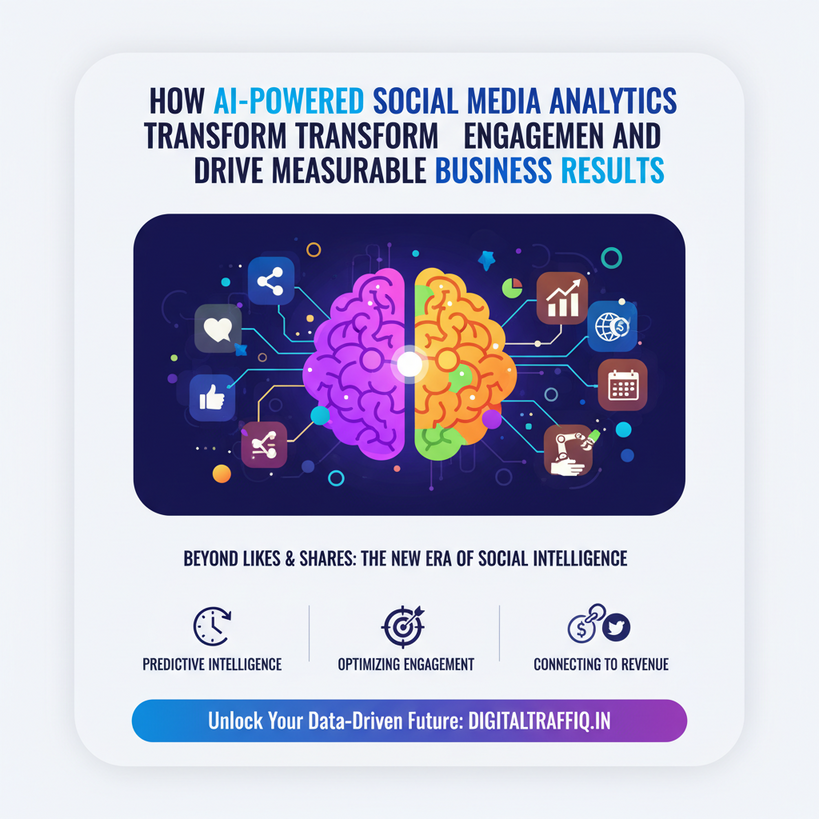
Beyond Likes and Shares: The New Era of Social Media Intelligence
Estimated reading time: 5 minutes
Key Takeaways:
- AI moves social media analytics beyond vanity metrics to measure tangible business impact and ROI.
- Predictive intelligence and sentiment analysis transform social data into proactive strategy.
- AI-driven insights optimize content, timing, and engagement with surgical precision.
- Advanced tracking connects social activity directly to revenue and customer journey outcomes.
- Intelligent automation frees marketers for creative work while AI handles data-heavy tasks.
Table of Contents
- From Reactive Reporting to Predictive Intelligence
- Optimizing Engagement with Surgical Precision
- The Holy Grail: Connecting Social Activity to Revenue (Social Media ROI Measurement)
- Predictive Analytics: The Future is Now
- Intelligent Automation: Freeing Marketers to Be Creative
- Implementing AI Analytics: A Practical Roadmap with Digital Traffiq
For years, social media marketing has been guided by a familiar set of metrics: likes, shares, follower counts, and comments. While these vanity metrics offer a surface-level view of activity, they often fail to answer the most critical business question: Is our social media investment driving tangible results? The gap between posting content and proving its impact on revenue has been a persistent challenge for marketers. Enter Artificial Intelligence. No longer a futuristic concept, AI-powered social media analytics is fundamentally reshaping how brands understand their audience, optimize their strategies, and, most importantly, connect social efforts directly to business outcomes. At Digital Traffiq, we see this not as a mere tool upgrade, but as a paradigm shift from guesswork to precision-driven marketing.
From Reactive Reporting to Predictive Intelligence
Traditional analytics platforms are inherently reactive. They tell you what happened last week or last month. AI social media analytics flips this model on its head. By leveraging machine learning algorithms, these systems process vast, unstructured datasets—including image content, video context, slang, emojis, and conversational nuances—that humans simply cannot analyze at scale. This capability, often called social listening AI, moves beyond tracking brand mentions to understanding the why behind the conversation.
For instance, instead of just knowing your brand was mentioned 500 times, AI can categorize those mentions by emotion (joy, frustration, anticipation), intent (purchase consideration, customer service issue), and underlying themes. This depth of brand sentiment analysis allows you to proactively address emerging crises, identify brand advocates, and understand the true perception of your product in the market. It transforms social media from a broadcast channel into a rich, continuous focus group.
Optimizing Engagement with Surgical Precision
The goal of social media is engagement, but not all engagement is created equal. A thousand likes from users outside your target demographic hold little value. Engagement optimization AI solves this by identifying not just what content performs well, but for whom, when, and why.
AI systems can analyze historical performance data to determine:
- The optimal posting times for each segment of your audience.
- The specific visual elements (colors, compositions, faces) that drive higher engagement in your niche.
- The headline and caption structures that prompt saves and shares—key indicators of high-value engagement.
- The content formats (Reels, Carousels, long-form video) that align with your audience’s current consumption habits.
This intelligence directly fuels an AI-driven content strategy. Rather than relying on hunches, marketers can use data-backed insights to create content that the algorithm—and more importantly, the human on the other side—genuinely prefers. This leads to higher organic reach, more meaningful interactions, and a community that actively anticipates your content.
The Holy Grail: Connecting Social Activity to Revenue (Social Media ROI Measurement)
This is where AI analytics delivers its most compelling business case. Advanced platforms now enable sophisticated social media conversion tracking and social media performance tracking across the entire customer journey. By integrating with CRM and sales data, AI can attribute offline sales and lead generation activities back to specific social media interactions.
Imagine being able to see that a particular LinkedIn article directly influenced five enterprise sales, or that a specific Instagram Story series has the highest cost-per-acquisition for e-commerce. AI models can create multi-touch attribution models for social, giving credit to the first touchpoint that created awareness and the last touchpoint that sealed the deal. This moves social media ROI measurement from estimating “engagement value” to reporting on actual pipeline influence and closed revenue. For the first time, C-suites can see a clear, quantifiable return on social media spend.
Predictive Analytics: The Future is Now
The most forward-looking application is predictive social analytics. By analyzing trends, competitor movements, and audience behavior patterns, AI can forecast potential outcomes. It can predict:
- Which upcoming content topics are likely to trend in your industry.
- Potential spikes in customer service inquiries based on product launch chatter.
- Future shifts in audience sentiment, allowing for preemptive strategy adjustments.
- Optimal budget allocation across platforms and campaigns for the next quarter.
This shifts the marketing function from tactical reaction to strategic foresight, offering a significant competitive advantage.
Intelligent Automation: Freeing Marketers to Be Creative
A common misconception is that AI replaces human marketers. In reality, it augments them. Social media automation powered by AI handles the repetitive, data-heavy tasks: scheduling posts at optimal times, generating basic performance reports, categorizing incoming messages, and even suggesting real-time responses to common queries. This liberates marketing teams from the grind of manual monitoring and reporting, allowing them to focus on high-value creative work, strategy, and community building—the uniquely human skills that drive brand love.
Implementing AI Analytics: A Practical Roadmap with Digital Traffiq
The transition to AI-powered analytics doesn’t have to be daunting. The key is to start with a clear business objective. Are you aiming to improve customer service response times, increase lead quality from social, or boost the ROI of your content production? At Digital Traffiq, we help clients navigate this journey through a structured approach:
- Audit & Integration: We assess your current data streams and integrate your social platforms, CRM, and web analytics into a unified dashboard.
- Goal-Aligned KPI Definition: We move beyond vanity metrics to define the Key Performance Indicators (KPIs) that actually reflect your business goals, such as conversion rate per social channel or sentiment trend lines.
- Intelligent Monitoring & Listening: We deploy AI listening tools to establish a baseline for brand sentiment and competitive landscape.
- Predictive Modeling & Strategy: Using historical data, we help build models to test content strategies and predict outcomes before you invest in production.
- Ongoing Optimization: We establish a cycle of measurement, learning, and refinement, where AI insights continuously inform and improve your social media execution.
The landscape of social media is no longer just about being present; it’s about being intelligent. AI-powered social media analytics provides the lens through which chaos becomes clarity, and activity translates into accountable growth. It empowers brands to listen with understanding, engage with purpose, and invest with confidence.
Ready to move beyond surface-level metrics and start measuring what truly matters for your business? The future of data-driven social strategy begins with a single, intelligent step.