
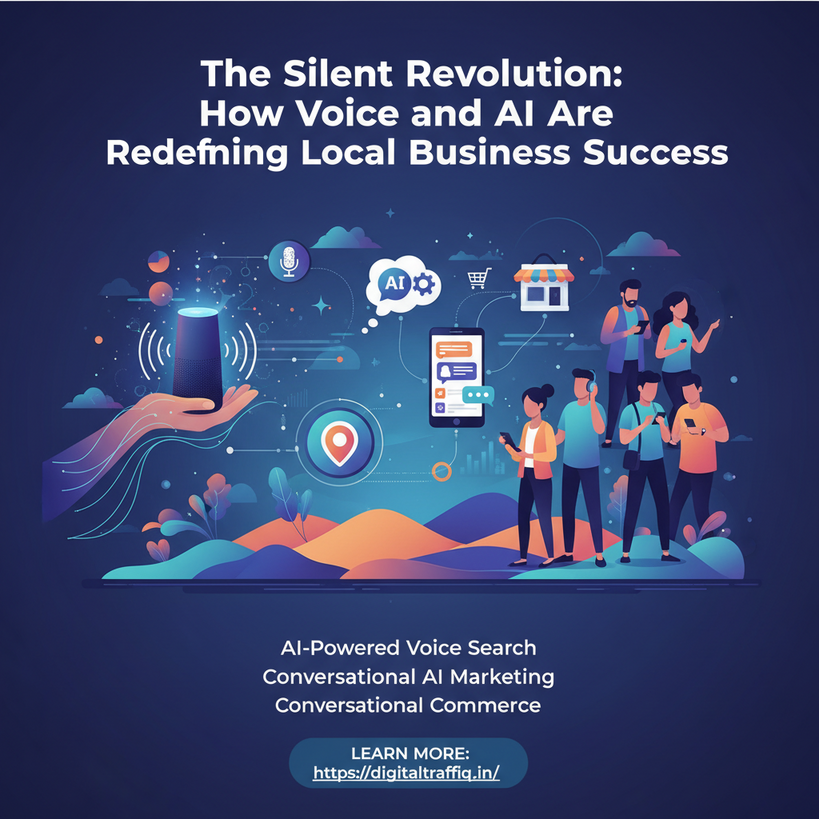
The Silent Revolution: How Voice and AI Are Redefining Local Business Success
Estimated reading time: 6 minutes
Key Takeaways:
- Voice search uses natural, question-based language, requiring a shift from keyword-focused to answer-focused content.
- Conversational AI marketing moves beyond discovery to enable dynamic engagement and conversational commerce like booking via chat or voice.
- Success depends on data: Voice search analytics provide critical insights into customer intent and behavior.
- A practical action plan includes optimizing for questions, mastering local listings, and implementing AI touchpoints like chatbots.
- The future of local search is conversational; adapting now is a customer experience imperative for long-term success.
Table of Contents
Imagine a potential customer, hands full, asking their smart speaker, “Hey Google, find me a reliable plumber near me who can fix a leak tonight.” In that moment, a complex, AI-driven race begins. Which local business will be deemed the most relevant, trustworthy, and immediate answer? This isn’t the future; it’s the present reality of local search. For businesses still optimizing solely for typed keywords on a screen, a massive shift is underway. At Digital Traffiq, we understand that the convergence of AI-powered voice search optimization and conversational AI marketing isn’t just a trend—it’s a fundamental transformation in how customers discover and interact with local services. This article explores how these technologies are reshaping the landscape and what your business must do to stay audible in a voice-first world.
Understanding the Voice Search Paradigm Shift
Voice search is fundamentally different from traditional text-based queries. When people type, they use fragmented keywords like “best pizza NYC.” When they speak, they use natural, long-tail, question-based language: “What’s the best pizza place in Manhattan that delivers after 10 PM?” This shift demands a new approach to local business SEO AI. The algorithms behind Alexa, Siri, and Google Assistant are powered by sophisticated natural language processing (NLP) and machine learning, designed to understand intent, context, and nuance. They prioritize concise, direct answers—often pulling from featured snippets or business listings that perfectly match the conversational query. For local businesses, this means your online presence must be structured to answer questions, not just list services.
Conversational AI: Beyond Simple Search to Dynamic Engagement
While voice search is about finding your business, conversational AI is about engaging with it. Conversational AI marketing involves technologies like AI chatbots on websites, messaging apps, and even voice apps (skills/actions) for smart speakers. These tools simulate human conversation to provide instant customer service, book appointments, answer FAQs, and guide users through a purchase—a concept known as conversational commerce.
For a local restaurant, this could mean a Facebook Messenger bot that takes to-go orders. For an auto repair shop, it could be a voice app that lets customers schedule oil changes by speaking to their car’s infotainment system. This creates a seamless, frictionless experience that today’s consumers expect. It’s no longer enough to be found; you must be conversationally competent.
A Data-Driven Strategy: The Role of Voice Search Analytics
Implementing these technologies without measurement is like marketing in the dark. This is where voice search analytics become critical. Specialized tools and analytics frameworks can help you understand:
- What specific voice queries are leading customers to your business (or to your competitors).
- The intent behind those queries (informational, navigational, transactional).
- The devices and platforms being used (smart speaker, mobile, in-car).
- The conversion paths from voice search to actual store visit or call.
This data is the bedrock of an effective AI local business strategy. It moves you from guesswork to precision, allowing you to refine your content, structured data (schema markup), and business listings to align with how your customers are actually speaking.
Building Your AI-Powered Local Marketing Action Plan
So, how does a local business practically adapt? Here is a foundational action plan, the core of what we help clients implement at Digital Traffiq:
1. Optimize for ‘Near Me’ and Question-Based Queries
Audit and rewrite your website content, Google Business Profile description, and other local listings. Incorporate full-sentence questions and answers. For example, instead of just “emergency plumbing services,” create content that answers, “What should I do if I have a burst pipe?” and clearly states your service area and 24/7 availability.
2. Master Your Local Listings and Structured Data
Consistency is king. Ensure your business name, address, phone number (NAP), hours, and services are identical across Google, Bing, Apple Maps, Yelp, and industry directories. Implement local business schema markup on your website. This structured code helps search engines understand your business details, making you a prime candidate for voice search answers and local packs.
3. Develop a Conversational AI Touchpoint
Start with a low-barrier entry into conversational commerce. Deploy an AI chatbot on your website to handle after-hours inquiries and basic booking. This provides immediate voice-enabled customer service and captures leads 24/7. For businesses with higher engagement, explore developing a simple voice app for smart speakers to provide business hours, directions, or promotional offers.
4. Create FAQ Content That Speaks Aloud
Develop a comprehensive FAQ page where each question is phrased exactly as someone would ask it verbally. Read your answers aloud—do they sound natural and provide a complete, helpful response in 1-2 sentences? This content is gold for capturing voice search featured snippets.
5. Adopt an ‘Answer First’ Content Philosophy
When writing blog posts or service pages, state the direct answer to a probable query at the very beginning. This mimics the pattern of voice assistants, which provide the answer first. This approach not only satisfies voice search algorithms but also improves readability for all users.
The Future is Conversational: Embracing the Change
The trajectory is clear. As AI models grow more sophisticated and smart speaker penetration increases, AI-powered local search will become the default for many consumers. The businesses that thrive will be those that view this not as a technical challenge, but as a customer experience imperative. It’s about being present, helpful, and accessible in the moments that matter—when a customer is cooking and needs a recipe ingredient, driving and needs directions, or dealing with an emergency and needs immediate help.
At Digital Traffiq, we specialize in crafting and executing AI local business strategies that bridge the gap between cutting-edge technology and real-world local commerce. We help you not just optimize for voice search, but build a holistic conversational ecosystem that drives discovery, engagement, and loyalty.
The question is no longer if voice and conversational AI will impact your local business, but how soon you will adapt. The businesses that start today, building their content and systems around the human voice, will own the conversational frontier of tomorrow’s market. The time to start listening—and responding—is now.