
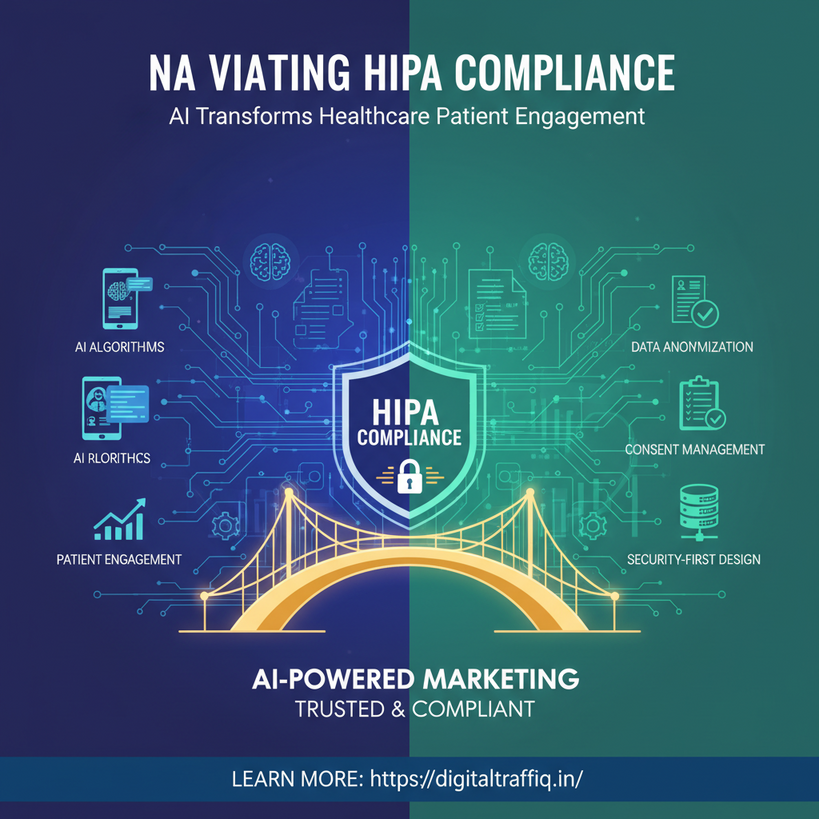
Navigating HIPAA Compliance: How AI-Powered Marketing Transforms Healthcare Patient Engagement
Estimated reading time: 6 minutes
Key Takeaways
- AI enables sophisticated, HIPAA-compliant marketing automation by operating within strict regulatory guardrails, anonymizing data, and managing granular consent.
- A compliant strategy rests on three pillars: Data Anonymization, Consent-Based Orchestration, and Predictive Engagement that avoids privacy invasion.
- Practical applications span the healthcare ecosystem, from streamlining patient journeys for hospitals to driving adoption for telehealth marketing automation and medical device marketing AI.
- Successful implementation requires a strategic blueprint: auditing data, choosing a compliance-first platform, starting with low-risk use cases, and establishing continuous oversight.
- The future of healthcare personalization is AI-driven, using compliance as a blueprint for building more respectful, effective, and successful patient engagement.
Table of Contents
- The Dual Mandate: Engagement vs. Compliance in Healthcare Marketing
- Core Pillars of a Compliant AI Marketing Strategy
- Practical Applications: AI Marketing Across the Healthcare Ecosystem
- Implementing AI: A Strategic Blueprint for Healthcare Marketers
- The Future is Personalized, Compliant, and AI-Driven
The Dual Mandate: Engagement vs. Compliance in Healthcare Marketing
Healthcare marketing operates under a dual mandate. On one hand, the goal is to educate, attract, and retain patients—driving appointments, fostering loyalty, and improving health outcomes. On the other, every communication, data point, and campaign must adhere to stringent privacy laws. Traditional marketing automation often stumbles here, treating patient data like any other consumer data, which is a significant compliance risk.
AI changes this equation. Modern AI systems can be trained and configured to operate within strict regulatory guardrails. They can identify PHI within datasets, anonymize information for analysis, and trigger communications based on permissible criteria without ever exposing sensitive details. This allows for sophisticated healthcare marketing automation that respects the letter and spirit of the law.
Core Pillars of a Compliant AI Marketing Strategy
1. Data Anonymization & Secure Processing
The first step in any HIPAA-compliant marketing automation strategy is ensuring raw patient data is never used directly for marketing segmentation or personalization. AI models can be trained on anonymized datasets, where identifying information is removed or tokenized. These models can then predict patient needs, preferred communication channels, and optimal messaging without ever accessing a specific individual’s PHI. The marketing execution layer only receives the output—”send Condition Education Campaign A to Patient Cohort B”—not the underlying clinical data that informed the decision.
2. Consent-Based Communication Orchestration
AI excels at managing complexity. In healthcare, consent is not monolithic. A patient may consent to appointment reminders via SMS but not to newsletters via email. They may opt into educational content about a chronic condition but not about new cosmetic services. AI-powered platforms can track these granular consent preferences in real-time, ensuring every automated touchpoint is not only relevant but also explicitly permitted. This builds trust and keeps your medical practice digital strategy firmly within compliance boundaries.
3. Predictive Engagement Without Privacy Invasion
One of AI’s superpowers is predictive analytics. For healthcare lead generation, this means identifying individuals who may benefit from a specific service (e.g., seasonal allergy shots, diabetic eye exams) based on anonymized, aggregated trends and permissible data like zip code or age range. The outreach can then be crafted as a general educational campaign to that demographic, inviting them to self-identify and initiate contact. The AI guides the “who” and “when,” while the “how” remains respectful and non-invasive.
Practical Applications: AI Marketing Across the Healthcare Ecosystem
For Hospitals & Large Practices: Streamlining the Patient Journey
From a patient’s first online search for symptoms to post-discharge follow-up, AI can create a seamless, supportive journey. Chatbots can handle initial FAQ and triage, scheduling initial consultations while collecting only necessary intake information securely. Post-appointment, AI can personalize follow-up content—recommending specific recovery videos or reminding about medication—based on the procedure code (a non-PHI data point) and the patient’s consented communication preferences.
For Medical Device Companies: Educating & Supporting Clinicians
Medical device marketing AI isn’t just about selling; it’s about supporting adoption and proper use. AI can analyze published research, forum discussions, and conference materials to identify healthcare providers who are exploring new treatment modalities. It can then deliver tailored, valuable content to them, establishing thought leadership and guiding them through the evaluation process, all within the bounds of professional compliance.
For Telehealth Providers: Driving Adoption & Retention
The telehealth marketing automation challenge is two-fold: acquiring patients comfortable with virtual care and ensuring they return. AI can identify patients within a network who have conditions suitable for telehealth, live in remote areas, or have previously missed in-person appointments. It can then launch targeted campaigns highlighting the convenience of telehealth, using compliant channels. Furthermore, AI can analyze engagement patterns to predict which patients might lapse and trigger retention messages or check-ins from a care coordinator.
Implementing AI: A Strategic Blueprint for Healthcare Marketers
Transitioning to an AI-powered strategy requires careful planning. Here is a blueprint to ensure success and compliance:
- Audit & Map Your Data: Identify all data sources and classify data types. Clearly separate PHI from non-PHI, and marketing consent data from clinical data.
- Select a Compliance-First Platform: Choose marketing technology vendors, like Digital Traffiq, who design for healthcare. Look for features like automated PHI detection, audit trails, and role-based access controls.
- Start with a Low-Risk Use Case: Begin your AI for medical practices journey with a contained project. Examples include automating non-clinical appointment reminders or personalizing website content based on anonymous browsing behavior (not medical history).
- Establish Continuous Oversight: AI is not a “set it and forget it” tool. Implement regular compliance reviews of AI model inputs and outputs, and ensure human oversight for all patient-facing communications.
The Future is Personalized, Compliant, and AI-Driven
The goal of healthcare personalization is not to be intrusive, but to be profoundly helpful. AI-powered marketing, built on a foundation of ethical data use and rigorous compliance, makes this possible. It allows healthcare organizations to meet patients where they are, with the right message, at the right time, through the right channel—all while safeguarding the sacred trust of patient privacy.
At Digital Traffiq, we believe that compliance shouldn’t be a barrier to innovation; it should be its blueprint. By leveraging healthcare compliance automation within our AI-driven strategies, we empower medical providers, device companies, and telehealth platforms to grow their reach and deepen their patient relationships with confidence and integrity.
Embrace an AI strategy that sees HIPAA not as a limitation, but as a framework for building more respectful, effective, and ultimately successful marketing. The future of patient engagement is intelligent, secure, and already here.