
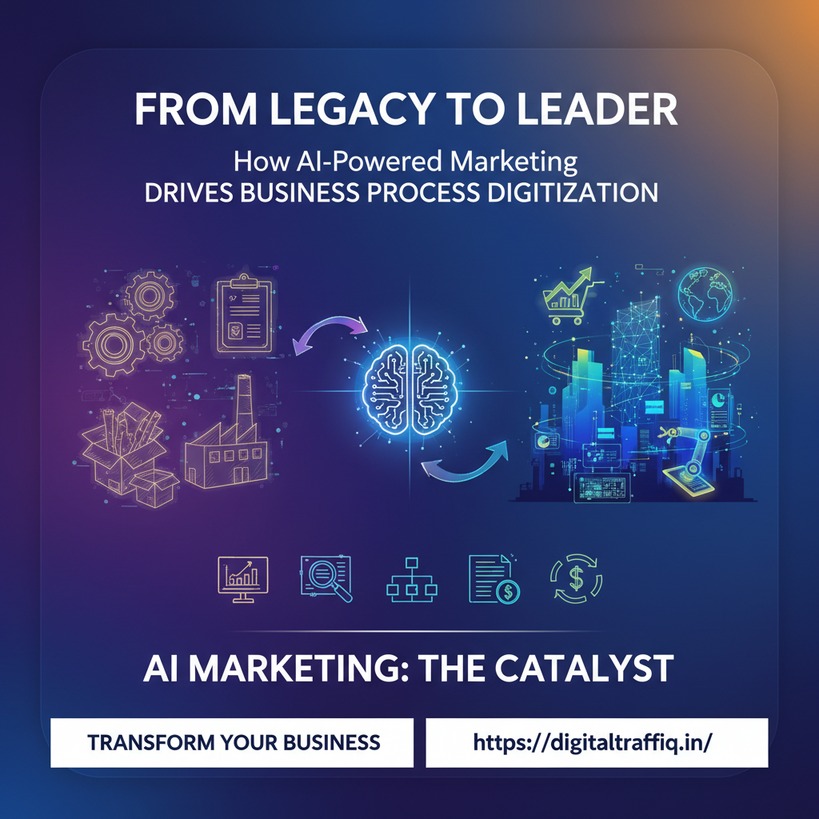
The Digital Imperative: Why Traditional Industries Can No Longer Afford to Wait
Estimated reading time: 6 minutes
Key Takeaways
- AI-powered marketing is the critical catalyst for true business process digitization, moving beyond simple automation to re-engineer core operations.
- A three-stage framework—Discovery, Re-Design, and Optimization—ensures digitization efforts are tied directly to market demand and measurable ROI.
- Real-world applications in retail, manufacturing, and logistics show how digitized processes become powerful marketing and customer trust tools.
- The transformation requires a strategic roadmap starting with the customer, unifying data, and piloting precise changes before scaling.
- The future belongs to integrated organizations where process digitization and intelligent marketing are two sides of the same coin.
Table of Contents
- The Digital Imperative: Why Traditional Industries Can No Longer Afford to Wait
- Beyond Automation: AI Marketing as the Engine of Process Digitization
- Transforming Core Industries: From Theory to Practice
- Becoming a Digital-First Leader: A Strategic Roadmap
- The Future is Integrated
The Digital Imperative: Why Traditional Industries Can No Longer Afford to Wait
For decades, traditional industries—manufacturing, retail, logistics, and energy—have operated on established, often manual, processes. Their success was built on physical assets, supply chain relationships, and incremental innovation. Today, that model is under unprecedented pressure. Consumer expectations have shifted to digital-first experiences, supply chains demand real-time visibility, and operational efficiency is measured in data points, not just output. The bridge between a legacy operation and a market-leading, digital-first enterprise is no longer just about adopting new software; it’s about a fundamental re-engineering of business processes, powered by intelligent marketing. This is where AI-powered marketing for business process digitization becomes the critical catalyst for transformation.
At Digital Traffiq, we see this not as a technology trend, but as a survival and growth strategy. The goal isn’t to add a digital layer on top of old workflows; it’s to use marketing intelligence—supercharged by artificial intelligence—to identify, prioritize, and optimize the very processes that define your business, turning them into sources of competitive advantage and customer value.
Beyond Automation: AI Marketing as the Engine of Process Digitization
Many companies mistake automation for digitization. Installing a robotic arm on an assembly line automates a task. Digitizing that process involves connecting the robot to a central system that monitors its performance, predicts maintenance needs, adjusts its workflow based on real-time orders from an AI-driven marketing platform, and feeds data back to inform product development. AI-powered operational marketing sits at the center of this loop, ensuring that digitization efforts are directly tied to market demand and customer behavior.
How It Works: A Three-Stage Framework
1. Intelligent Process Discovery & Prioritization: AI marketing tools analyze vast datasets—from website interactions and campaign performance to CRM data and even IoT sensor feeds from equipment. This analysis doesn’t just reveal customer preferences; it highlights operational bottlenecks. For instance, if marketing data shows high demand for a customizable product, but fulfillment data reveals a 10-day lag in the configuration stage, AI pinpoints that specific process for digitization. It answers the crucial question: Which process, if digitized, will have the greatest impact on customer satisfaction and revenue?
2. Data-Driven Process Re-Design: Once a target process is identified, AI provides the blueprint for change. In a manufacturing digitization scenario, an AI model might recommend digitizing the quality inspection process by integrating computer vision. The marketing angle? This digitized process generates a unique “digital twin” and quality certificate for each product, which becomes a powerful marketing asset—provable quality assurance that can be used in B2B sales and consumer-facing content.
3. Closed-Loop Optimization & ROI Measurement: This is where traditional digitization projects often fail: proving value. AI-powered marketing closes the loop. It tracks how the digitized process impacts key performance indicators. Did digitizing the procurement process (a supply chain digitization win) reduce lead times, allowing marketing to promise and deliver faster shipping? AI correlates the process change with changes in customer acquisition cost, lifetime value, and market share growth, providing clear process digitization ROI.
Transforming Core Industries: From Theory to Practice
Retail: From Inventory Management to Personalized Experience Engine
Traditional Model: Seasonal buying based on historical sales, generic marketing blasts, and in-store experiences disconnected from online behavior.
AI-Powered Digitization: AI analyzes real-time sales data, social sentiment, and local foot traffic to predict hyper-local demand. This doesn’t just optimize inventory (a digitized process); it triggers automated, localized marketing campaigns. A retail digital transformation powered by AI turns inventory management from a cost center into a marketing tool, enabling “available-to-promise” marketing that guarantees product availability for advertised promotions.
Manufacturing & Industry 4.0: From Reactive Maintenance to Predictive Service Marketing
Traditional Model: Run-to-failure maintenance schedules, generic service contracts, and product marketing divorced from product performance.
AI-Powered Digitization: Sensors on machinery feed data to AI models that predict failure before it happens. The digitized maintenance process automatically generates a work order. Simultaneously, the marketing system engages the customer with a proactive service alert, recommended maintenance window, and an educational content piece on maximizing equipment lifespan. This transforms a cost-centric service department into a proactive customer retention and value-added marketing channel, a core tenet of true Industry 4.0 marketing automation.
Supply Chain & Logistics: From Linear Tracking to Dynamic Customer Communication
Traditional Model: A tracking number and a static ETA. Customer service handles delays reactively.
AI-Powered Digitization: AI digitizes the entire shipment monitoring process, analyzing weather, port congestion, and traffic data in real-time. If a delay is predicted, the system doesn’t just update a dashboard; it automatically triggers a personalized email or SMS to the end-customer with a revised ETA, a reason for the delay, and a goodwill discount code for their next order. The logistics process becomes a direct, trust-building marketing touchpoint.
Becoming a Digital-First Leader: A Strategic Roadmap
The journey from a traditional industry player to a digital-first leader requires a shift in mindset. It’s not an IT project; it’s a business strategy led by customer-centricity and enabled by AI-driven insights.
- Start with the Customer, Not the Server: Audit your customer journey. Identify every touchpoint that is hampered by a manual, slow, or opaque internal process. These are your prime digitization candidates.
- Unify Data Silos: Break down walls between marketing, sales, operations, and service data. AI cannot optimize what it cannot see. A unified data foundation is non-negotiable.
- Pilot with Precision: Choose one high-impact, manageable process. Use AI marketing tools to establish a baseline, implement a digitization solution, and measure the downstream impact on marketing metrics like lead quality, conversion rate, and customer satisfaction.
- Scale with Confidence: Use the proven ROI from your pilot to build internal advocacy and secure investment for broader transformation. Document how the legacy business modernization effort directly contributed to growth.
- Cultivate a Culture of Agility: Embed marketing and operations teams together. Foster a culture where process improvements are continuously identified and driven by data, not just intuition.
The Future is Integrated
The transformation of traditional industries is no longer optional. The winners in the next decade will be those who understand that digitizing business processes and marketing them intelligently are two sides of the same coin. AI is the thread that weaves them together, creating a resilient, responsive, and customer-obsessed organization.
At Digital Traffiq, we specialize in building these integrated engines. We don’t just run your ads; we help you identify the operational bottlenecks that, once digitized, become your most compelling market advantages. The path from legacy to leader is paved with intelligent data, re-imagined processes, and marketing that speaks not just to what you sell, but to how innovatively you operate. Let’s build your digital-first industry strategy together.