
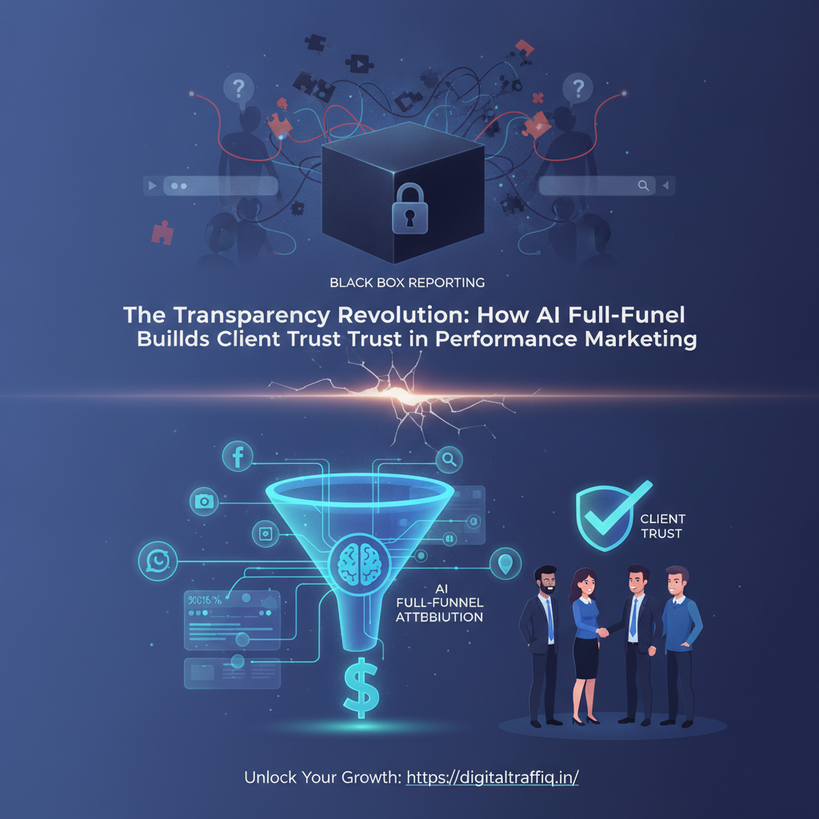
AI Full-Funnel Attribution: The Key to Performance Marketing Trust
Estimated Reading Time: 6 minutes
Key Takeaways
- Traditional last-click attribution models are dangerously misleading, ignoring the impact of upper-funnel efforts that initiate customer journeys.
- AI full-funnel attribution processes vast datasets across every touchpoint, assigning proportional credit and moving beyond correlation to understand causation.
- Cross-channel funnel reporting eliminates data silos, standardizes conversion windows, and provides a unified “source of truth” for client reporting.
- Marketing reporting automation transforms agency-client conversations from “what did you do?” to “what did we achieve together?”—fostering data-driven client trust.
- The future of performance marketing lies in interpretative analytics, where AI-powered dashboards prove value in real-time rather than promising it.
Table of Contents
- The Problem with ‘Siloed’ Reporting
- AI: The Connective Tissue of the Funnel
- The Rise of Full-Funnel Reporting
- Building Data-Driven Client Trust Through Accountability
- The Future of Performance Marketing is Transparent
In the high-stakes world of performance marketing, trust is the ultimate currency. Yet, for years, the industry has been plagued by a persistent paradox: while data has become more abundant, true campaign transparency has remained frustratingly elusive. Clients are often handed a fragmented puzzle—a click here, a view there—without a clear picture of how these pieces fit together to generate revenue. This ‘black box’ approach to reporting has historically chipped away at client confidence, leaving marketers scrambling to justify budgets and prove ROI.
Enter the era of AI full-funnel attribution. As the digital landscape grows more complex, the integration of artificial intelligence into analytics is not just a luxury; it is the critical component for fostering performance marketing trust. For agencies like those leveraging Digital Traffiq, the shift from siloed data to unified intelligence is redefining what it means to be accountable to clients. Let’s dive into how AI is tearing down the walls of obscurity and building a foundation of data-driven client trust.
The Problem with ‘Siloed’ Reporting
Historically, performance marketing reporting has relied on a single-touch attribution model—usually last-click. While this model is simple, it is dangerously misleading. It gives credit to the final channel (often a branded search or a direct visit) while ignoring the upper-funnel efforts that initiated the customer journey.
Think of a consumer who first sees a display ad, then reads a comparison blog post, clicks a social media link, and finally searches for the brand by name to make a purchase. In a last-click model, the social media post and the blog get zero credit. The client sees that ‘Direct’ or ‘Brand’ generated the sale and may incorrectly assume their top-of-funnel awareness campaigns are failing. This lack of AI campaign transparency in legacy systems creates frustration and often leads to premature budget cuts on high-impact strategies.
AI: The Connective Tissue of the Funnel
AI-driven funnel analytics solves this dilemma by processing vast amounts of data across every touchpoint. Unlike human analysts who can only review a finite set of data points, AI algorithms can ingest terabytes of information, recognize patterns, and assign proportional credit across the entire journey.
By leveraging machine learning, AI full-funnel attribution goes beyond ‘correlation’ to understand ‘causation.’ It analyzes time lag, channel interaction, and audience behavior to provide a holistic view of what is truly driving conversions. This isn’t just about assigning credit; it’s about uncovering the narrative of the customer experience.
For a client, this means the days of asking ‘Why did we spend money on YouTube if Google gets all the credit?’ are over. Instead, they see a nuanced report that clearly shows how YouTube ads contributed to 20% of the final sale value by creating awareness. This level of clarity is the cornerstone of transparent marketing reporting.
The Rise of Full-Funnel Reporting
The phrase ‘full-funnel’ can often feel like jargon, but in the context of modern analytics, it represents a paradigm shift in how we view the customer lifecycle. Cross-channel funnel reporting integrates data from paid social, SEO, paid search, email, and offline conversions into a single, unified dashboard.
Here is how AI enhances this integration:
1. Eliminating Data Silos
AI tools can automate the syncing of ad platforms (Google Ads, Meta, LinkedIn) with CRMs and web analytics tools. This ensures that the data feeding into the reporting dashboard is clean, standardized, and real-time. Marketing reporting automation ensures that human error is removed from the data-collection process, giving clients confidence that the numbers are accurate.
2. Predictive Insights over Historical Data
While standard analytics tells you what already happened, AI predicts what will happen. By analyzing historical full-funnel marketing measurement data, AI can forecast future trends, allowing marketers to reallocate budgets preemptively. This proactive approach demonstrates to clients that their agency is not just ‘spending’ money, but strategically investing it based on predictive intelligence.
3. Unified Attribution Windows
Different platforms view conversion windows differently. Facebook might use a 7-day click window, while Google Ads uses a 30-day window. This discrepancy can lead to double-counting or under-reporting. AI creates a ‘source of truth’ by standardizing these windows, ensuring that the numbers reported to the client represent a singular reality rather than a mish-mash of platform-specific metrics.
Building Data-Driven Client Trust Through Accountability
So, what does this mean for the agency-client relationship? For starters, it transforms the conversation from ‘what did you do?’ to ‘what did we achieve together?’
When an agency presents a report backed by AI campaign transparency, they aren’t just handing over a PDF; they are handing over a strategic narrative. Here are three ways this builds trust:
A. Radically Honest Performance Reviews
With marketing accountability automation, there is nowhere to hide. If a campaign is underperforming, the AI will flag it immediately. While this might sound daunting, it actually builds credibility. Clients respect agencies that come to the table with bad news early, accompanied by AI-driven recommendations to fix the issue. Hiding behind vanity metrics is a thing of the past.
B. Dynamic Customization
AI allows reporting to be highly customized. A CFO might want a high-level ROI summary, while a CMO wants granular engagement details. AI-driven tools can generate both from the same dataset, ensuring that the right stakeholders get the right information. This bespoke approach to data-driven client trust shows that the agency understands the unique needs of the business, not just the marketing department.
C. Agile Budget Allocation
When clients see live, cross-channel data, they become partners in budget allocation rather than passive observers. They can see that a specific audience segment is converting more efficiently on LinkedIn than on PPC, and they can agree to shift spend accordingly. This collaborative decision-making, fueled by AI-driven funnel analytics, makes the client feel empowered and in control, thereby solidifying their trust in the agency’s expertise.
The Future of Performance Marketing is Transparent
The age of opaque reporting is dead. In a competitive market where clients have access to infinite analytics tools themselves, the value of an agency now lies in their ability to interpret and synthesize data into actionable strategy.
By embracing AI full-funnel attribution, performance marketers can stop selling ‘activity’ and start selling ‘outcomes’. For companies like Digital Traffiq, the integration of AI into their reporting stack is the ultimate differentiator. It showcases a commitment to honesty, accuracy, and results.
When you provide transparent marketing reporting backed by machine learning, you aren’t just keeping the client informed—you are proving your worth in real-time. This is the new standard of client service, where trust is not promised, but mathematically proven. In the digital ecosystem, the path to growth is paved with visibility, and AI is the torch that lights the way.