
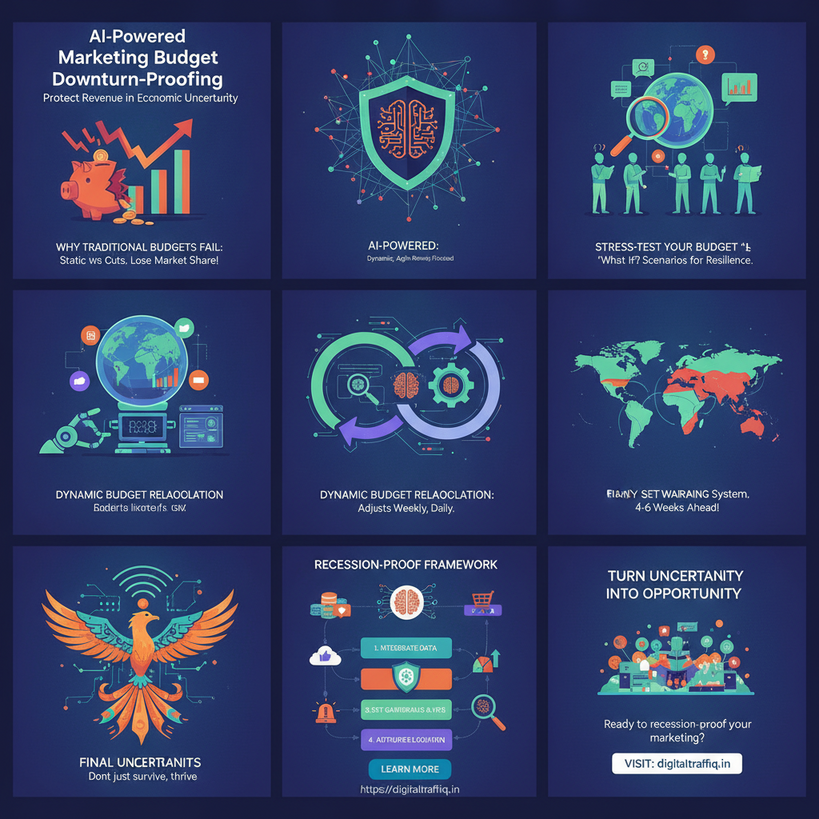
Why Traditional Marketing Budgets Fail in a Downturn
Estimated reading time: 7 minutes
Key Takeaways
- Traditional budgeting fails in downturns because it relies on static, historical data and linear projections that cannot adapt to sudden demand shifts.
- AI scenario simulation marketing stress-tests your budget against multiple economic futures, identifying recession-resistant channels before cuts are made.
- Demand sensing AI detects downturns 4–6 weeks before they hit revenue by analyzing leading indicators like search trends, sentiment, and economic data.
- AI-driven budget reallocation uncertainty enables weekly or even daily budget adjustments, keeping spend agile and revenue-focused.
- Recession-proof marketing strategy AI turns uncertainty into opportunity by uncovering hidden niches and acquiring customers from weaker competitors.
Table of Contents
- Why Traditional Marketing Budgets Fail in a Downturn
- What Is AI-Powered Marketing Budget Downturn-Proofing?
- How Scenario Simulation Protects Revenue
- The Role of Demand Sensing AI
- Building a Recession-Proof Marketing Strategy with AI
- Why AI Marketing Budget Resilience Matters More Than Ever
- Final Thoughts
Why Traditional Marketing Budgets Fail in a Downturn
Economic uncertainty has a brutal way of exposing brittle marketing plans. When revenue forecasts wobble, most companies react with across-the-board cuts, slashing brand awareness, pausing campaigns, and hoping to ride out the storm. But this reactive approach often backfires: you lose market share, weaken customer relationships, and emerge from the downturn weaker than competitors who stayed visible.
The core problem is that traditional budgeting relies on static, historical data and linear projections. It cannot account for sudden demand shifts, supply chain disruptions, or rapid changes in consumer behavior. That’s where AI-powered marketing budget downturn-proofing comes in—using scenario simulation and demand sensing to dynamically protect revenue.
What Is AI-Powered Marketing Budget Downturn-Proofing?
AI marketing budget downturn-proofing is a strategic approach that leverages artificial intelligence to make marketing spend resilient against economic shocks. Instead of guessing which channels to cut, you use AI to simulate multiple economic scenarios, sense real-time demand signals, and automatically reallocate budget to the highest-impact activities.
At its core, this methodology combines two powerful AI capabilities:
- AI scenario simulation marketing: Running thousands of virtual “what-if” scenarios to predict how different budget allocations perform under various downturn severities.
- Demand sensing AI: Continuously ingesting signals from search trends, social media, sales data, and even macroeconomic indicators to forecast demand shifts before they hit your P&L.
Together, they create a feedback loop that keeps your marketing budget agile, data-driven, and revenue-focused—even when the economy is unpredictable.
How Scenario Simulation Protects Revenue
1. Stress-Testing Your Budget Against Multiple Futures
Traditional forecasting asks, “What will happen if the economy slows by 10%?” AI scenario simulation asks, “What happens if it slows by 5%, 15%, or 30%—and how does that change the optimal spend across channels?” By modeling hundreds of variables simultaneously, AI identifies which budget lines are most vulnerable and which are actually recession-resistant.
For example, a SaaS company might discover that while paid search conversions drop in a downturn, content marketing and email retention campaigns deliver higher ROI. The AI then recommends shifting budget from the former to the latter—protecting revenue without gutting brand presence.
2. Dynamic Budget Reallocation in Real Time
Static budgets are set quarterly or annually. AI-driven budget reallocation uncertainty means your budget adjusts weekly—or even daily—based on real-time performance and demand signals. If a particular region enters a recession, the AI automatically reduces spend there and reallocates to healthier markets. This agility is impossible with manual processes.
The Role of Demand Sensing AI
Demand sensing AI goes beyond traditional forecasting by using leading indicators, not lagging ones. Instead of waiting for sales reports, it analyzes:
- Search volume changes for your product categories
- Social sentiment and competitor ad spend
- Economic indicators like inflation, unemployment, and consumer confidence
- Internal signals like website behavior and cart abandonment
Predictive demand sensing marketing can detect a downturn 4–6 weeks before it shows up in revenue. That early warning gives you time to adjust messaging, offers, and budget allocation—turning a potential crisis into a manageable dip.
Building a Recession-Proof Marketing Strategy with AI
A recession-proof marketing strategy AI is not about cutting everything—it’s about spending smarter. Here’s a step-by-step framework:
Step 1: Integrate Your Data Sources
Feed your AI models with CRM data, ad platform metrics, web analytics, and external economic data. The more diverse the inputs, the more accurate the scenario simulations.
Step 2: Define Downturn Scenarios
Work with your AI tool to create scenarios like “mild recession,” “severe recession,” and “stagflation.” Assign probabilities and model the impact on each marketing channel.
Step 3: Set Guardrails and KPIs
Define minimum spend thresholds for brand protection, maximum CPA limits, and revenue targets. The AI will optimize within these constraints.
Step 4: Automate Budget Reallocation
Use AI marketing scenario planning tools to automatically shift budget based on real-time demand sensing. Review and refine weekly.
Step 5: Measure and Learn
Track how your AI-driven decisions perform against the scenarios. Continuously retrain models to improve accuracy.
Why AI Marketing Budget Resilience Matters More Than Ever
Economic uncertainty is not a one-time event—it’s a permanent condition. Companies that embrace AI marketing forecasting models and resilient marketing spend optimization will outperform those that rely on gut instinct. AI doesn’t just protect revenue; it uncovers hidden opportunities in downturns, such as acquiring customers from weaker competitors or entering underserved niches.
At Digital Traffiq, we specialize in building AI-powered marketing systems that downturn-proof your budget. Our scenario simulation and demand sensing solutions help you stay ahead of economic shifts, so you never have to choose between cutting costs and growing revenue.
Final Thoughts
The next downturn is not a matter of if—but when. The question is whether your marketing budget will be a casualty or a competitive advantage. With AI-driven budget reallocation, predictive demand sensing, and scenario simulation, you can turn uncertainty into an opportunity. Protect your revenue, keep your brand strong, and emerge stronger on the other side.
Ready to recession-proof your marketing? Let Digital Traffiq show you how AI can transform your budget into a resilient revenue engine.