
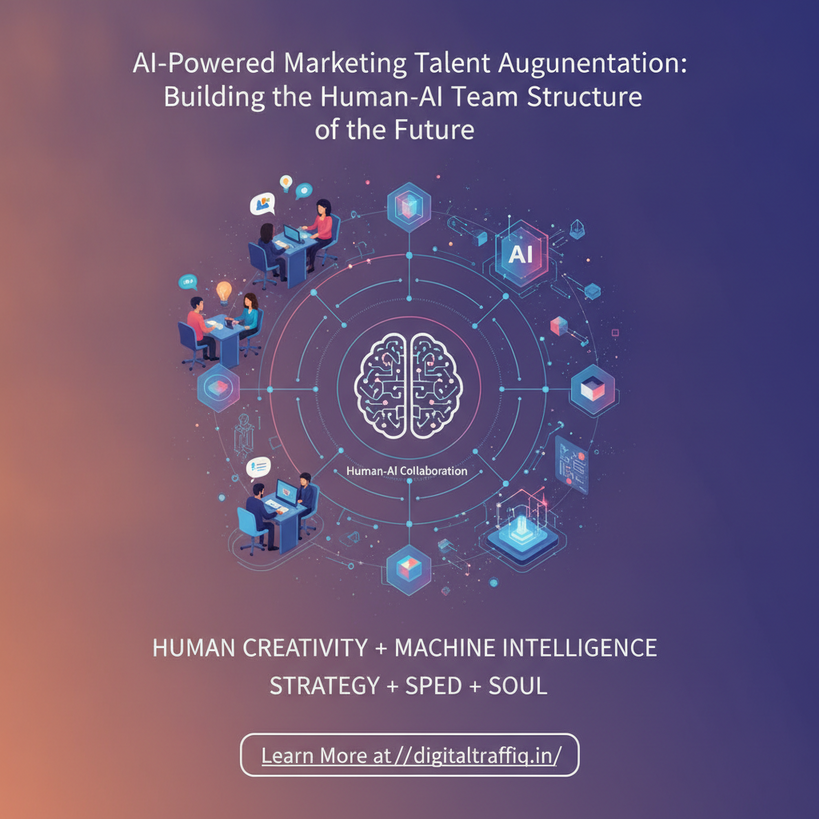
AI-Powered Marketing Talent Augmentation: Building a Future-Proof Marketing Team Structure
Estimated reading time: 8 minutes
Key Takeaways:
- AI marketing team augmentation expands human capacity rather than replacing marketers.
- Human-AI collaboration marketing outperforms pure automation by combining speed with strategic judgment.
- Future-proof marketing teams are organized by function, not just channel.
- Upskilling existing talent in prompt literacy, data fluency, and AI ethics is essential.
- Measuring AI-driven marketing efficiency requires outcome-based metrics, not just hours saved.
Table of Contents:
- What Is AI Marketing Team Augmentation?
- Why Human-AI Collaboration Marketing Beats Pure Automation
- Rethinking the Future-Proof Marketing Team Structure
- Upskilling Your Existing Talent
- The Human-in-the-Loop Marketing AI Model
- Measuring AI-Driven Marketing Efficiency
- Scaling Marketing Teams Without Burning Out Talent
- Where Digital Traffiq Fits
The marketing landscape is shifting faster than most teams can hire. Budgets are tightening, channels are multiplying, and the demand for hyper-personalized, data-driven campaigns grows by the quarter. In this environment, the question is no longer whether to adopt AI—it is how to restructure your marketing talent around it. That is where AI-powered marketing talent augmentation comes in. Rather than replacing marketers, augmentation blends human creativity with machine intelligence to create a future-proof marketing team structure that scales output without sacrificing strategy.
What Is AI Marketing Team Augmentation?
AI marketing team augmentation is the practice of using artificial intelligence to expand the capacity, speed, and precision of an existing marketing workforce. It is not about cutting headcount. It is about giving every marketer an AI-powered co-pilot for research, content production, audience analysis, and performance optimization.
Think of it as an operating layer that sits on top of your current team. An AI-augmented marketing agency, for example, might use large language models for first-draft copy, predictive analytics for budget allocation, and automation tools for campaign QA. The result is an augmented marketing workforce strategy that treats AI as a teammate, not a threat.
Why Human-AI Collaboration Marketing Beats Pure Automation
Pure automation promises efficiency but often produces generic, brand-blind output. Human-AI collaboration marketing flips that model. Humans set strategy, define brand voice, interpret nuance, and make judgment calls. AI handles repetition, pattern recognition, and scale.
This division of labor matters because marketing is both art and science. AI can identify that a headline underperforms, but a human knows why a cultural reference falls flat. AI can generate 50 ad variations, but a strategist knows which three align with brand positioning. When you combine the two, you get speed plus soul.
The Productivity Math
Teams using AI marketing productivity tools report significant time savings on routine tasks. Copy editing, keyword clustering, reporting dashboards, and audience segmentation can shrink from hours to minutes. That reclaimed time is reinvested into strategy, creative testing, and client relationships—the work that actually drives growth.
Rethinking the Future-Proof Marketing Team Structure
A traditional marketing team is organized by channel: social, content, email, paid media. An AI-first marketing operations model is organized by function: strategy, data, creative direction, and AI orchestration. This shift requires new roles and new skill mixes.
Emerging AI Marketing Roles and Skills
If you are scaling marketing teams with AI, expect to hire or upskill for titles like:
- AI Marketing Operations Manager – owns tooling, prompts, and workflow integration.
- Prompt Strategist – translates brand voice into repeatable AI instructions.
- Data Storyteller – turns model outputs into human-readable insights.
- Human-in-the-Loop Editor – ensures AI content meets brand and compliance standards.
- AI Ethics and Brand Safety Lead – guards against bias, misinformation, and tone drift.
These roles do not replace copywriters or strategists. They amplify them.
Upskilling Your Existing Talent
Marketing team upskilling AI is not optional. Even the best AI marketing productivity tools fail when teams do not know how to use them. Invest in:
- Prompt literacy – teaching marketers how to structure requests for reliable output.
- Data fluency – helping creatives read dashboards and question model assumptions.
- AI ethics – ensuring every output respects brand values and audience trust.
- Workflow design – mapping where AI enters and exits the creative process.
Upskilling turns fear into fluency. It also reduces turnover, because marketers see a future where their judgment matters more, not less.
The Human-in-the-Loop Marketing AI Model
The most effective augmented marketing workforce strategy places humans at critical checkpoints. This human-in-the-loop marketing AI approach works like a loop:
- AI proposes – drafts, clusters, predicts, or generates.
- Human reviews – edits, approves, or rejects based on brand and strategy.
- AI learns – incorporates feedback to improve future outputs.
- Human decides – owns the final call and the client relationship.
This loop keeps quality high and accountability clear. It also makes AI marketing roles and skills more strategic, not less.
Measuring AI-Driven Marketing Efficiency
AI-driven marketing efficiency should be measured in outcomes, not just hours saved. Track:
- Campaign velocity (how fast you launch tests)
- Content output per marketer
- Cost per qualified lead
- Creative win rates
- Client retention and satisfaction
When these metrics improve alongside team morale, you have proof that augmentation works.
Scaling Marketing Teams Without Burning Out Talent
The old way to scale was to hire more people. The new way is to scale marketing teams with AI while protecting human energy for high-value work. This is marketing workforce optimization AI in practice: fewer repetitive tasks, faster iteration, and more room for strategic thinking.
For agencies and in-house teams alike, the goal is not to become a fully automated marketing machine. It is to become a hybrid team where humans and AI each do what they do best. That is the future-proof marketing team structure—one that adapts as models improve, channels shift, and audience expectations evolve.
Where Digital Traffiq Fits
At Digital Traffiq, we help brands design and implement AI-powered marketing workforce strategies. From audit to upskilling to workflow integration, we build human-AI team structures that deliver measurable growth. Whether you are exploring AI-augmented marketing agency models or restructuring your in-house team, our focus is the same: put humans in control, give them better tools, and scale what works.
The future of marketing talent is not human or AI. It is human and AI, working as one team.