
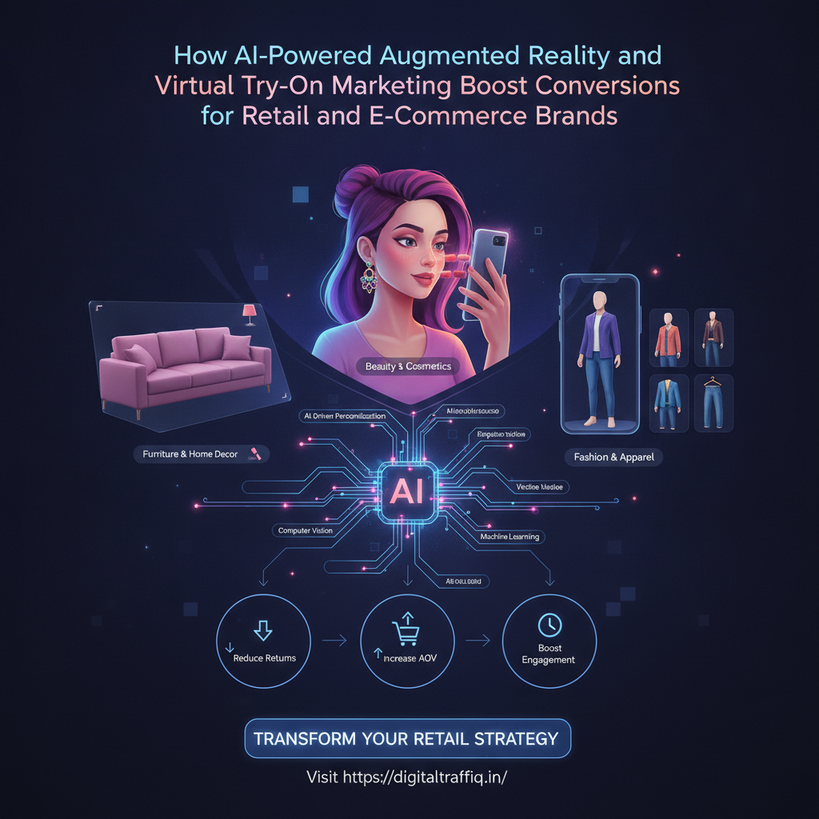
How AI-Powered Augmented Reality and Virtual Try-On Marketing Boost Conversions for Retail and E-Commerce Brands
Estimated reading time: 8 minutes
Key Takeaways
- AI-powered AR and virtual try-on close the confidence gap between physical and online shopping, driving measurable conversion lifts.
- Virtual try-on AI reduces returns, which can exceed 30% in apparel, directly improving margins and lowering logistics costs.
- AR product visualization marketing increases average order value by encouraging frictionless exploration and cross-selling.
- Immersive retail marketing works best when paired with high-intent product categories, mobile-first performance, and direct commerce integration.
- AI-driven immersive commerce is shifting from novelty to expectation, making AR strategy essential for competitive retail brands.
Table of Contents
- What Is AI-Powered AR Marketing?
- Why Virtual Try-On AI Drives Conversions
- Real-World Applications Across Retail Verticals
- Building an Augmented Reality Retail Strategy That Works
- Why AI Makes AR Smarter
- The Future of AI-Driven Immersive Commerce
- Final Thoughts
Shopping online has always come with a silent tax: uncertainty. Will the jacket fit? Does the lipstick match my skin tone? Will this sofa look right in my living room? For decades, e-commerce brands accepted this friction as an unavoidable cost of doing business. Today, that assumption is being dismantled by artificial intelligence and augmented reality working in tandem.
AI-powered augmented reality (AR) and virtual try-on experiences are no longer gimmicks reserved for tech-forward startups. They have become core conversion tools for retail and e-commerce brands that want to reduce returns, increase average order value, and turn browsers into buyers. In this guide, we break down how these technologies work, why they convert, and how brands can build a practical AR retail strategy that delivers measurable ROI.
What Is AI-Powered AR Marketing?
AI-powered AR advertising and immersive retail marketing combine two complementary technologies. Augmented reality overlays digital content onto the physical world through a smartphone camera or headset, allowing customers to see products in context. Artificial intelligence adds the intelligence layer: computer vision recognizes body shapes, facial features, room dimensions, and lighting conditions, while machine learning models recommend sizing, personalize looks, and optimize the experience in real time.
Together, they create what the industry calls AI-driven immersive commerce: shopping experiences that adapt to the individual user rather than offering a one-size-fits-all catalogue view.
Why Virtual Try-On AI Drives Conversions
The conversion gap between physical and digital retail has always been about confidence. In a store, customers can touch, fit, and test products. Online, they rely on static images and hopeful guesswork. Virtual try-on AI closes that gap in several measurable ways.
1. It Reduces Purchase Anxiety
Virtual product trials powered by AI let shoppers visualize how an item fits, drapes, or performs before they buy. This directly addresses the biggest objection in e-commerce: “What if it doesn’t look right on me?” When that doubt disappears, hesitation-based cart abandonment drops.
2. It Cuts Return Rates
Returns are a silent profit killer. For apparel and accessories, return rates can exceed 30%, eroding margins and adding logistics costs. When customers use AR product visualization marketing before purchasing, they make more informed decisions, and fit-related returns decline significantly.
3. It Increases Average Order Value
Interactive shopping experience automation encourages experimentation. A shopper trying on one pair of sunglasses can quickly test ten more. That frictionless exploration naturally increases basket size and cross-sell opportunities within the AR environment.
4. It Boosts Engagement Time
Time on site is a powerful conversion signal. AR shopping experiences keep users interacting with products far longer than static pages, giving brands more opportunities to present offers, upsells, and social proof.
Real-World Applications Across Retail Verticals
Fashion and Apparel
Virtual fitting rooms use computer vision retail AI to map a shopper’s body measurements from a single phone photo, then render garments onto a realistic avatar. Shoppers can compare colors, sizes, and styles instantly.
Beauty and Cosmetics
Virtual try-on for makeup, hair color, and skincare leverages facial recognition and shade-matching algorithms. Users see products on their own face under their own lighting, which dramatically increases add-to-cart rates.
Furniture and Home Decor
AR product visualization marketing lets customers place a sofa, lamp, or rug in their actual room at true scale. AI suggests complementary items based on existing decor, turning a single purchase into a full-room sale.
Eyewear and Accessories
Try-on tools for glasses, watches, and jewelry have become conversion staples. Face-shape analysis and style recommendations drive both engagement and purchase confidence.
Building an Augmented Reality Retail Strategy That Works
Adopting the technology is only half the battle. The brands that win with immersive retail marketing follow a strategic playbook.
Start With High-Intent Products
Focus AR experiences on categories where fit, scale, or appearance uncertainty is highest. These deliver the fastest conversion lift and clearest ROI.
Prioritize Mobile Performance
Most AR shopping experiences happen on smartphones. Fast load times, lightweight 3D assets, and seamless browser integration are non-negotiable.
Integrate With Existing Commerce Infrastructure
Virtual try-on AI should connect directly to your product catalogue, inventory, and checkout. Friction between the AR experience and the purchase flow kills conversions.
Personalize With AI
The AI layer should learn from every interaction, recommending sizes, styles, and pairings based on user behavior. E-commerce conversion optimization AI improves over time, making each session more effective than the last.
Measure What Matters
Track engagement rate, add-to-cart rate, conversion rate, average order value, and return rate. These metrics tell the real story of AR’s impact on your bottom line.
Why AI Makes AR Smarter
AR without AI is a filter. AR with AI is a salesperson. Machine learning models analyze millions of data points to predict fit, match shades, suggest complementary products, and adapt the experience to each shopper. This is what separates a novelty feature from a genuine revenue driver.
The Future of AI-Driven Immersive Commerce
As AR hardware improves and AI models become more sophisticated, virtual product trials will evolve from a nice-to-have into an expectation. Shoppers will increasingly refuse to buy from brands that can’t show them how a product will look, fit, or function in their lives.
Brands that invest now in AI-powered AR advertising and immersive commerce will build a durable competitive advantage: lower returns, higher conversion, deeper customer loyalty, and a shopping experience that feels genuinely personal.
Final Thoughts
The convergence of AI and augmented reality is rewriting the rules of retail marketing. Virtual try-on AI, AR shopping experiences, and computer vision retail AI are no longer experimental, they are proven conversion tools. For retail and e-commerce brands looking to grow in a competitive landscape, an AI-augmented reality strategy isn’t just innovative. It’s essential.
Digital Traffiq helps brands design, deploy, and scale AI-powered AR and immersive marketing experiences that convert. If you’re ready to turn browsing into buying, let’s talk.