
Beyond Basic Personalization: The Era of AI-Driven Hyper-Personalization at Scale
Estimated reading time: 5 minutes
Key Takeaways
- AI enables true one-to-one personalization at scale, moving beyond basic segmentation to predict and serve individual customer needs in real-time.
- Traditional rule-based systems are static and manual, while AI-powered systems automate deep customer engagement, driving growth without proportional effort.
- The business impact is tangible, leading to exponential increases in engagement, conversion rates, and customer lifetime value while boosting operational efficiency.
- Implementation requires a strategic, phased approach, starting with a data audit and high-impact channels before expanding to a full omnichannel strategy.
Table of Contents
- The Limitations of Manual Segmentation and Rule-Based Systems
- How AI-Powered Hyper-Personalization Actually Works
- The Tangible Business Impact: Driving 10X Engagement
- Real-World Applications: From E-commerce to SaaS
- Getting Started with Digital Traffiq: A Strategic Approach
- Conclusion: The Future is Autonomous & Personalized
For years, marketers have understood the power of personalization. Using a customer’s first name in an email or recommending products based on past purchases became standard practice. However, this basic level of personalization is no longer a competitive advantage—it’s a customer expectation. The real challenge, and the monumental opportunity, lies in achieving hyper-personalization at scale. This means delivering uniquely relevant, one-to-one experiences to every single customer, across every touchpoint, in real-time. For most businesses, scaling this level of detail manually is a logistical and resource nightmare. This is where Artificial Intelligence (AI) transforms from a buzzword into the most critical tool in your marketing arsenal. At Digital Traffiq, we specialize in deploying AI-powered hyper-personalization systems that automate deep customer engagement, driving exponential growth without proportional increases in manual effort.
The Limitations of Manual Segmentation and Rule-Based Systems
Traditional personalization relies on manual segmentation and predefined rules. Marketers create audience segments (e.g., “women aged 25-34 who bought skincare”) and set up triggered emails or content blocks. The problems are manifold. First, segments are static and broad, missing nuanced individual behaviors. Second, rule maintenance is a constant, manual task that doesn’t scale. Third, these systems react slowly, if at all, to real-time intent signals. The result is a generic experience masquerading as personalization, leading to campaign fatigue and diminishing returns. True scalable personalization requires a system that learns, predicts, and adapts autonomously.
How AI-Powered Hyper-Personalization Actually Works
AI-driven personalization engines, like those we implement at Digital Traffiq, function on a continuous loop of data ingestion, analysis, prediction, and execution. Here’s the breakdown:
1. Unified Data Synthesis
The AI ingests and unifies data from every source: website behavior, purchase history, CRM data, email engagement, support tickets, and even third-party intent data. It creates a dynamic, 360-degree profile for each user that updates in real-time, far surpassing the static profile of old.
2 Predictive Behavioral Modeling
This is the core of AI marketing personalization. Using machine learning algorithms, the system doesn’t just analyze what a customer did; it predicts what they will do next. It identifies patterns to forecast churn risk, lifetime value, product affinity, and content preferences. This moves marketing from reactive to proactive.
3. Automated Micro-Segmentation & Dynamic Content Assembly
Gone are the dozen broad segments. AI performs automated segmentation into thousands of micro-segments, often segments of one. It then dynamically assembles the optimal message, offer, product recommendation, or website experience for that individual at that exact moment. This is real-time personalization in action.
4. Continuous Optimization
The system tests, learns, and optimizes every interaction. It understands which subject lines, images, CTAs, and channels work best for which user profile, constantly refining the customer journey optimization process without human A/B testing overhead.
The Tangible Business Impact: Driving 10X Engagement
Implementing AI for hyper-personalization isn’t just a tech upgrade; it’s a business growth lever. The outcomes we consistently see include:
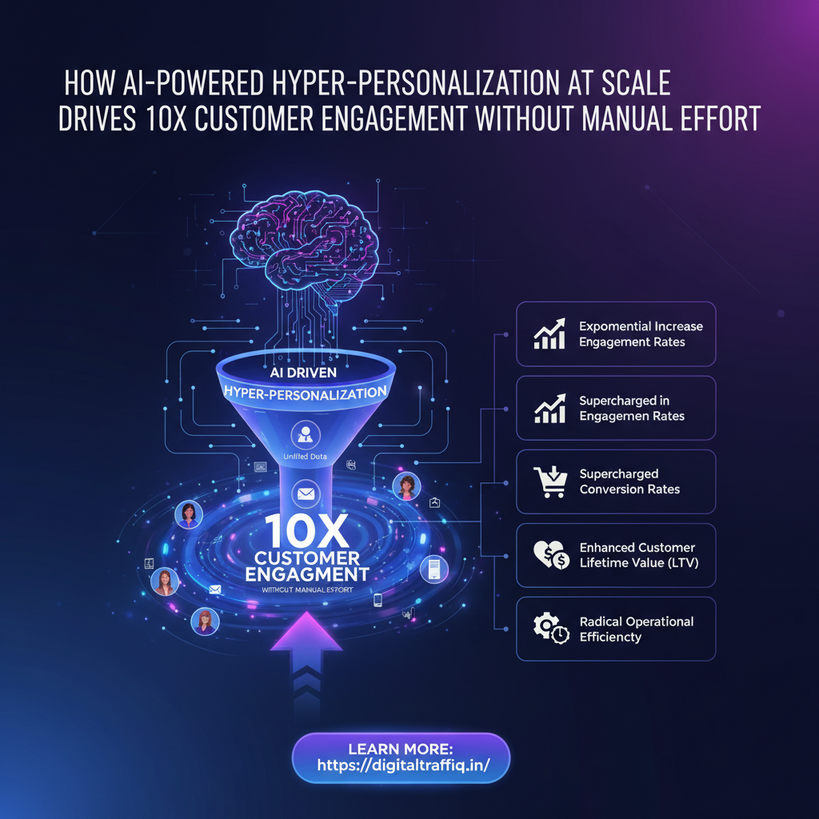
- Exponential Increase in Engagement Rates: When every communication is precisely relevant, open rates, click-through rates, and time-on-site skyrocket. We’re talking about moving metrics by 200%, 300%, or more, leading to that 10X multiplier effect.
- Supercharged Conversion Rates: dynamic customer experiences that guide users seamlessly from awareness to purchase see dramatically higher conversion rates. Personalized product recommendations alone can account for substantial revenue increases.
- Enhanced Customer Lifetime Value (LTV): By predicting needs and delivering value at every stage, you foster deep loyalty. Customers feel understood, reducing churn and increasing repeat purchase frequency.
- Radical Operational Efficiency: This is the “without manual effort” promise realized. Marketing teams are freed from the grind of segment management and manual campaign builds. They can shift focus to strategy, creativity, and high-level analysis while the AI handles the execution at scale.
Real-World Applications: From E-commerce to SaaS
The principles of AI-driven content personalization apply across industries:
E-commerce: Dynamic websites where every visitor sees a unique homepage, product order, and offers based on their predicted intent and past behavior. Cart abandonment flows that offer the exact item left behind, plus a personalized cross-sell.
SaaS & B2B: Personalized onboarding journeys, in-app messaging that guides users to features they’re most likely to need, and automated email nurture streams that deliver case studies and content relevant to the user’s industry and role.
Content & Media: A homepage and article recommendations that adapt to each reader’s content consumption habits, dramatically increasing pageviews and subscription rates.
Getting Started with Digital Traffiq: A Strategic Approach
The journey to personalization at scale requires a strategic foundation. It’s not about flipping a switch. At Digital Traffiq, our process begins with a deep audit of your existing data infrastructure, customer touchpoints, and business goals. We then design a phased implementation roadmap, often starting with a high-impact channel like email or on-site content before expanding to a full omnichannel strategy. We build the data pipelines, select and tune the AI models, and create the feedback loops necessary for autonomous optimization. Our role is to be your guide and operator, ensuring the technology serves your business objectives, not the other way around.
Conclusion: The Future is Autonomous & Personalized
The frontier of marketing is no longer about who has the biggest budget, but who can build the deepest, most scalable relationships. AI-powered hyper-personalization is the engine for that future. It represents the ultimate synthesis of data and creativity, where technology handles the precision of delivery at scale, allowing human marketers to focus on the art of connection and brand storytelling. The result is a win-win: customers receive experiences that feel uniquely crafted for them, while businesses achieve unprecedented efficiency and growth.
Are you ready to move beyond basic segmentation and manual campaigns? The era of automated, intelligent, and deeply personal customer engagement is here. Let’s discuss how to build your competitive advantage.